10 Things to Check Before You Trust an AI Audience Simulator (2026)
A marketing or brand leader testing a campaign concept, headline, or price against a target audience has a real menu of AI audience simulators to pick from. The dangerous mistake is trusting a synthetic panel that was never calibrated or validated, greenlighting a launch decision on that basis, and finding out after the campaign underperforms, or after a comprehension or fairness problem surfaces with real customers, that the read was wrong.
Vendor rankings do not protect against that outcome, because a demo can make almost any panel look convincing. What protects against it is knowing which properties of a simulation approach predict whether its output can be trusted, and checking each one before the budget commitment.
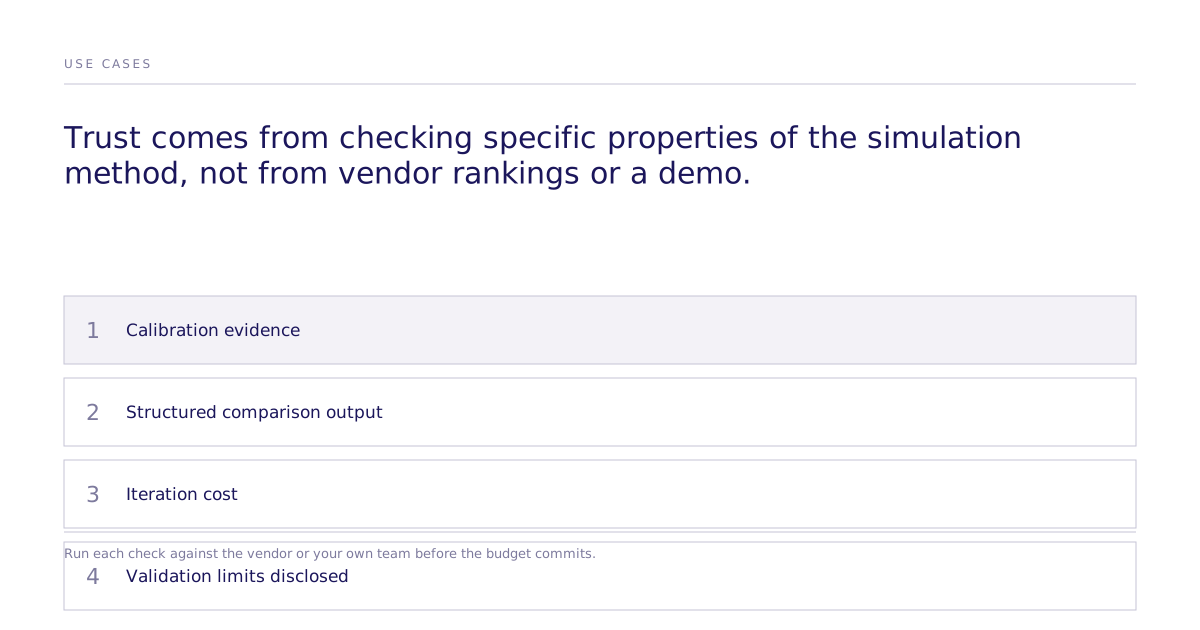
The ten properties worth checking
These ten checks apply to any audience-simulation approach, whatever it is called and whoever built it. Each is a question to put to a vendor, or your own team, before a simulated read decides a real spending decision.
1. How is the audience calibrated?
A tool that assigns demographic labels to generated personas is not the same as a tool that grounds each simulated respondent in verifiable evidence about how that kind of person actually behaves. Ask what data anchors each respondent, and whether the vendor can show the grounding, not just describe it. Research on generating synthetic survey responses with large language models finds that response quality depends heavily on how the underlying population is represented and conditioned, not just on model size (arXiv, 2026).
2. Whether the response format is structured or conversational
A useful audience simulator returns structured comparisons: intent, comprehension, sentiment by segment, and where responses disagree. A tool that mainly produces chat-style commentary is closer to a brainstorming aid than a decision input. Before a study runs, confirm the output format will answer the comparison question, not just narrate around it.
3. Whether segment detail survives the rollup
An aggregate top-line number hides the segment where a message fails. Ask whether the platform reports cross-tabs by the segments that matter, or whether detail gets averaged away before it reaches a dashboard.
4. What re-running a study actually costs
Iteration is the point. A team that can only afford to test one version of a headline learns nothing about the eight variants it didn't run. Ask how a second, refined pass is scoped and priced, and confirm it preserves comparability with the first pass.
5. How does the method distinguish a controlled comparison from a single reaction?
Asking a language model to react to one stimulus, and asking it to compare two or more alternatives under a controlled design, answer different questions. Research examining LLM-simulated experiments has found that a single-shot reaction to a prompt behaves like an observational read of the model's training data, not like a randomized intervention, unless the study is explicitly structured to compare defined alternatives (arXiv, 2026). Ask which kind of study the platform runs.
6. Are population-scale claims separated from panel-scale reality?
Some platforms describe simulating an entire market; others run against a bounded, purpose-built panel. A vendor should be able to state how many simulated respondents inform a given result and what population that panel represents, rather than leaving "scale" as a marketing adjective.
7. How validation against real people is reported, and where the limits are disclosed
Ask what the vendor's evidence shows about how closely a simulated result tracks a real-human result, on what kind of question, and where the two diverge. A study of how well large language models can reproduce individual survey respondents using socio-economic microdata found agreement varies by question type and demographic subgroup, rather than holding at one constant accuracy figure (arXiv, 2026). Treat a single unqualified accuracy percentage as a claim to interrogate.
8. Whether a simulated result can move to a real-human check without changing the question
For consequential decisions, the simulated study should hand off to a real-human study that tests the same causal question, not a different one. Subconscious can test or validate a study with real human participants, letting a team move from a simulated read to a human-baseline check without redesign.
9. What audience the platform can actually reach
A simulator's usefulness for a specific brief depends on whether it has real evidence about the audience in question, not just a plausible-sounding persona. Subconscious runs controlled studies against a person-level audience graph covering 800 million real people, a source of grounding evidence rather than a recruitable panel of respondents. Ask any vendor to be equally specific about what "audience" means in their system.
10. Whether the operating model matches how often you will actually run studies
A self-serve workflow, an analyst-mediated service, and a full enterprise implementation carry different levels of analyst involvement, study constraints, and minimum commitments. A team running ten concept checks a month needs a different operating model than a team running one high-stakes pricing study a quarter. Match the model to the cadence of decisions you need to make, not the cadence a sales conversation assumes.
A quick-scan reference
| Property | What to ask the vendor |
|---|---|
| Calibration | What grounds each simulated respondent, and can it be shown? |
| Response structure | Structured comparison, or conversational commentary? |
| Segment detail | Does segment-level disagreement survive to the final report? |
| Iteration cost | How is a second, refined pass scoped and priced? |
| Comparison design | Single reaction to one stimulus, or controlled comparison of alternatives? |
| Scale claim | Population-scale or panel-scale, stated in specific numbers? |
| Validation reporting | Where does simulated agreement with real people break down? |
| Human-baseline path | Can the same question move to a real-human check without redesign? |
| Audience reach | What real-world evidence backs the audience being simulated? |
| Operating model | Self-serve, analyst-mediated, or enterprise, matched to your cadence? |
Where causal action-testing fits among these ten
Subconscious answers most directly to properties 5, 8, and 9: it runs controlled, discrete-choice-style experiments that compare defined actions rather than reading a single reaction, it supports moving a validated result to real human participants without changing the underlying question, and it grounds studies in a specific, disclosed audience graph rather than an unspecified panel. That's not a substitute for checking the other seven properties against any vendor, including Subconscious.
Before the budget commits
Score any AI audience simulator against the ten properties above, using the vendor's own disclosed evidence rather than a demo. For decisions where a wrong read is expensive, plan a step where a simulated finding gets checked against real people before it becomes a media buy or a launch decision. Research walks through how that causal design and validation work in practice, and the leaderboard tracks how simulated results compare against real-human benchmarks across study types. Teams that want a walkthrough of the operating model can see how the work happens or book time to scope a first study.