AI Competitor Analysis Through Buyer Decisions
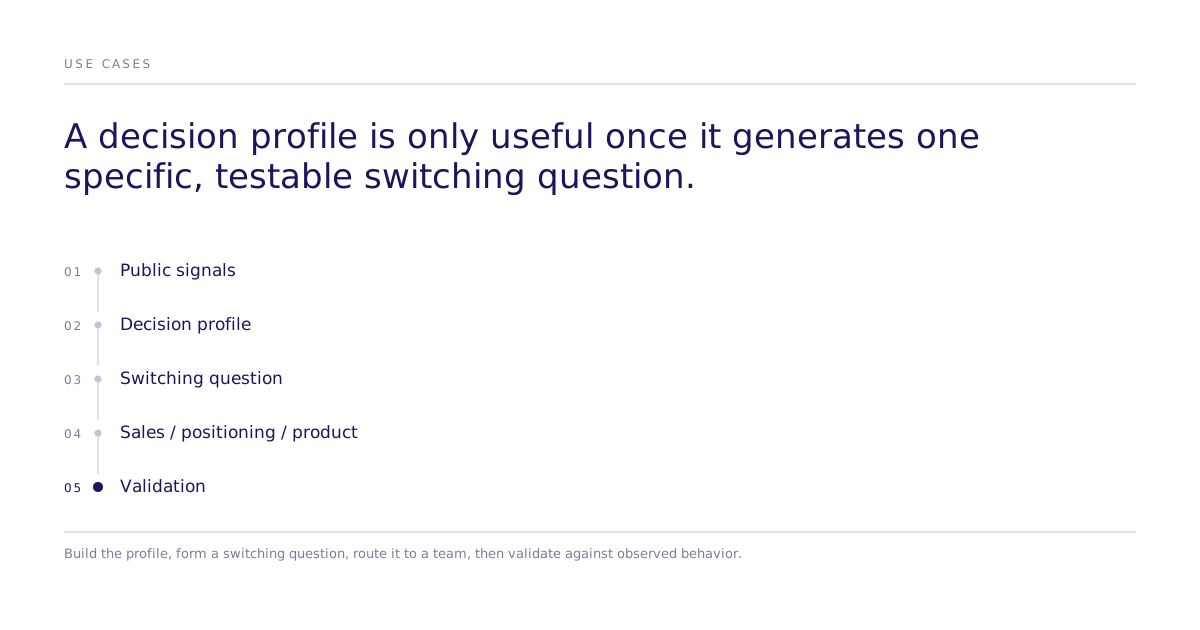
AI competitor analysis through buyer decisions uses public signals and approved evidence to model the reasoning behind a buyer's choice of a competitor and the conditions that would make them switch. Pricing pages, launch notes, job listings, and feature grids show what a competitor is doing. They do not explain why a buyer chose that competitor, what creates loyalty, or what would trigger a switch.
AI-assisted competitor research can model those decision questions using public signals and approved evidence. The output is a set of hypotheses for sales, positioning, and product work. Stating the boundary here is what keeps the output checkable against real evidence. It is not private knowledge about a competitor or its customers.
Focus on decision dynamics
- Why a buyer chose the alternative.
- Which parts of the experience create real loyalty.
- Which frustrations are tolerable and which prompt evaluation.
- What event, feature gap, or price change could overcome switching costs.
- Which alternatives the buyer may not know.
For a hypothetical switching interview, ask whether a team chose a competitor because it needed a system before Q4 planning and accepted a promised two-week deployment. Establish the actual account history from customer evidence; the example is not a measured adoption result.
How do you build competitor-customer profiles?
Define the role and company context. A mid-market director and an enterprise vice president can use the same product for different reasons.
Add an adoption history: the previous approach, the trigger for evaluation, and the reason the current product won. Distinguish a power user with embedded workflows from a casual user with low switching costs.
Use public reviews, forums, and approved win-loss evidence to constrain strengths and weaknesses. Corporate Visions describes win-loss interviews as a way to investigate decision criteria. Compare those accounts with CRM records and observed outcomes; neither source automatically establishes a causal mechanism. Do not invent proprietary experience.
For an illustrative brief, use several profile types: a loyal power user, a frustrated but constrained user, a new customer, and a customer evaluating alternatives. Select profiles from the decision and available evidence.
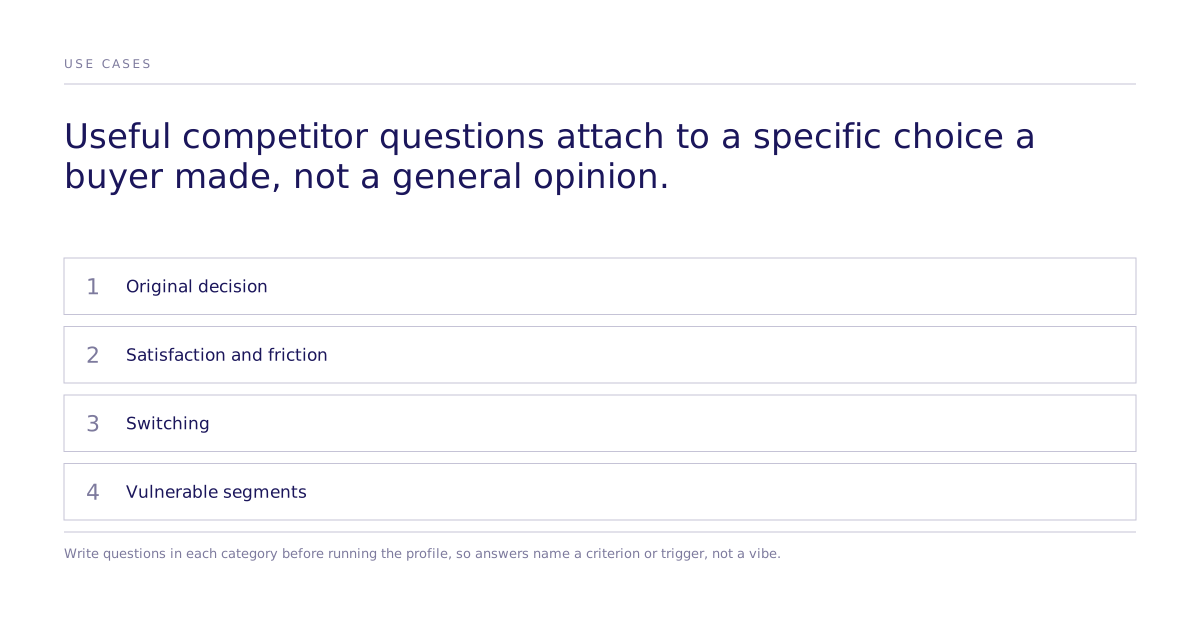
Ask questions tied to a choice
Original decision
Ask which alternatives were considered, which criterion decided the outcome, and whether the same buyer would make the same choice today.
Satisfaction and friction
Identify the one capability the buyer would miss, the largest current frustration, and any expectation the product has not met.
Switching
Ask what an alternative would need to offer, how much operational pain a move would create, and which event would make evaluation worthwhile.
Which segments are vulnerable to switching?
Look for use cases where the current product is tolerated because no better option is visible. A planning scenario can ask whether a 30% price increase would trigger a search for alternatives.
Combine market facts with simulation
Traditional competitive analysis covers features, pricing, positioning, and market share. Simulated buyer research explores motivation, loyalty, and triggers for change.
Public facts constrain the simulation. The simulation points to questions that win-loss interviews, sales calls, product analytics, or market experiments can test. See how the research behind this approach is designed and read.
Where can the results be used?
Sales teams can turn likely decision criteria into battle-card questions without presenting simulated statements as customer proof.
Positioning teams can test whether a claimed advantage changes consideration. If implementation speed appears important, compare the messages and supporting proof rather than assuming the claim will win.
Product teams can investigate repeated frustration with a competitor's limitation. Naming this failure mode is what stops a hypothesis from being treated as data. A simulated pattern is a reason to research the opportunity, not evidence that demand exists.
Keep the limits explicit
Naming the limit here is what lets a buyer verify the method before relying on it. The representation is simulated, not a real competitor customer. It cannot know a private roadmap, internal metric, or upcoming feature. Calibration quality sets the ceiling on the exercise.
Subconscious is relevant when the next step is a controlled comparison of product, pricing, messaging, or go-to-market actions for a defined buyer segment. Use the competitor model to form the experiment. Use observed behavior to validate it. See how the process runs or book a demo to test a specific differentiator claim.