AI Market Research for Startups: Faster Decisions Without False Certainty
Startups need customer evidence before they can justify a large research budget. Causal behavioral experiments compare early product, pricing, and message decisions before a team commits capital. The result is a sharper hypothesis for the human research that follows, not a reason to skip real customers.
Why startup research gets deferred
Recruitment, fieldwork, and analysis depend on the audience and design. Drive Research's cost guide is one provider's planning perspective, not a universal quote. Ask for the smallest study that answers the decision and compare the delivery date with the product schedule.
Founders often replace formal research with a handful of friendly conversations. Those conversations do not establish a market-wide pattern. The goal is to separate exploration from validation and use the right evidence for each.
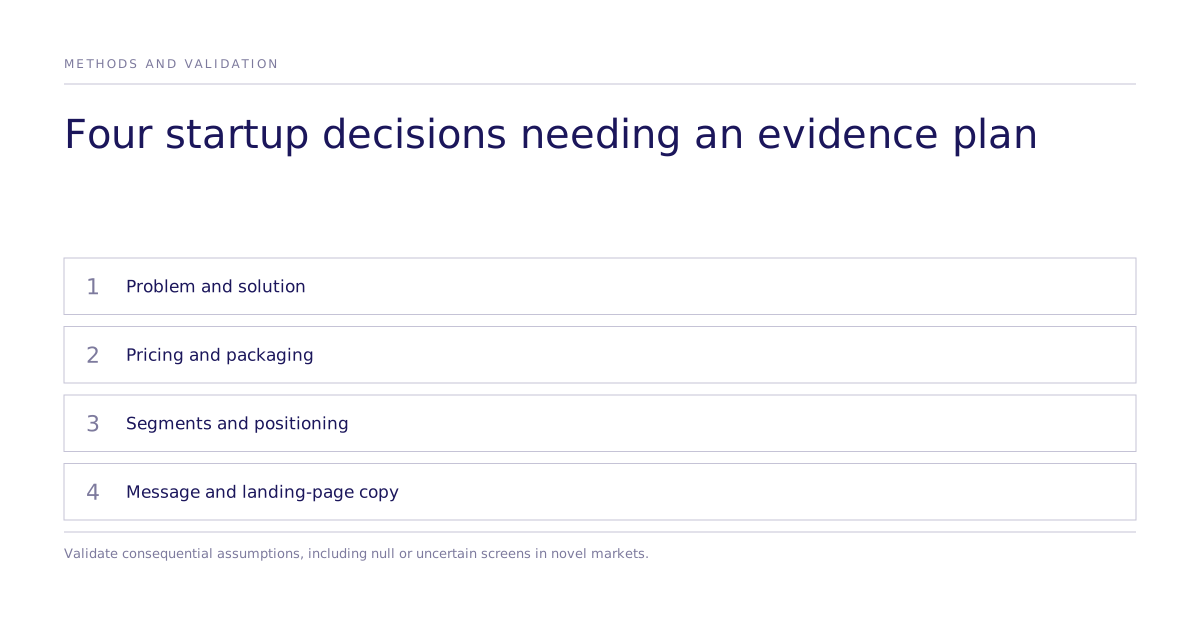
Decisions to test early
Problem and solution hypotheses
Define the audience, alternatives, and outcome. Customer conversations can establish the problem context; modeled exploration can suggest questions about workarounds or switching. Estimate session and validation time from the actual scope.
Business model and pricing scenarios
Compare specific alternatives rather than asking whether one price “seems fair.” Test monthly versus annual packaging, the evidence a buyer would need before committing, and the alternatives they already consider. Treat the result as a directional scenario comparison, not willingness-to-pay proof.
Segments and positioning
Compare the same product or message across distinct roles, industries, company sizes, or contexts. The point is to find where an action changes response, not to turn demographic labels into fixed truths.
Message and landing-page choices
Test concrete copy variants before paying for production or media. Ask what each version communicates, which audience it appears to address, and what action a buyer would take next.
Pair simulation with human evidence
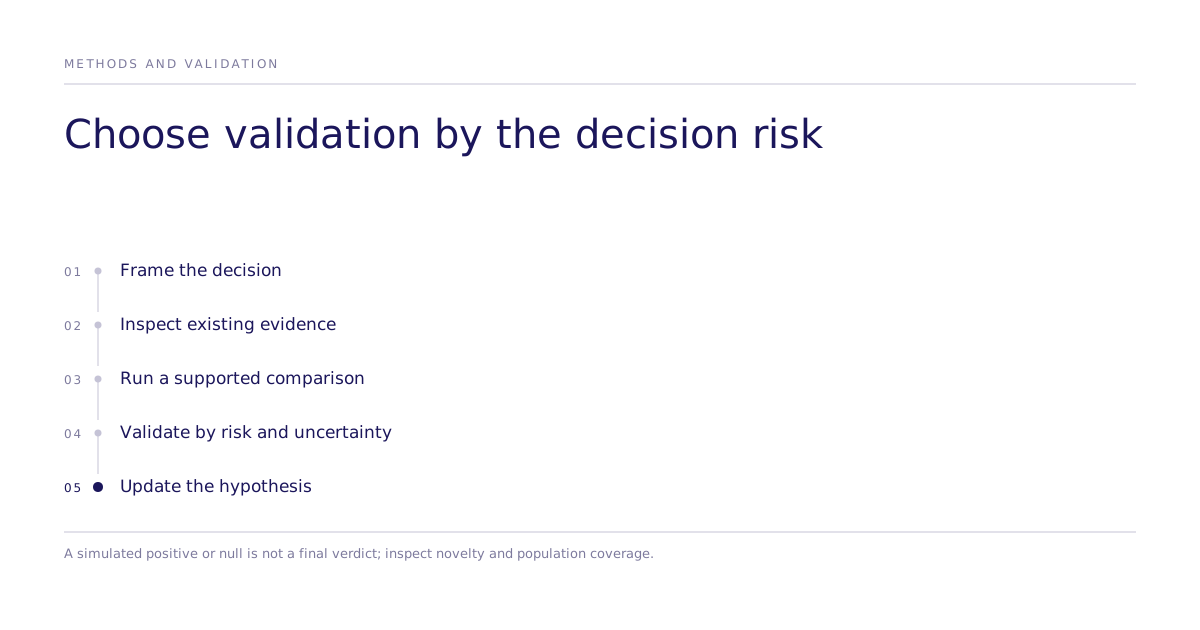
Use modeled exploration to generate and prioritize hypotheses. Route validation by decision cost, uncertainty, novelty, and population coverage. A null screen can be a false negative and a positive screen can be a false positive. Customer interviews, usability studies, experiments, and product data contribute different evidence; choose the source that can check the claim.
Write a brief around the most consequential unknowns, alternatives, and outcome. Scope the comparison, record what changed your view, and use the findings to improve the next customer test. The result should clarify the next evidence needed, without a fixed session-time or launch-validity promise.