AI Positioning Research: Testing a Value Proposition Before It Ships
A CMO choosing between two or three competing positioning statements does not need another opinion. The decision is which statement changes how a buyer understands the category, places the product against alternatives, and decides to learn more, a question a controlled comparison can answer before the campaign budget is committed.
Why the decision matters
Positioning sets the frame for everything downstream: messaging, content, sales conversations, and creative. Most teams choose it by internal consensus, then find out whether it works only after months of campaign performance, sales-call recordings, and win/loss analysis have accumulated, by which point the campaigns built around the wrong frame are already live.
The cost compounds. A framework that is slightly off produces messaging that is slightly wrong, which produces segmentation that targets the wrong buyer, which produces a campaign that performs 30% worse with no clear signal why. Traditional research methods (customer interviews, surveys, competitive analysis) are valuable but slow, and a single rating on a five-point scale tells a team almost nothing about why a positioning statement succeeds or fails with a given segment.
What causes a positioning statement to succeed or fail?
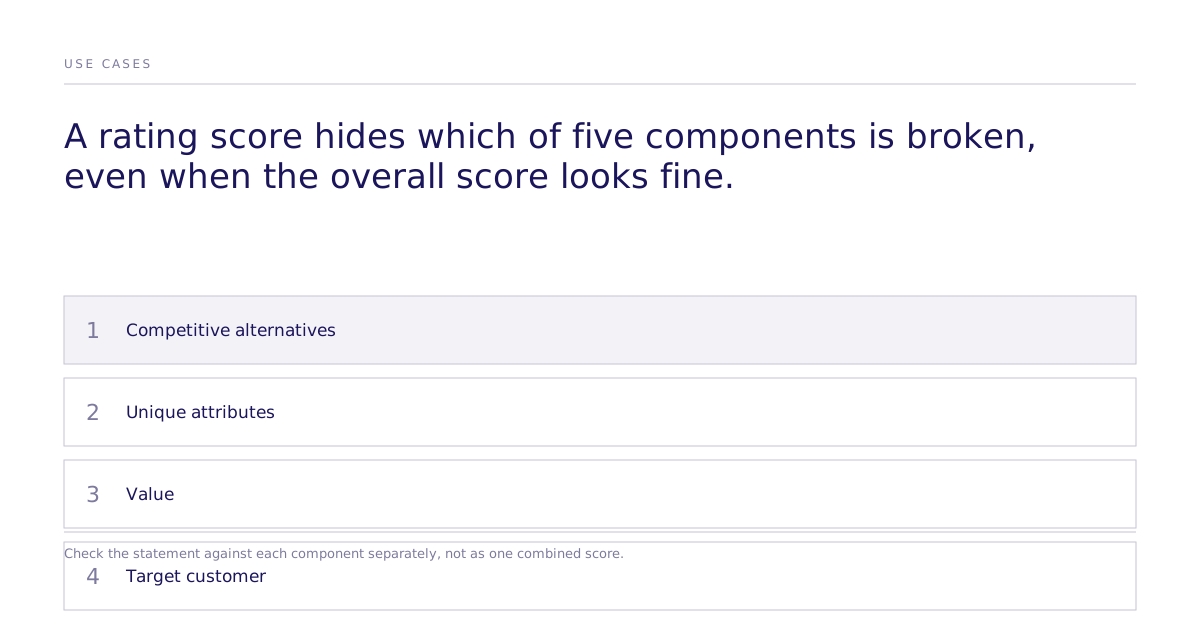
Positioning is not a tagline exercise. Following April Dunford's framework, a positioning statement stands or falls on five components:
- Competitive alternatives. What the customer actually compares the product to, not what the team assumes.
- Unique attributes. What is genuinely different about the approach, not a feature list.
- Value. What that difference is worth, stated in the customer's language.
- Target customer. Which segment feels the difference most urgently.
- Market category. The category the product occupies, or the one it is trying to create.
A statement that scores well on a rating scale can still fail on any of these five components, because a scale score does not reveal which alternative the buyer had in mind, what objection surfaced first, or which segment understood the claim at all. That gap between intended and perceived positioning only becomes visible when a buyer is asked to explain their own reasoning rather than rate a statement.
Evidence: comparing statements instead of rating them
Subconscious runs controlled experiments on simulated buyer segments rather than asking a single persona to score a statement. The comparison holds the segment constant and varies only the positioning statement.
That design surfaces the same signals a strong positioning research process is built to find:
- Understanding gap. Does the segment describe the product's category and function the way the team intended?
- Competitive-framework gap. Which alternatives does the segment name unprompted? A segment that consistently names a product the team does not consider a competitor is a positioning signal, not noise.
- Value-perception gap. Which benefit does the segment actually respond to, versus the one the team is leading with?
- Segment fit. Which segment shows the strongest response, which speaks to ideal-customer-profile prioritization rather than messaging alone.
Subconscious can run these controlled studies against a person-level audience graph covering 800 million real people, which matters for testing whether positioning holds across segments rather than one hand-picked persona. Subconscious can also test or validate a resulting study with real human participants, moving from the simulated comparison to a real-human check without changing the underlying question.
A recommended decision process
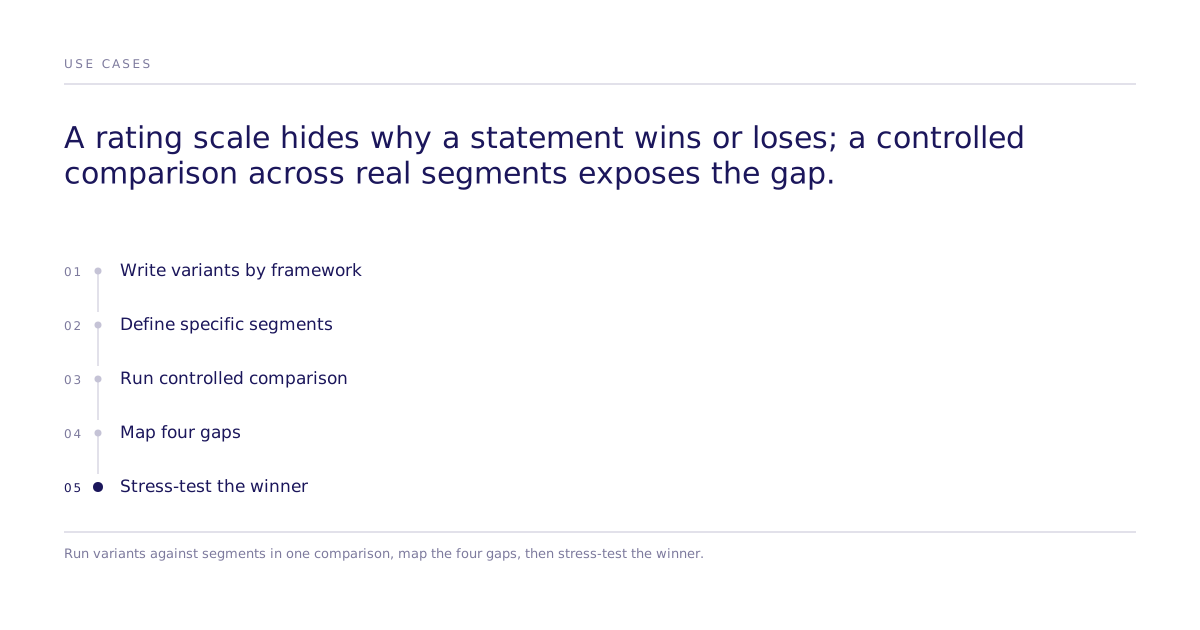
- Write two or three positioning variants that differ in framework, not word choice. For example, a category-first variant ("the market research platform for product teams"), a problem-first variant ("shrink the research cycle from months to hours"), and an alternative-first variant ("replace a costly research engagement with a faster comparison").
- Define three to five buyer segments with real specificity. Naming the role, company stage, and evaluation context, say, a product VP at a Series B SaaS firm shopping for a research tool, produces a more useful comparison than a generic "product leader."
- Run each variant against every segment in one controlled comparison, capturing, in the segment's own words: what the product does, who it is for, the first objection or question, how it compares to what the segment currently uses, and whether the segment would investigate further.
- Map the gaps across segments and variants, using the four gap types above to decide which statement to advance and which segment to prioritize.
- Stress-test the strongest variant by asking what a competitor would say to counter the claim, what a reader would need to see next on a landing page to keep reading, and whether any scenario makes the positioning actively repel a buyer it should attract.
Naming the estimate as illustrative is what keeps it useful for a reader who plans around it. Teams that follow a version of this pattern elsewhere describe it as roughly an afternoon of setup and a few hours of comparison, well short of a six-figure agency engagement run over a twelve-week timeline, though time and cost scale with the number of variants and segments tested and are illustrative, not a Subconscious delivery commitment.
Where does Subconscious fit in positioning research?
Subconscious's advantage over a rating-scale survey is that it tests a comparison, not a single statement, and reports what changed and for which segment rather than a single aggregate score. Our best configuration reaches 87% of the measured human ceiling on one study: 0.832 rank correlation against the published human result, where two independent samples of real humans reach 0.959. Across all 43 studies that pass design filters the mean is 0.73. The misses sit on the public record next to the hits, so this score comes with its boundary stated. It is a validation result, not a guarantee for a new market, and is the relevant proof point for trusting a simulated comparison as a first pass before a real-human check (the causal fidelity paper).
Limitations and failure conditions
A number without its limits is marketing, so this section states plainly what the comparison cannot do. A controlled comparison of positioning statements does not replace customer discovery, sales-call evidence, competitive win/loss analysis, or observed market performance after launch. It is a pre-launch filter that narrows which statement is worth taking to market, not a guarantee of market response. A statement that wins the comparison can still underperform if the launch executes poorly, the channel mix is wrong, or the competitive landscape shifts between the test and the launch date. Teams that skip the real-human validation step for a high-stakes launch are trading a cheap check for a small amount of remaining uncertainty, not eliminating it.
Where to go next
Review the methodology and validation evidence behind the replication figure, look at a documented decision that used a controlled comparison before launch, or set up a comparison for a specific positioning decision.