AI Purchase Intent Detection: How It Works
Purchase intent detection estimates whether a person, account, or market segment is likely to buy. Most intent systems make that estimate from evidence created after buyers begin acting. A launch team has a harder question: which audience and message should receive budget before those actions exist?
Synthetic pre-launch testing can supply an early directional signal. It belongs before behavioral scoring, then must be checked against real outcomes once the market responds.
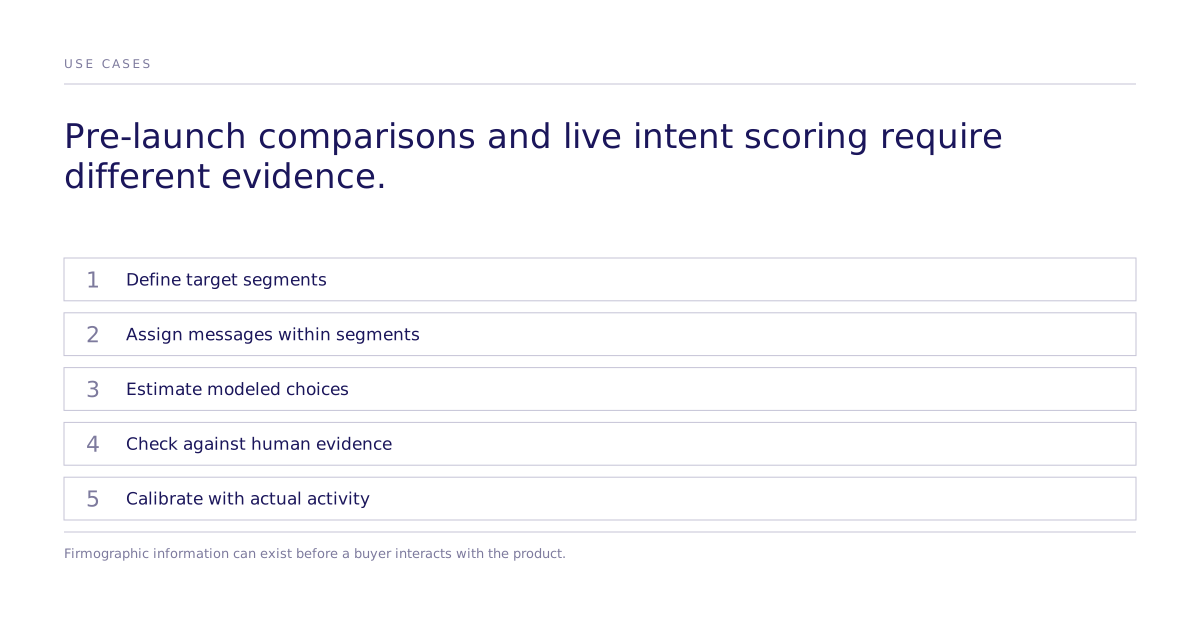
The missing input in a pre-launch intent stack
Live intent models use first-party activity, firmographic priors, and third-party research signals. Firmographic information can inform targeting before a buyer interacts with the product; behavioral scoring needs relevant observed activity.
The immediate problem is not how to score an active account. It is how to choose an initial segment, message, or position before committing GTM budget. Launching without evidence risks backing the wrong audience. Treating an untested synthetic result as observed buyer behavior creates the same exposure behind a more precise-looking number.
How does a synthetic purchase-intent test work?
A controlled simulated experiment assigns messages or product alternatives and estimates changes in modeled choices. Compare audience segments conditionally, and randomize the message within each segment. Segment membership itself is not a randomized treatment.
Subconscious supports pre-launch comparisons of defined actions and audiences. Once real activity appears, compare the modeled result with observed outcomes and let those observations govern ongoing scoring. See the workflow from question to experiment.
What does credible evidence look like?
Lin’s 2025 purchase-intent study evaluates classifiers on 12,330 sessions in the UCI online-shopper dataset. Its session-level purchase labels are useful for understanding predictive evaluation, but they do not establish causal effects or pre-launch performance in another market.
"The results show that CatBoost and XGBoost have the best prediction results when dealing with complex features and large-scale data, F1 scores are 0.93 and 0.92 respectively, and CatBoost's ROC AUC reaches the highest value of 0.985."
Jin Lin, PLoS One (source)
July 2026 causal-fidelity working paper (not peer reviewed) evaluates rank correlation on estimated choice parameters, not the accuracy of an individual lead score. A purchase-intent study needs outcome-specific validation; compare simulated results with a matched human study and actual purchases where the decision warrants it.
Decisions the signal can inform
The test is most useful when the team names an action before running it:
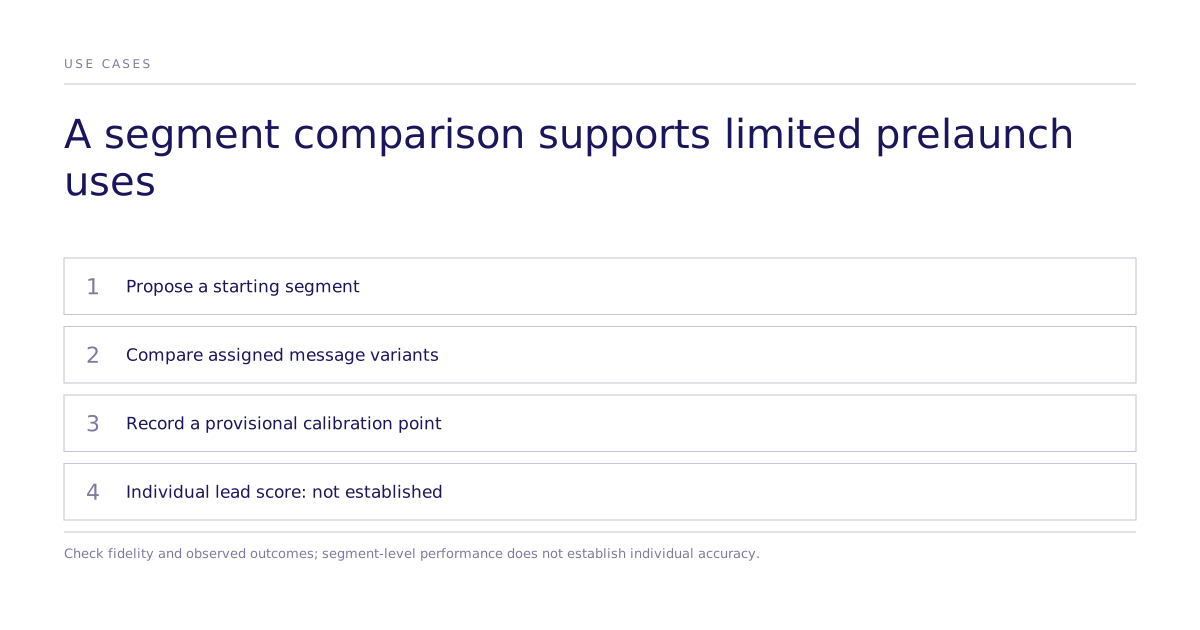
- Choose a starting segment. Compare defined audiences before allocating campaign spend.
- Select a message. Test competing propositions against the same purchase-intent outcome.
- Set a calibration point. Record the pre-launch result, then compare it with real buyer behavior as it arrives.
A segment-level contrast does not establish an individual lead score.
What guardrails apply when acting on the result?
Calibration against real outcomes is required when those outcomes become available. Known failure modes include variance collapse, demographic flattening, prompt sensitivity, and weaker fidelity for individuals than for aggregates. Segment-level performance therefore cannot establish individual-level accuracy.
The study design also determines what can be reported. Teams should not assume that confidence intervals, segment heterogeneity analysis, or a finished decision memo are standard outputs. They should ask which alternatives were tested, which outcome was measured, and what real-human evidence will be used to challenge the result.
Scope the decision before the study
Start with one launch choice: a defined set of segments, messages, or positions and a purchase-intent outcome that distinguishes them. Review the underlying research approach, then bring that exact decision to a demo. The useful deliverable is evidence for the next allocation decision, followed by a plan to calibrate it with real buyer behavior.