AI Research for Enterprise Teams: Choosing the Right Tier of Rigor
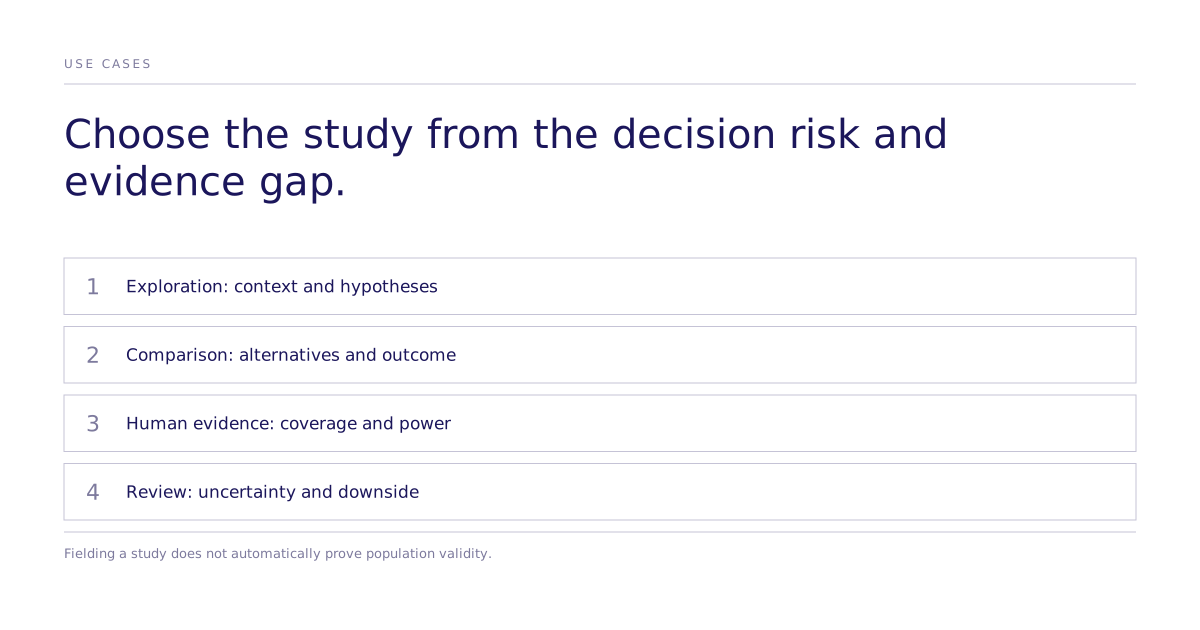
Route enterprise research requests from the question, evidence gap, and decision risk. Open-ended AI output can propose hypotheses; an assigned comparison estimates a contrast; a fielded human study measures recruited participants subject to sampling, power, and design limits.
Why the routing decision matters
Research demand inside a large organization grows faster than research headcount. Teams that cannot get a researcher's time within their decision window either wait until the decision is already made, skip research and guess, or run their own ad hoc questioning without a defined method.
An open-ended AI session can have a defined audience, but a fluent answer does not establish a measured comparison. Check the population definition, assigned alternatives, outcome, and validation separately. Use exploratory output to formulate a study when committed budget requires stronger evidence.
What causes the outcome?
Match the method to the endpoint. Open-ended generated responses can propose customer reactions. A designed comparison measures how modeled or recruited choices differ under assigned alternatives; neither automatically establishes actual market behavior or a go/no-go decision.
A controlled design specifies alternatives, population, assignment, endpoint, and an estimation method. Agree how uncertainty will be reported and which evidence supports human transfer.
Evidence
Subconscious structures randomized comparisons on simulated audiences. A test can estimate an assigned contrast within the model; it does not by itself identify a psychological reason. The aggregate evidence record, applied case examples, and July 2026 causal-fidelity working paper (not peer reviewed) provide context and limits, rather than certification of a new enterprise study.
Confirm audience coverage, calibration, and effective sample information for the proposed study. The size of an audience model is distinct from the number of recruited participants and the precision of a segment estimate.
Comparing the three methods
| Method | What it answers | What it requires | Where it fails |
|---|---|---|---|
| Self-serve open-ended AI session | Generated reactions and hypotheses | A task brief and audience context; inspect what is actually configured | May lack assigned alternatives or relevant fidelity evidence; fluency alone cannot substantiate a consequential claim |
| Controlled comparison (Subconscious) | Estimated effect on modeled choices under a specified design | Defined alternatives, audience, outcome, estimator, and uncertainty method | Needs matched validation for a consequential decision; modeled precision does not establish population validity |
| Fielded human study | Choices from recruited participants under the study conditions | Appropriate recruitment, power, assignment, and measurement | Representativeness, statistical significance, and regulatory adequacy each require separate checks |
Recommended decision process
Before a team commits budget or reputation to a decision, the research function should ask three questions in order:
- Is the question exploratory? Use open-ended output to propose hypotheses, with source review and explicit limits. Low stakes alone do not establish fidelity.
- Does the decision compare defined actions? Specify the audience, alternatives, assignment, endpoint, uncertainty method, and evidence needed before choosing a controlled design.
- Does the claim require recruited participants or observed behavior? Choose the relevant human method and assess sampling, power, measurement, and applicable requirements. Fielding alone does not establish population validity.
Where does Subconscious fit?
Subconscious can supply a configured comparison of generated choices between alternatives. Agree the estimator, uncertainty method, coverage, and deliverables, then assess relevant human evidence before a consequential commitment.
Carry the decision question into an aligned human study where needed, documenting recruitment, instrument, and context changes. Agree delivery with the team and retain results that support, contradict, or leave the simulation unresolved.
What are the limitations and failure conditions?
Choose the method and protocol required for the actual claim. Verify sampling, legal or regulatory requirements, source records, approval controls, and deliverables during scoping rather than inferring them from an experimental design.
Keep audience reach, simulated experiments, and recruited real-human participants distinct in every conversation about scale. A large audience graph is not evidence that a team can casually field real humans at that same scale on short notice.
Putting a request on the right tier
As a hypothetical planning example, a team might interview ten customers and explore related questions with fifty generated responses, or maintain five to eight configured customer types for preparation. These counts do not establish precision, effective sample size, or human fidelity.
Review the research approach or scope a working session with the actual enterprise question, endpoint, and evidence gap.