AI Social Listening Tells You What Happened. It Can't Tell You What to Do Next.
A sentiment dashboard shows a spike, a cluster of negative posts, or a rival gaining share of voice. It cannot tell a brand, insights, or communications lead which of three possible responses their broader target audience would actually accept. That gap is the real decision: treat the listening data itself as enough to act on, or run a controlled test of the candidate response before committing budget or making a public statement.
What does AI actually add to social listening?
Modern listening tools (the category includes vendors such as Brandwatch, Talkwalker, Sprout Social, and Meltwater) use natural language processing to read sentiment in context, unsupervised clustering to group thousands of posts into themes, and anomaly detection to flag when mention volume breaks from a historical baseline. Large language models now summarize that volume into an executive brief instead of a raw spreadsheet.
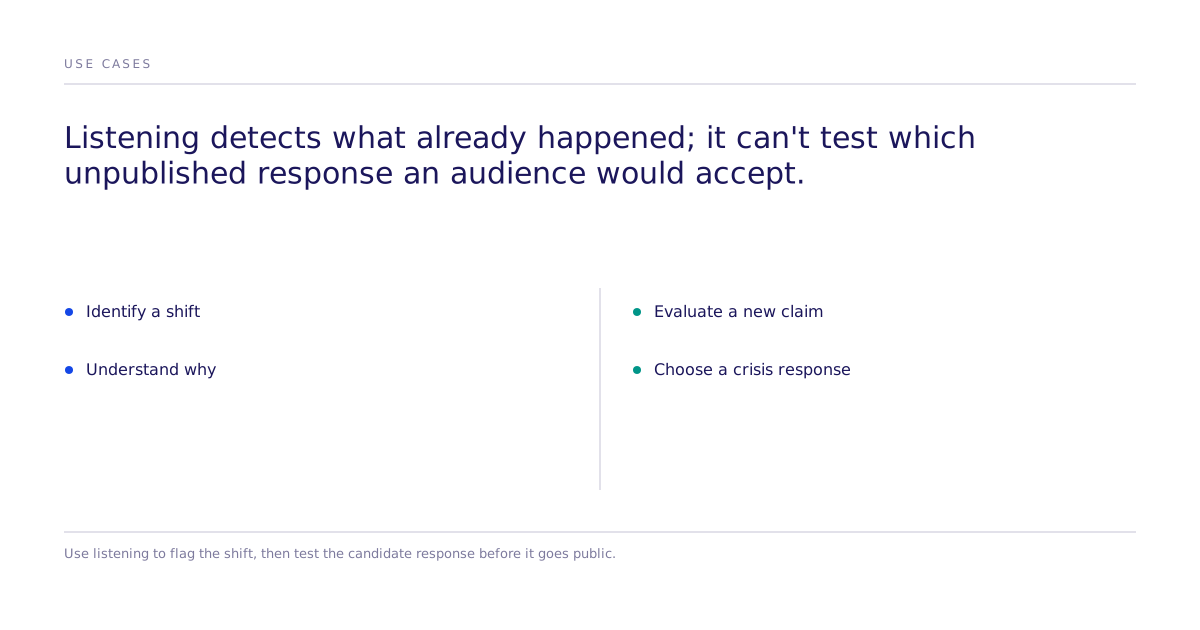
All of this is detection. It tells a team what has already been said, by whom, and how much. None of it tells a team what a specific audience would do if shown a message, product change, or crisis statement that has not been published yet.
Why the data itself can't answer the "what next" question
Social listening only sees people who chose to post publicly. Research on stance detection finds platforms carry a small, vocal share of users who generate most visible content, while a much larger, structurally passive population stays silent on any given topic (Zhu et al., 2024, EPJ Data Science). A dashboard built from public posts inherits that skew, reporting the vocal minority's reaction, not the reaction of the audience a brand actually needs to reach with its response.
A second, structural limit sits underneath the sampling one: the people in a listening feed never agreed to be asked anything. A team can observe what they already wrote, but it cannot put a new claim, price, or statement in front of them and record a reaction, because that requires consent to participate in research, not just a public post to scrape.
Turning a detected signal into a tested response
The fix is not a better dashboard. It's pairing detection with a controlled test of the response before it ships. Subconscious runs randomized experiments: a specific claim, message, or product concept is placed in front of a defined audience, and the test estimates which version changes the outcome, a different question from tallying what people already said.
| Research goal | Social listening (detect) | Subconscious (test) |
|---|---|---|
| Identify a shift worth acting on | Flags volume spikes and rising keywords against a historical baseline | Not the right tool: this stays a monitoring job |
| Understand why the shift is happening | Surfaces the words and phrases people used | Estimates which specific framing or claim changes a defined audience's response |
| Evaluate a new claim or concept | Cannot test something that has not been published yet | Places the unpublished claim or concept in front of the audience and measures the effect |
| Choose a crisis response | Tracks how the crisis is spreading across the open web | Compares candidate response statements before any of them goes public |
| Respond to a competitor claim | Maps competitor share of voice and public complaints | Tests which counter-message moves the target audience, not just which gets mentioned more |
What does this workflow require, and what doesn't it replace?
This tool publishes its own scope limits so a buyer can check them before relying on the result. Running a test like this assumes the team already has candidate responses: it is not a tool for discovering that a conversation exists, only for deciding what to do once one has been found. And the confidence-interval strength of any single result depends on how that specific study is designed; it is not automatic on every output.
When the decision is high-stakes enough that the team needs more than a directional read, Subconscious can test or validate the same study with real human participants without changing the underlying causal question, moving from a simulated first pass to human evidence on the same claim, not a different one. That path matters most for a public statement or a claim the team is not willing to walk back.
Stating exactly what a result proves keeps the claim honest for anyone checking it against the leaderboard. Real-human validation answers "does this hold up with real people," not "did this happen in a clinical trial or a market-representative sample." A causal test of a message is still a test of that message; it does not become a usability study, a regulatory submission, or proof of market performance just because a human panel ran it.
Where does this fit?
Social listening stays the detection layer, the way a team first learns something changed. Subconscious sits downstream of it, as the layer that turns "something changed" into "here is the response that works" before that response goes public. See how Subconscious runs a study, the current research and leaderboard results, or talk to the team about a specific response you're weighing.