Always-On Simulated-Customer Chat or a Causal Experiment?
Choose an always-on simulated-customer chat when the team needs hypotheses, language, or reactions to investigate. Choose a controlled experiment when the decision is which price, message, feature, or launch action to fund. The cost of confusing the two is a confident go or no-go call that never measured the behavior at stake.
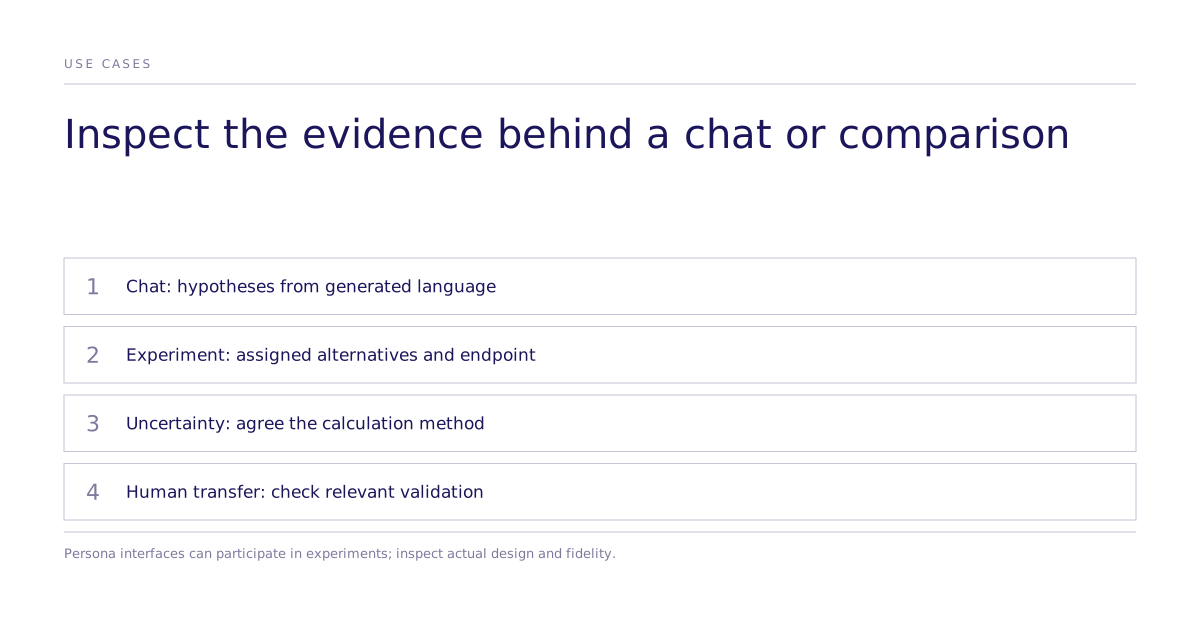
The purchase is really a choice of evidence
An ongoing conversation interface is designed to generate responses. A team describes a concept, price, or campaign and asks a simulated customer how it might react. That can help the team surface objections, vocabulary, and questions for further research.
A controlled experiment is designed to compare interventions. The team defines the action, alternative, population, outcome, and conditions held constant. The result estimates which action is likely to change the outcome and reports uncertainty where the study design supports it.
A number without its limits is marketing copy. Plausible language is not causal evidence. Research on generated social data has found that fluent responses can fail to preserve important properties of human data, with failures that are difficult to detect from the text alone (Synthetic social data: trials and tribulations, arXiv).
For a planning cycle, the practical question is which evidence can support the decision the team must make.
| Buying criterion | Always-on simulated-customer chat | Controlled causal experiment |
|---|---|---|
| Primary question | What might a customer say about this idea? | Which defined action changes the target behavior? |
| Unit of evidence | A generated conversation | A measured comparison between controlled alternatives |
| Best use | Hypothesis generation and exploratory language | Pricing, product, messaging, and launch choices |
| Population | The simulated customer selected for the conversation | A population defined before the test |
| Uncertainty | A plausible answer does not establish an effect range | Uncertainty can be reported when the study design supports it |
| Human check | Requires a separate human-research design | Can preserve the intervention and outcome while testing with real participants |
Four questions to ask before signing
What action will the result change?
Name the actual choice. “Learn what customers think” is a research objective, not an action. “Choose message A or message B for the launch” is a decision that can be tested.
What changes between alternatives?
A useful experiment specifies the intervention, population, outcome, and assignment plan. Factorial and planned adaptive designs can vary several elements; unplanned changes can make the result answer a different question.
What behavior will count as the outcome?
Preference, purchase choice, adoption, trust, and switching are different outcomes. Define the one that would change the business decision before evaluating the research instrument.
What would make the result credible enough to act?
Ask how the method is calibrated, what was compared, how uncertainty is handled, and where it has failed. A polished answer is not a substitute for a stated validation standard.
The causal decision layer
Subconscious is built for action questions. It uses causal experimentation and discrete-choice-style modeling to compare product, pricing, messaging, and go-to-market actions before a team commits capital.
The July 2026 causal-fidelity working paper (not peer reviewed) evaluates agreement on estimated choice parameters across replicated studies. Check whether a benchmark matches the new decision and which failures it includes. General validation does not establish a guaranteed result for an always-on customer chat.
Scope setup, experiment execution, review, and human recruitment separately. Ask for a current timing estimate for the configured study rather than inferring delivery time from an interface demo.
Keep discovery and human validation in the research system
A controlled experiment does not decide what the team should build from a blank page. Direct customer conversations, open-ended qualitative work, subject-matter judgment, and exploratory research still produce the alternatives worth testing.
When the decision needs human evidence, plan a comparison with aligned alternatives and endpoint. Document recruitment and instrument changes and agree delivery. The result can support, contradict, or leave the model unresolved; it does not automatically establish market performance.
Audience-graph reach is a targeting layer, not a pool of recruitable participants. Recruitment is a separate operational step and should be evaluated as such.
A procurement rule that survives the demo
Buy the conversational instrument when the job is to explore what a customer might say. Buy the causal instrument when the job is to choose which action to take. If both jobs matter, use each for the question it can answer and do not collapse generated reactions into behavioral proof.
Review the research standard and the public benchmark record before treating any result as decision evidence. To frame a price, message, product, or launch comparison, book a working session.