Choosing a Pre-Launch Validation Method for Messaging, Pricing, and Positioning
A launch is a few weeks out and the team still has to decide whose messaging wins, what price the market will accept, and whether the target buyer actually cares about the positioning. Those calls lock campaign spend, sales enablement, and packaging into production. Get the underlying behavior wrong and the fix arrives after launch, slow and expensive to unwind.
What is pre-launch validation for?
Pre-launch validation helps a team resolve a specified question before production work hardens. A message-comprehension question may call for interviews; comparing responses to alternative prices or positioning statements calls for a design that defines the audience, alternatives, and measured outcome.
Traditional interviews explore reasons and context; structured human surveys can include randomized tests. Synthetic tools can provide conversations or assigned choice tasks. The respondent type and the experimental design are separate choices.
How to evaluate a pre-launch method
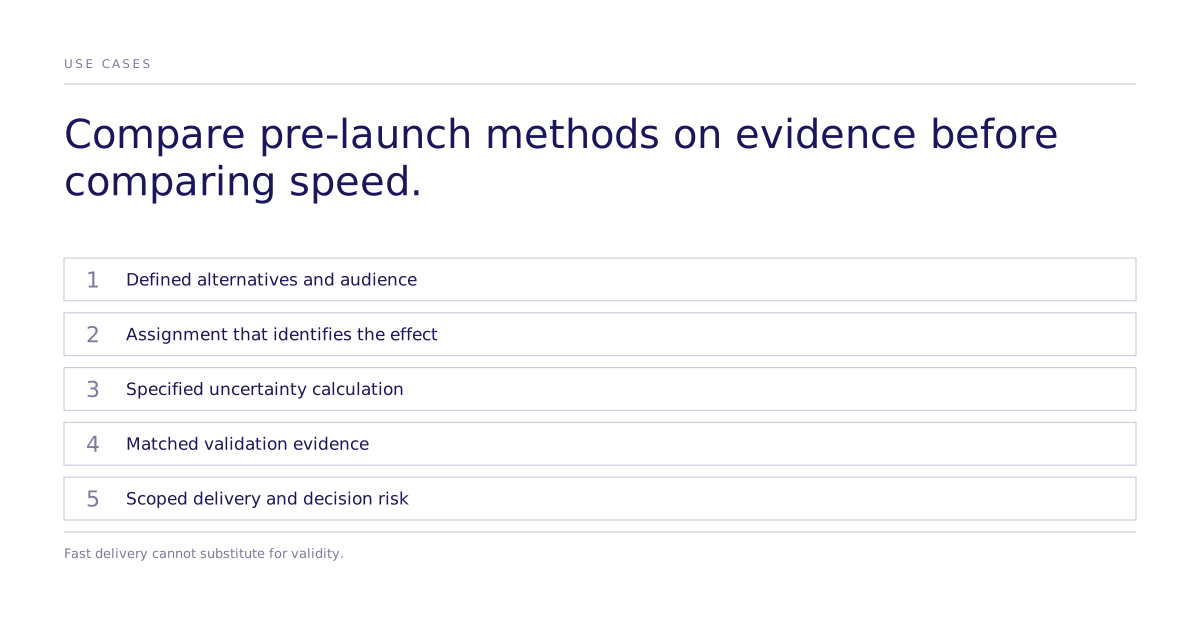
Before choosing a method, check it against the actual decision it needs to support:
- Does it name explicit alternatives? If the decision is between two options, compare those options in a defined task. An open-ended reaction can explain context, but it does not estimate the difference between assigned alternatives.
- Does the design identify the effect? Specify assignment, alternatives, and outcome. A factorial design can vary several attributes; a comment thread alone cannot isolate an intervention. Conjointly’s documented A/B and choice methods illustrate why the design must be checked separately from the platform label.
- Does it report uncertainty and limits? Agree on how uncertainty is estimated and what the result covers. A confidence interval alone does not establish audience coverage, model fidelity, or transfer to purchases.
- Can the team run it without a research team as a bottleneck? Iteration speed depends on whether a product or GTM lead can set up and read a test without waiting on a specialist.
- Does it distinguish audience reach from who actually answers? A large audience definition is not the same as a large number of recruited respondents; confusing the two overstates what a single test proves.
What to test before launch
Four assets are worth testing before they harden into production work:
- Positioning. Define buyer segments, then compare the opening value proposition, category framing, proof points, and language used to describe the problem. Specify whether the endpoint is comprehension, stated choice, a generated choice, or observed behavior.
- Pricing and packaging. Frame willingness to pay, how buyers perceive plan boundaries, and discount sensitivity as a discrete choice among named packaging options, rather than an open question about a single price point.
- Launch assets. Put landing-page hero copy, subject lines, ad concepts, and sales-deck opening slides in front of the same defined segments so results are comparable across touchpoints.
- Segment divergence. Run the same comparison across buyer roles, regions, company sizes, and category maturity. Check whether a shared promise or different proof points fit the measured responses; treat segment differences as hypotheses to validate.
How does Subconscious approach this decision?
Subconscious structures discrete-choice comparisons of specified alternatives. A randomized design can estimate effects on choices under the task conditions; synthetic choices remain modeled outcomes. Agree on estimation and uncertainty before interpreting results. Review aggregate parameter-rank comparisons and applied examples for their documented scope.
Scope a matched human study when the decision requires it. Check recruitment, coverage, measurement, and power independently of the modeled audience, while preserving the decision question.
Comparing method types
| Method | What it measures | Delivery to scope | Where it fits |
|---|---|---|---|
| Traditional recruited research | Stated preference, open-ended reaction, or assigned tasks with real respondents | Scope recruitment, instrument design, and analysis | Decisions needing direct evidence from the relevant audience |
| Open-ended persona simulation | Free-form generated reaction to a concept | Scope configuration, calibration, and review | Generating questions and hypotheses for further research |
| Controlled discrete-choice experiment | Effects on choices within a specified task; uncertainty depends on design and estimator | Request a scoped schedule | Decisions with named alternatives, a defined audience, and relevant validation |
What are the limitations of this approach?
A simulated pre-launch comparison requires relevant calibration; sparse evidence for a new behavior or a rare audience can leave that calibration unresolved. For a consequential decision, scope direct human research or a live test around the actual evidence gap. Check recruitment, measurement, and the cost of error before committing production spend.
Next step
Start with the alternatives already on the table: two positioning statements, two price points, two hero lines. Structure them as a discrete choice rather than a single concept for reaction. Book a demo to see how a controlled experiment is set up, or read how Subconscious works for the underlying method.