Choosing a Synthetic-Data Method for a Marketing Decision
A marketing or insights leader choosing research for a concept, message, price, or segment needs to define the decision and endpoint first. Compare synthetic, human, and live methods by their actual design and relevant evidence before committing budget.
What Does "Synthetic Data" Mean for a Marketing Decision?
For a marketer, synthetic data can mean generated survey answers, modeled audience responses, or simulated interview transcripts. The delivery format helps describe the output; it does not establish reliability for a particular marketing decision. Check population coverage, model assumptions, and relevant external validation before treating generated responses as buyer evidence.
Compare the Method Categories
| Method | What it produces | Typical use | Where it's weakest |
|---|---|---|---|
| Conversational response simulation | Free-form generated reactions to a concept or message | Exploring language, context, and possible objections | An unassigned open-ended conversation does not estimate a difference between alternatives |
| Managed enterprise study | Vendor-run research with a specified methodology | Studies needing custom design and delivery | Ask for methods, data access, validation, timing, and audit terms |
| Behavioral agent simulation | Agent-based modeling of consumer decisions | Consumer behavior projections and specified intervention comparisons | Ask how interventions are assigned and whether modeled effects have relevant external validation |
| Discovery-interview simulation | Simulated qualitative interview transcripts | Product discovery and hypothesis generation | Generated explanations need external checks; causal inference requires an appropriate design |
| Audience-segment modeling | Modeled customer segments for message and creative testing | Segmentation and creative pre-testing | Quality depends on input coverage, model assumptions, implementation, and relevant validation |
| Population-level modeling | Aggregate modeling of a market population | Market sizing and strategy comparisons | Check which interventions are compared, what aggregation hides, and where the result transfers |
| Pre-launch feature validation | Simulated reactions to an unshipped feature | Comparing feature hypotheses before launch | Check the prototype, alternatives, assignment, and calibration for the intended endpoint |
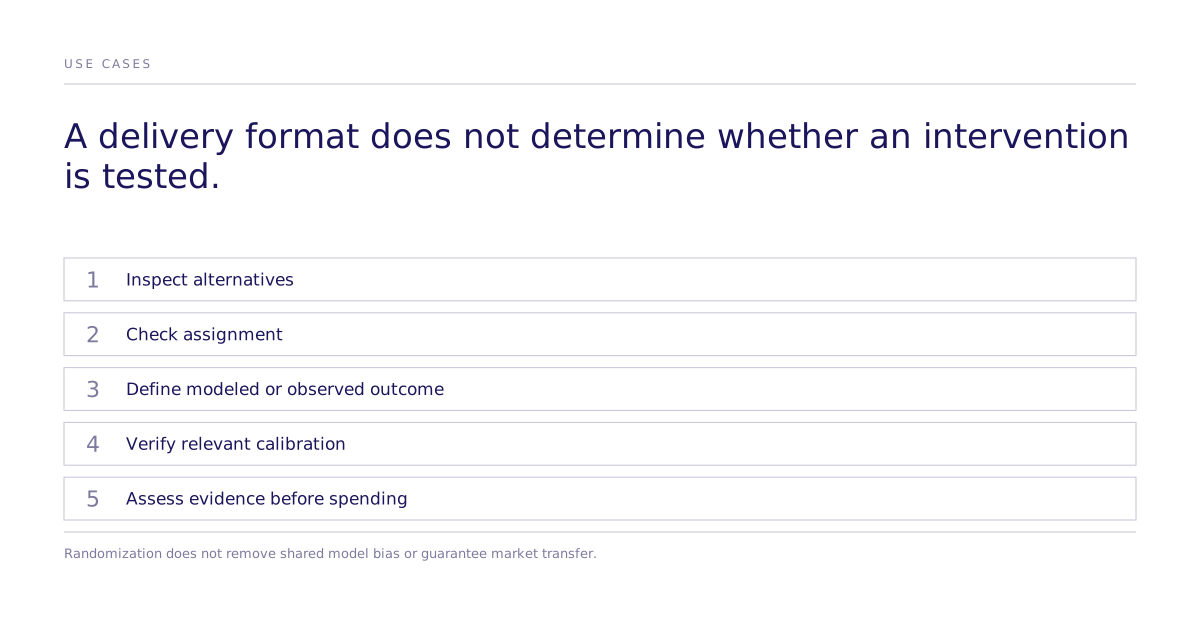
These delivery formats do not determine whether an intervention is tested. Agent-based models and managed studies may compare actions, while a conversational tool may support a randomized task. Inspect the actual design and outcome rather than classifying every synthetic method as conversation.
What Is the Cost of Treating a Simulated Read as Decision-Grade Evidence?
A team can commit spend to an unsupported hypothesis when it treats an unvalidated simulated result as a real-market effect. In Kaiser and colleagues’ 2026 marketing-funnel study, generated responses captured broad brand patterns but overstated positive attitudes and showed less variation than human responses. That finding concerns the tested survey methods and brand tasks; it does not establish the same error for every synthetic method. See the synthetic-respondent evaluation guide for questions to ask about a new study.
What Does a Causal Test Add Instead?
Subconscious structures comparisons of defined alternatives and outcomes. Ask how the simulated audience is calibrated and how effects and uncertainty are estimated. Relevant human validation is needed before treating a modeled effect as a real-market effect. The leaderboard documents general research scope, which must be matched to the new study.
Limitations
A causal action test does not replace customer discovery, usability observation, or in-market results, and it is not itself a substitute for testing with real people. Audience reach (the scale of the simulated experiment's defined population) is a separate claim from recruiting real participants for validation. Keep the two distinct rather than treating one as proof of the other.
From Simulation to Real-Human Validation
Scope a matched human study when direct audience evidence is needed. Confirm recruitment, coverage, measurement, and fieldwork arrangements separately from the simulated population. The human comparison may agree, disagree, or remain inconclusive; use its actual endpoint and uncertainty when deciding whether to act.
Next Step
Start by naming the decision and endpoint: concept comprehension, a choice between messages, acceptance of a price, or differences across segments. Inspect assignment when estimating an effect, and request validation relevant to the intended action. See how Subconscious structures a study or book a walkthrough around your alternatives.