Competitive Win/Loss Analysis: Testing Objections Before You Trust a Thin Interview Sample
A head of product marketing has a pricing narrative or battlecard objection ready to ship against a competitor. The problem: the exit interviews that would confirm the pattern haven't come in yet, and the few that did might be noise from whoever was willing to explain why they walked.
A thin set of self-reported loss reasons can miss buying-committee constraints and alternatives. Compare interview coverage with deal records: who answered, which roles they held, what alternatives they considered, and which lost accounts remain unrepresented. User Intuition’s win/loss guide offers practitioner context for planning those checks.
Why is win/loss data thin by default?
Check who answered the exit survey against the full set of lost or churned accounts. Missing buyer roles, deal sizes, or competitor choices can change the pattern the interviews suggest. A response such as "we went in a different direction" needs follow-up about the alternatives and constraints before it becomes an actionable explanation.
What can a controlled experiment do before the interviews arrive?
A simulated choice study can compare claims, framing, or price against a named competitor for a defined profile. Specify the outcome and uncertainty method. Matching a lost-deal profile does not identify why an actual account was lost; test the proposed explanation independently.
This is a hypothesis-generation step, not a replacement for real win/loss interviews: it tells a team what to test next with real people, not why any named deal was lost or why a specific account churned.
Building the test
- Describe the loss or churn profile. Start from what the CRM shows about a cluster of lost deals or churned accounts: company size, industry, the decision-maker's role, the competitor chosen.
- Split into two or three segments. An enterprise evaluator who chose a named competitor is a different buyer than an SMB founder who churned after a free trial; test each separately.
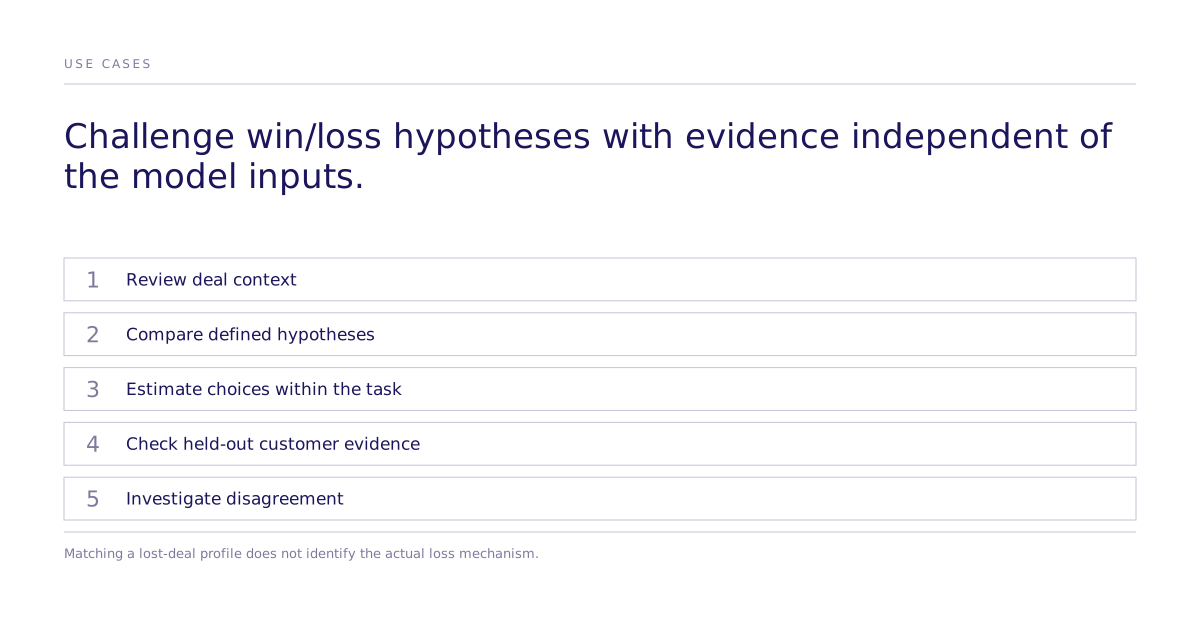
- Run the same choice experiment across segments, varying price framing, a specific feature’s presence, and switching cost. Label generated choices separately from human stated choices, and estimate differences within the assigned task.
- Compare with independent evidence. Use held-out interviews, deal records, and a matched human test to challenge the ranking. Agreement with interviews used to build the simulation is not independent validation.
Do simulated experiments replace real interviews?
Neither replaces the other; the right approach depends on how much real data is available and how fast a decision is needed.
| Situation | Best approach |
|---|---|
| Enough real respondents available | Interview relevant buyer roles; use a human or calibrated simulated choice task to compare defined hypotheses |
| Too few completed interviews to trust the pattern | Inspect missing roles and accounts; use a calibrated choice study to propose hypotheses for independent checks |
| Testing an unbuilt feature | Simulated or human concept research using a clear prototype; actual usage requires a usable product |
| A competitive response is needed before interviews can be scheduled | Check whether an available calibrated simulation can propose useful questions; interviews may confirm, contradict, or leave them unresolved |
| Entering a new market with no existing relationships | Establish relevant audience evidence and calibration before relying on simulation; gather human context for unfamiliar buying conditions |
Turning the result into action
Sales enablement. Give sales a testable objection and counter-argument, labeled with the study’s respondent source and limits. Check the hypothesis against customer conversations or a live pilot before adopting it broadly.
Roadmap input. When a feature gap consistently ranks as the deciding factor, that's a reason to investigate with real customers, not a green light to build.
Positioning. If a modeled message loses to a competitor’s framing, test a revised message with independent evidence. A task comparing claims alone cannot establish whether messaging or actual product capability caused a lost deal.
Limitations
A simulated study can compare stated choices for a defined profile. Confirm coverage and calibration; it does not replace the company’s deal records or conversations with lost and churned customers.
Before a consequential pricing or positioning change ships, challenge the ranked hypothesis with independent deal evidence or a matched human study. Confirm recruitment, coverage, measurement, and fieldwork arrangements. Keep any remaining disagreement and uncertainty visible in the recommendation.
See current research and methodology, read a case study of a study built this way, book time to scope a study against a specific competitive loss pattern, or read how a study like this gets built.