Concept Testing Before You Build
Concept testing works best while an idea can still change. Once a team has spent weeks refining a concept, internal agreement can turn research into a request for approval. The better question comes earlier: which version changes the behavior that matters, for which buyers?
Subconscious structures decision-specific choice comparisons on simulated buyers. Specify assignment, the modeled outcome, and relevant calibration before interpreting an effect. Use concept evidence to choose the next question, then challenge consequential findings with independent customer evidence.
Why timing changes the value of a concept test
A traditional study may require a developed concept, finished stimulus, an agency brief, respondent recruitment, fieldwork, and analysis.
Scope the planning constraints before commissioning a round:
- Confirm recruitment access, stimulus preparation, and the analysis required.
- Obtain a quote and delivery schedule for the specific audience, concepts, and validation plan.
Limited research budgets can favor ideas the team already likes. Plan coverage explicitly: how many distinct concepts will be examined, which rejected options receive a check, and which decisions remain untested.
Early concept testing changes the sequence. Teams can compare rough alternatives, learn which differences matter, and carry fewer, stronger concepts into customer research.
Start with the decision
A useful concept test begins with one choice the team must make. Examples include:
- Which value proposition should lead the launch?
- Which product configuration should move forward?
- Which message changes stated choice among the target audience?
- Which price scenario deserves further study?
- Which concept works across segments, and which needs a separate treatment?
Write down the action, the audience, the alternatives, and the behavior to observe. If the result cannot change a decision, the test is not ready.
Compare actions, not descriptions
Concept teams often ask whether people like an idea. A stronger design asks buyers to choose between clear alternatives under the same conditions.
Value proposition
Describe the problem, the proposed solution, and the expected benefit in plain language. Compare distinct versions rather than polishing one version in isolation.
Positioning
Hold the offer steady and vary the frame. A time-saving message, a risk-reduction message, and a growth message imply different reasons to act. The experiment should reveal how those alternatives change choice across defined segments.
Feature priorities
Long wish lists hide tradeoffs. Say the roadmap holds ten features: the real question is which three earn their place, and for whom. Present concrete configurations and ask buyers to choose. A decision-specific comparison produces more useful evidence than asking whether every feature sounds valuable.
How should pricing scenarios be tested?
Pricing should be treated as scenario testing, not an automatic optimization claim. Compare explicit alternatives when the study supports them. Do not infer elasticity, willingness to pay, margin effects, or a revenue outcome unless the study was designed to estimate those quantities.
Competitive position
Place the concept beside real alternatives. If buyers cannot distinguish the offer or explain why they would switch, the team has learned something specific enough to change the concept.
Naming and language
Names, taglines, and feature descriptions can be tested as parts of a decision. Keep the underlying offer fixed when the goal is to isolate the effect of language.
Iterate without losing the experiment
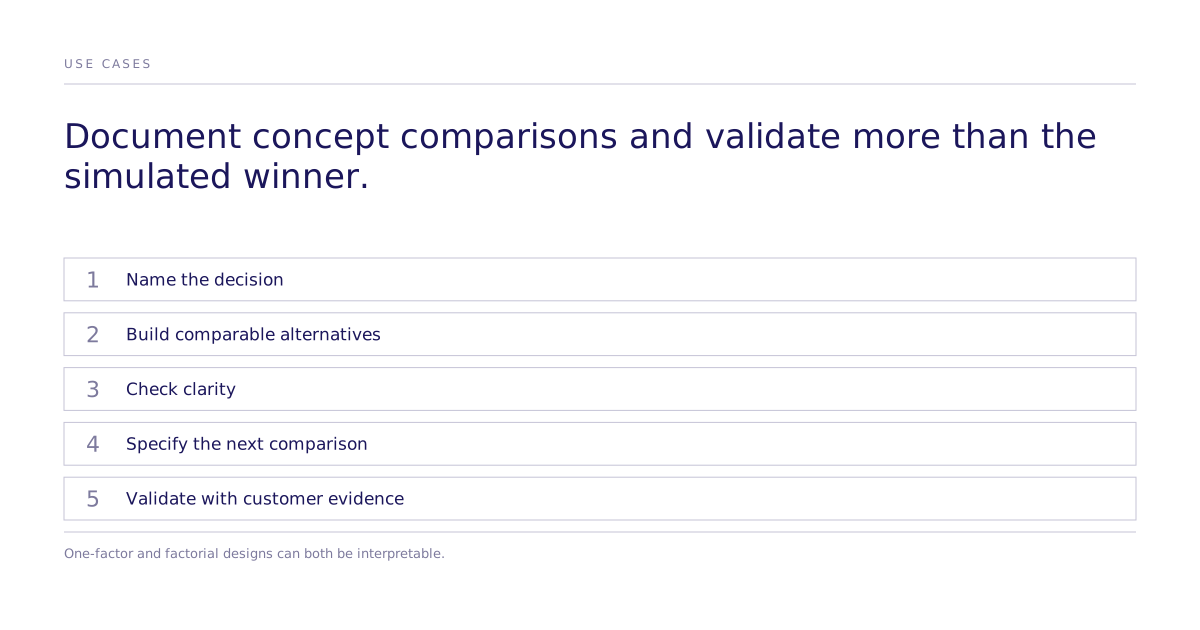
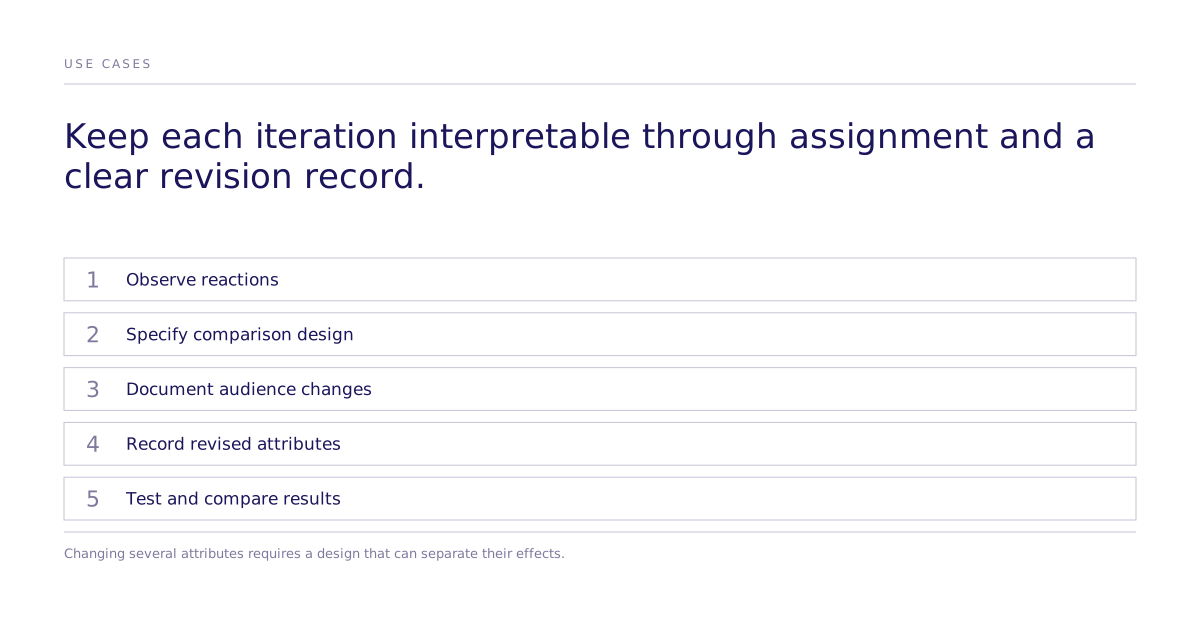
Record what changed and keep the comparison interpretable. A one-factor revision can help isolate that factor; a factorial design can vary several attributes if assignment and analysis can separate their effects. Document any changes to the audience definition.
The following example has four deliverables: audience definitions, a concept-clarity check, documented revisions, and a record of the decision evidence. Scope the schedule around the stimulus and validation work required.
Step 1: Define three audience hypotheses
Define the core buyer, an adjacent segment, and a skeptical segment. Use available customer evidence to ground those definitions. Treat each persona as a hypothesis about an audience, not as proof of behavior. Then write the concepts in comparable form.
Step 2: Check concept clarity
Use the same five prompts to check whether each concept is clear enough for an experiment:
- What is the first reaction?
- Who does the buyer think the concept is for?
- What would stop the buyer from choosing it?
- How does it compare with the current alternative?
- What would make it necessary rather than merely useful?
These prompts help expose missing assumptions. They do not by themselves establish causal effects or predict purchase behavior.
Step 3: Revise and document the concept
Use the response to Version 1 to create Version 2 and document the change. A clean record keeps iteration from becoming a sequence of unrelated prompts.
Step 4: Record the decision evidence
Capture the alternatives, audience definitions, observed differences, consistent objections, and remaining uncertainty. State what the evidence supports and what still needs real-world validation.
Where does early concept testing help most?
A hypothetical screen might narrow twenty ideas to five, but model rejection is not market rejection. Human discovery should examine promising options and a selection of discarded concepts, especially when the category is novel.
Cross-segment testing helps frame different questions for distinct buyer groups. Define each modeled segment using relevant evidence, then check whether the comparison needs recruited respondents from those groups. The number of personas does not determine the human sample or fieldwork schedule.
The method is less useful when a stimulus depends on a finished sensory experience or when the audience lacks relevant calibration. Check response variability as well as averages: Kaiser and colleagues’ 2026 brand-survey study found less variation in generated responses than in human responses. That result does not validate an untested product concept.
Use early concept research to identify hypotheses and evidence gaps. For a large investment, examine promising concepts and a selection of rejected ones with research matched to the actual risk. The leaderboard describes aggregate method comparisons; it does not establish that a new concept will sell.