Cost-based versus value-based pricing
Cost-plus establishes a cost floor and margin target. Value-based pricing asks how much economic value a buyer receives and what alternatives constrain the price. A senior pricing leader can combine both, then use choices and transactions to test the proposed offer.
- Combine cost feasibility with buyer value and validated demand evidence before setting a live price.
- Direct price-perception questions, hypothetical choice tasks, economic-value analysis, and transactions provide different evidence. State which source supports the proposed price.
- Hypothetical willingness to pay can differ from actual purchasing; measure the relevant error rather than assuming its direction.
- Randomized attributes can identify effects on choices within the task under the design’s assumptions. Multinomial logit, mixed logit, and ICLV models analyze those choices; the estimator alone does not create identification.
- A randomized hypothetical choice study can estimate effects within its task; relevant human or transaction evidence is still needed to validate the price.
Combine cost feasibility with evidence about buyer value
Simon-Kucher’s Global Pricing Study 2025 surveyed more than 2,200 business leaders across 28 countries. Its discussion of pricing execution and AI adoption describes surveyed business practice; it does not validate a particular research instrument. Ask which costs, customer-value evidence, choices, and transactions support the price in front of the committee.
Does value-based pricing beat cost-plus pricing?
McKinsey’s 2018 industrial-pricing article says advanced pricing techniques may allow a 5–10% increase in return on sales. That is a conditional opportunity, not an observed average across clients. Value-based pricing can use economic value and transaction evidence as well as research. Cost analysis establishes feasibility; buyer evidence helps test how much value a price can capture.
What can stated-preference research tell you?
Van Westendorp’s PSM elicits perceived price thresholds; Gabor-Granger asks purchase intention at specified prices. A conjoint task instead compares alternatives that vary in several attributes. These hypothetical responses differ from transactions, but the methods also differ from one another. Conjointly’s PSM documentation explains that the named optimal threshold does not necessarily optimize profit, revenue, or volume.
A stated answer may differ from what the respondent later buys. Error can depend on the task, audience, available alternatives, and incentives. Conjointly’s Gabor-Granger guidance describes both understated willingness to pay and overstated purchase intention as possible biases. Measure calibration for the proposed price; a forced hypothetical choice does not remove that need.
Match the evidence to the pricing question
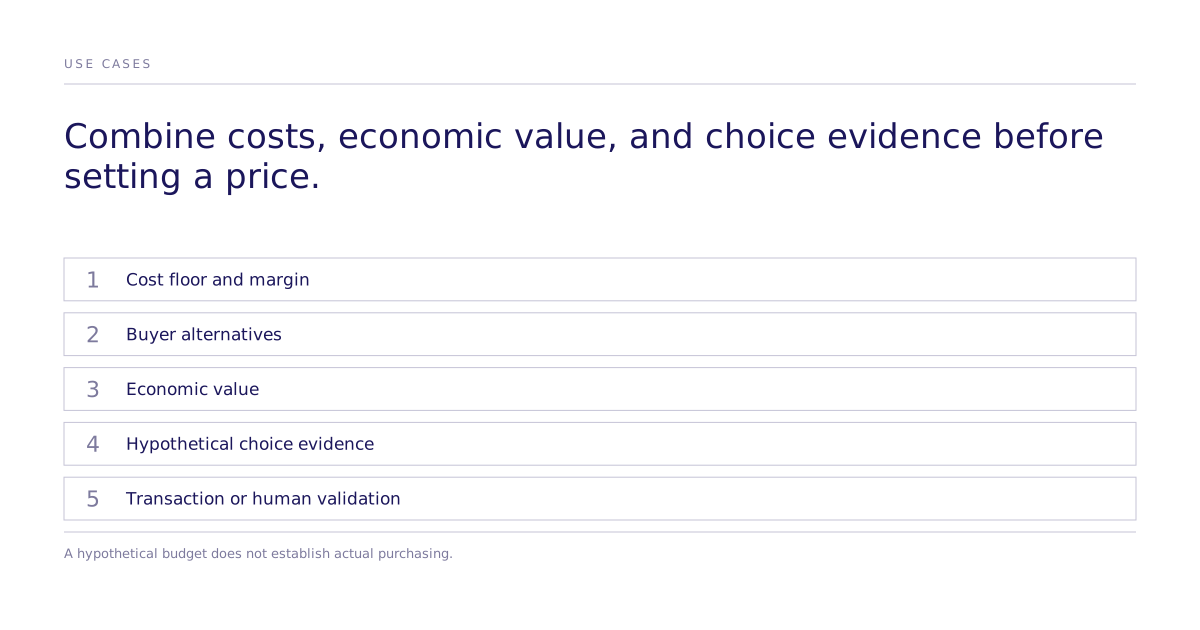
The useful distinction is which evidence supports the price: costs, economic value, stated choices, or transactions. Each answers part of the question, and none should be described as actual purchasing unless money changed hands.
What does a forced trade-off pricing experiment look like?
One illustrative task gives respondents a hypothetical budget and asks them to choose among named offers. The budget makes a constraint explicit but does not create real spending. Randomizing price, features, or framing can identify effects on choices within the task, under the assignment and analysis assumptions. With generated respondents, those effects remain modeled until relevant human or transaction evidence challenges them.
Multinomial logit, mixed logit, and ICLV are models for analyzing choices. Standard multinomial logit assumes independence of irrelevant alternatives, which may be unsuitable for close substitutes. Mixed logit can represent preference heterogeneity and additional substitution patterns. ICLV links choice to latent constructs measured through indicators; that modeled association does not establish a latent causal mechanism by itself. Choose the specification for the data and decision, then check relevant predictive validation.
Direct price elicitation and assigned hypothetical choice tasks
| Direct price-perception questions | Assigned hypothetical choice tasks | |
|---|---|---|
| What it asks | Perceived acceptable or desired price | Choice among named offers with specified attributes |
| Incentives | Check whether answers have purchase consequences | A hypothetical budget does not create real spending; inspect task consequences separately |
| Output | Perceived price thresholds; extensions require their own interpretation | Modeled trade-offs or price response within the choice task; purchasing requires validation |
| Identification | Check whether an intervention was assigned; an unassigned price opinion does not identify its effect | Inspect assigned attributes and analysis assumptions; being a stated choice does not exclude an experiment |
| Useful for | Exploring price perceptions; obtain a scoped cost and schedule | Comparing defined offer conditions; obtain a scoped cost and schedule |
What does Subconscious’s published validation measure?
The July 2026 causal-fidelity working paper (not peer reviewed) compares ranks of estimated choice parameters in replicated studies. It does not establish a universal willingness-to-pay accuracy rate or validate a new live price.
Which pricing question should a senior buyer actually ask?
Ask which alternatives were tested, what outcome was measured, and whether independent evidence supports applying the result to the proposed price. Perceived acceptability, hypothetical choice, economic value, and purchases can each inform the decision. Review applied examples, methods and validation, and method comparisons with those distinctions in mind.
Review the last study that set a live price: what alternatives were shown, what consequences respondents faced, and what later purchases confirmed or contradicted it. Hypothetical studies can inform a decision if their limits and calibration are understood. Book time to scope a price comparison and the independent evidence it needs.