Cross-Cultural Market Research Before an International Launch
The decision that matters before an international launch is not whether to research each market. It is which pricing, packaging, or positioning variant to run in each target country, decided before per-market launch spend, inventory, and campaign budget are committed. Get it wrong and the money is spent on a message or price point a local segment does not respond to, and the miss surfaces only once the commitment can't be recalled.
Why One Market's Playbook Rarely Travels
Cross-country research requires planning for local recruitment, translation, measurement, and delivery. A result from the home market may not transfer when buyer roles, available alternatives, channels, or product understanding differ. Check those differences before adopting the same launch variant elsewhere.
Cross-cultural research is harder than single-market research for reasons beyond logistics and translation:
- Local context can be missing. Ask the actual buyer group how approval authority, partner relationships, and channel access affect purchasing. Do not infer those constraints from nationality alone.
- Scores may not be comparable. Check whether respondents understand scale labels and constructs similarly across markets. A difference in scores can reflect measurement as well as preferences.
- Translation can change the task. Review the meaning of concepts and alternatives with local speakers, then test comprehension before comparing responses across languages.
How Do You Test Positioning in Each Market?
Compare the same pricing, packaging, or message alternatives within comparable buyer groups in each country. Specify assignment and uncertainty, and check translation, scale meaning, and available alternatives. A simulated comparison estimates modeled choices; cross-country interpretation also requires measurement equivalence.
An illustrative planning exercise for expansion into the US, Japan, and Brazil:
| Market | Illustrative buyer segment | Hypotheses to investigate |
|---|---|---|
| US | Growth-team lead at a mid-market SaaS company | Measurable ROI; skeptical of vendor claims without data |
| Japan | IT decision-maker at a large enterprise | Vendor stability, integration complexity, multi-stakeholder sign-off |
| Brazil | Company founder or growth lead at an early-stage company | Relationship signals, team adoption, ease of rollout |
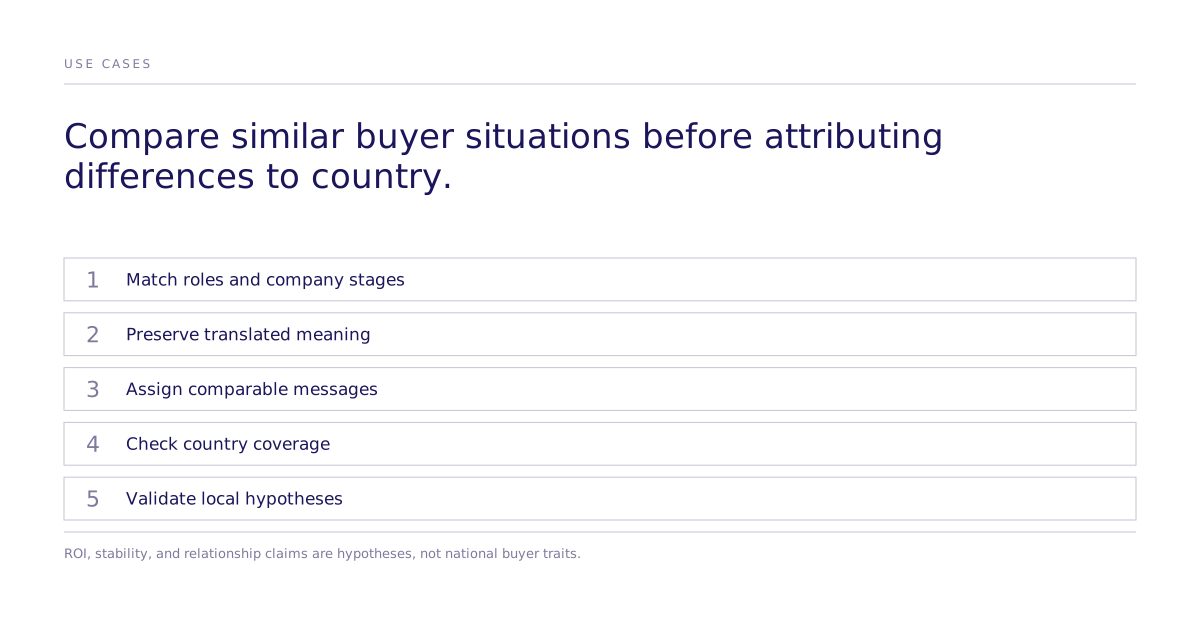
The roles and company stages in this example differ across countries, so a preference difference cannot be attributed to culture alone. Match comparable buying situations or model those differences explicitly. Treat ROI, integration, and relationship framing as hypotheses to test within each market.
What Cultural Framework Grounds the Comparison?
Hofstede’s national-culture framework can suggest questions about country-level patterns. It does not establish which offer an individual buyer will prefer. Ground segment definitions in current local evidence and check the hypothesis in the relevant role and company context.
| Dimension | Country-level concept | Buyer question to investigate |
|---|---|---|
| Power distance | A national-level description of hierarchy | Hypothesis about authority framing; verify with the actual buyer group |
| Individualism vs. collectivism | Relative independence and interdependence within larger groups | Ask how individual and shared responsibilities enter this buying decision |
| Uncertainty avoidance | Tolerance of uncertainty in a society | Investigate how the buyer evaluates ambiguity; do not assign a national average to an individual |
| Long-term vs. short-term orientation | Societal orientation toward adaptation and traditions | Test the actual buyer’s time horizon and evidence requirements |
| Indulgence vs. restraint | Societal norms around gratification and restraint | Check relevance to the product and task before using this dimension |
What This Replaces, and What It Does Not
A prespecified assignment design can estimate effects within a choice task, with uncertainty calculated using a stated method. Generated choices remain modeled outcomes. Local expertise, legal review, distribution access, and observed sales answer additional launch questions; include those evidence gaps before allocating country-level spend.
Confirm coverage and calibration separately for each country and buyer role. A matched human study may confirm, contradict, or leave a simulated result unresolved. Keep the decision question fixed while adapting translation and measurement to preserve meaning.
A Practical Path to Building This Out
Ongoing cross-cultural coverage comes from maintaining segment definitions per target market rather than rebuilding them for every campaign:
- Cultural input per market, sourced from local employees, partners, or consultants who know how business gets done there.
- Local market data: consumer research, prior campaign results, and market-specific signals that keep segment definitions grounded rather than assumed.
- Periodic refresh. Compare segment definitions with current local customer evidence and document changes to the audience, market conditions, and calibration.
Where to Verify This
Review aggregate parameter-rank comparisons for published method scope, applied examples for documented decisions, and how Subconscious works for the study process. Book a walkthrough to scope the alternatives, local evidence, and remaining risk for a particular market entry.
Hofstede’s national-culture framework describes country-level patterns, not deterministic traits of individual buyers.