Customer Insight Platforms: Matching the Evidence Tier to the Decision
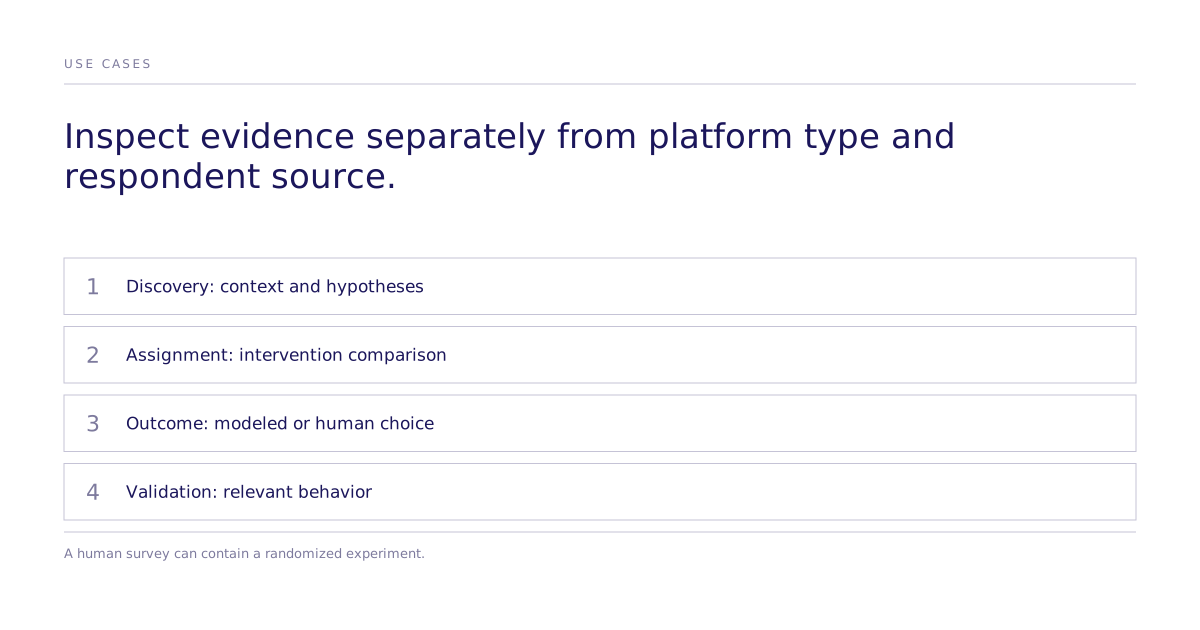
A team evaluating a customer insight platform can start with the next decision: which evidence would support the proposed action? An unassigned exploratory conversation can generate hypotheses. An appropriate assigned comparison can estimate an effect within its task. Either output still needs relevant validation before it supports a market claim.
Limits of unassigned exploration
An unassigned exploratory AI session can surface language and proposed explanations. Without prespecified alternatives, assignment, and analysis, those explanations remain hypotheses. A conversational interface can also present an experimental task; inspect the actual design rather than treating format as proof of identification.
Adoption statistics do not establish whether a specific synthetic study is trustworthy. Compare its disclosed design and human validation with the decision you need to make.
Three kinds of evidence to inspect
Discovery, assigned comparisons, and direct human research can contribute different evidence. They can overlap: a human study may contain a randomized experiment, and generated answers can be collected in a conversational or structured task.
| Tier | What it produces | Defined alternatives compared? | Fits | Main limitation |
|---|---|---|---|---|
| Unassigned open-ended AI conversation | Generated explanations and impressions | Not in this exploratory task | Language and hypothesis generation | Does not estimate an intervention effect or establish which offer will sell |
| Controlled choice experiment | Effects on choices within a defined task; uncertainty requires a specified method | When assignment supports it | Comparing named alternatives before commitment | Synthetic results need relevant validation; task effects are not realized market performance |
| Fielded human study | Responses from recruited participants under a specified instrument | When the design supports it | Decisions requiring human evidence | Recruitment, cost, and timing depend on scope; representativeness and power need checks |
Traditional insight platforms can aggregate historical CRM, support, and behavioral data. Survey modules can also recruit prospects and test hypothetical alternatives. Separate retrospective analytics from assigned research rather than assuming a whole platform cannot evaluate an unpublished offer.
What Does a Discrete-Choice Design Add?
A DCE compares attributes and estimates effects on choices under the task conditions. External validity is a separate question. Quaife and colleagues’ 2018 review identified eight health-choice studies, with six included in meta-analysis; pooled sensitivity was 88%, specificity 34%, and AUC .60. Those uneven results do not validate an LLM audience or guarantee transfer to a new market.
Where the Tiers Actually Get Used
Match recurring research to the question, uncertainty, and cost of error. Illustrative examples:
- A product team runs a 30-minute, open-ended AI persona session before writing sprint specs, purely to sanity-check an assumption before deeper work starts.
- A marketing team tests a campaign message with an open-ended session before a brief is finalized, then escalates to a controlled comparison of the finalists once the brief narrows to two or three real options.
- A strategy team uses a multi-persona panel to surface positioning risk ahead of a quarterly review, then commissions a controlled experiment only where the review surfaces a genuine fork in direction.
Matching Tier to Stakes
The right tier follows the cost of being wrong, not convenience:
- Exploratory questions can use open-ended conversations to generate language and hypotheses; validate any factual audience claim separately.
- Budget or engineering decisions need evidence matched to the proposed action. If the claim concerns an intervention effect, examine its identification design, outcome, uncertainty, and external validity.
- Decisions high-stakes enough to require recruited human validation before shipping need a path to a fully fielded human study.
How Does Subconscious Fit the Middle Tier?
Subconscious structures comparisons of defined alternatives using generated choices. Specify the effect to estimate, assignment, modeled audience, and supported uncertainty output for the study. A choice-task effect does not establish purchases or engineering value without relevant external evidence.
When direct audience evidence is needed, scope a matched human study and confirm recruitment, measurement, coverage, and fieldwork arrangements separately. Review aggregate method comparisons for their published scope and how the study process works for the design questions.
What This Method Does Not Cover
Combine study results with customer interviews, CRM and support records, usability observations, and judgment about the decision’s downside. Those sources answer different questions; the choice experiment does not replace them.
Keep model coverage, recruited sample size, and actual customer activity separate. Inspect whether the proposed platform can supply the data and monitoring required for this decision rather than inferring those capabilities from a large audience definition.
Ready to see which tier fits an upcoming decision? Book time to walk through it, or review case evidence from completed studies.