Customer Simulations for Hiring Assessments
A conversation about past work gives limited evidence of how a candidate will handle a new customer problem. A job-relevant work sample can add evidence about the candidate’s response to a defined scenario.
A simulated customer interaction can serve as a hiring work sample when every candidate receives comparable conditions and a defined rubric. This is a methodological analogy to controlled comparisons, not a claim that Subconscious provides a validated hiring product. Keep structured interviews, references, accommodations, legal review, and a human decision.
Why do hiring assessments vary?
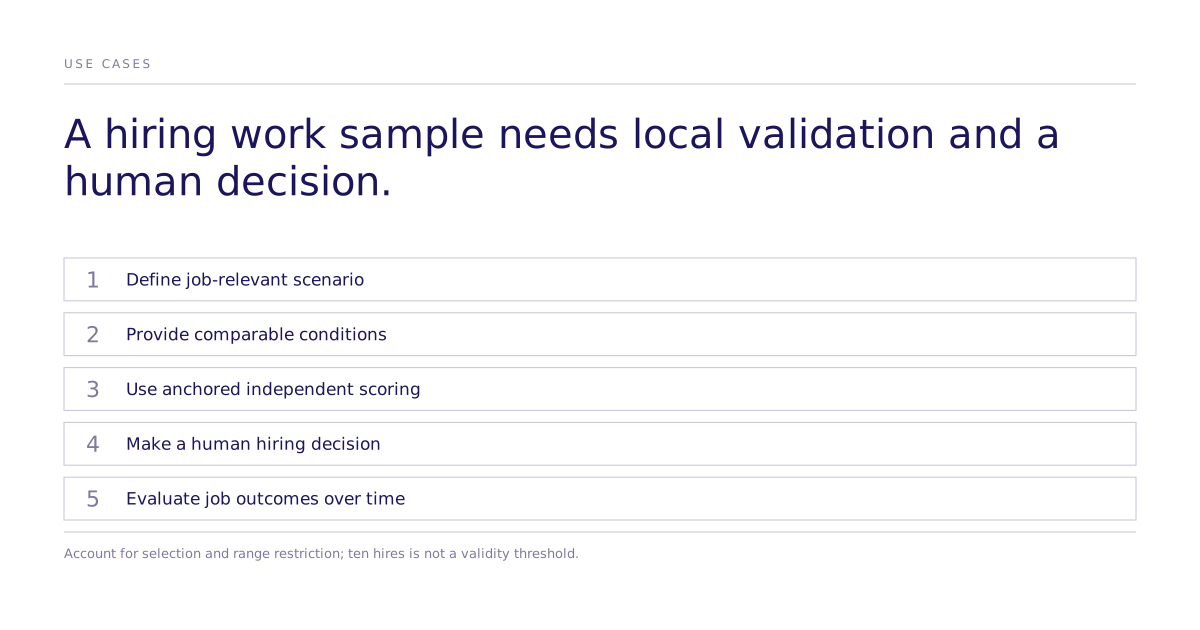
A hiring work sample needs evidence that its task and scoring fit the role. U.S. EEOC guidance on employment tests discusses work samples, job relevance, validation, and discrimination risks. Apply the rules relevant to the hiring location with qualified advice; a consistent scenario alone does not establish validity or fairness.
Three sources of variation make customer-facing assessment difficult:
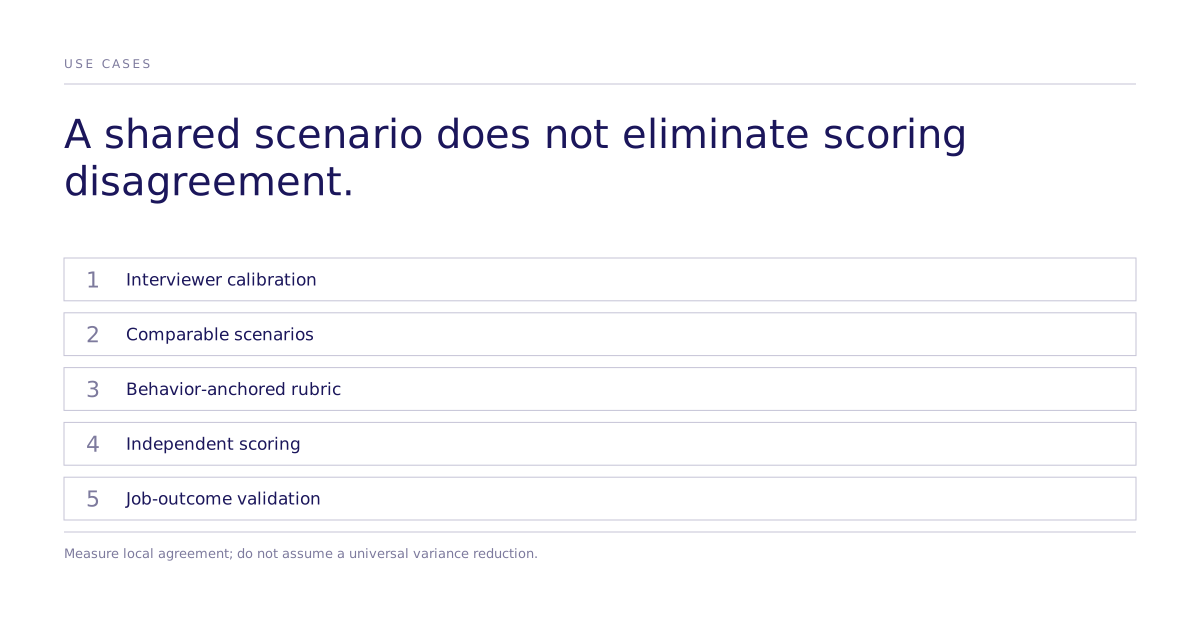
Interviewer variation. Interviewers can disagree about the same response. Use behavior-anchored rubrics, independent scoring, and calibration examples; measure local agreement instead of assuming a universal variance percentage.
Scenario inconsistency. A roleplay changes as the evaluator warms up, tires, or adjusts after the first three candidates. Candidate eight and candidate ten may face different levels of difficulty.
Self-presentation. A candidate can rehearse stories about difficult customers. Recalling one moment is not the same as managing that moment in real time.
Document scenario changes and compare independent reviewer scores. A standardized work sample can reduce differences in what candidates encounter, but the scoring still needs agreement checks and the assessment still needs job-relevance and fairness review.
What does a controlled simulation workflow involve?
Define the role and one representative scenario. A sales candidate might run discovery with a skeptical buyer. A customer-success candidate might handle a renewal conversation after two promised features were delayed.
Give candidates comparable preparation and conditions, with accommodations addressed in advance. Set the conversation length during the pilot, capture a transcript, and score only the behaviors defined before assessment begins.
The candidate should know that the customer is simulated and that the exercise is assessed. Human reviewers should inspect the transcript and make the decision. Technical failures need a retry rule. Accommodations and working-language needs must be part of the design.
Four roles where the method can be useful
Sales
An illustrative exercise gives the candidate a 5-minute product brief and 30 minutes with a skeptical buyer. Observe whether the candidate discovers the problem before pitching, handles an early price question, and confirms a next step. Adjust the allocation during piloting and apply the resulting conditions consistently.
Customer success
A renewal or escalation work sample can reveal how a candidate approaches the scenario. Compare that evidence with structured interviews and later job performance; a short exercise has not been shown here to outperform a longer assessment.
Customer service
A complaint or troubleshooting scenario can test composure, diagnostic questions, and resolution structure under pressure.
Account management
A multi-stakeholder scenario can test whether the candidate can navigate an existing account rather than simply maintain a friendly conversation.
Five behaviors to inspect
Observe job-relevant behaviors in the exercise:
- real-time problem solving when the customer raises an unexpected concern;
- empathy after two minutes of sustained frustration;
- technical depth when a buyer asks about implementation;
- communication clarity under time pressure;
- recovery after a mistake.
The simplest scorecard has three dimensions: process, substance, and presence. A more detailed sales scorecard might rate opening, discovery, objection handling, value articulation, and next steps from 1-5.
Measure the time needed for careful scoring during the pilot. Plan review capacity for the actual transcript length and rubric rather than applying a universal minutes-per-candidate estimate.
Why should the hiring decision stay human?
Hiring uses sensitive personal data and can carry legal duties that vary by place and role. Consult qualified counsel before deploying an automated or simulated assessment. Do not use an automatically generated score as the sole decision signal.
Use one signal among several: a controlled simulation, structured interviews, relevant references, and a human decision. Review score distributions across groups, document accommodations, limit access to transcripts, and follow the organization's retention policy.
Start with one role
Pilot one role and scenario with a preset rubric. Validate against job-relevant outcomes over an adequate period and sample, accounting for the fact that only hired candidates have later performance data. Investigate disagreement and range restriction before using the score as a hiring cutoff. Subconscious’s case studies concern business decisions rather than hiring validity.
Use the pilot to examine job relevance, scoring agreement, group differences, and the relationship to later outcomes. Consistency makes comparisons easier to interpret; it does not establish fairness or a performance-prediction claim by itself.