Testing Brand Ambassadors Before Signing a Contract
Before signing an ambassador contract, compare audience fit, credibility, and the proposed claims. A randomized choice task can estimate effects on stated choices under its conditions; realized purchase and reputational effects need further evidence.
- Perceived endorser fit is one hypothesis to examine alongside credibility, audience relevance, exposure context, and the actual claim. A favorable attitude is a different endpoint from a purchase.
- Ambassador selection needs evidence about audience fit, claim credibility, reach, and downstream outcomes. A skewed return distribution alone would not identify which selection criterion caused performance.
- A February 2026 study of 310 Lithuanian social-media users examines associations involving celebrity and influencer credibility, parasocial relationships, and brand equity. Its cross-sectional models do not identify causal effects on purchases.
- AB InBev’s February 2024 results release reports declining U.S. revenue and Bud Light volumes in 2023. Those business results illustrate downside; they do not identify the company’s ambassador-selection process or prove that a pretest would have predicted the outcome.
- General synthetic choice validation is distinct from ambassador-specific evidence. Require a matched audience and outcome before using a modeled endorsement effect to select a partner.
What does "diagnosis over vibes" mean for ambassador selection?
A survey can include randomized endorser attributes and estimate their effect on stated choices. Human stated choice remains hypothetical; a synthetic task estimates modeled choices. Distinguish that effect from actual purchases and from explanations inferred through correlated attitudes.
Why does a fit judgment need further evidence?
An image-fit judgment, social listening, and an unassigned attitude survey can suggest endorsement hypotheses. They do not identify a purchase effect by themselves. A survey can also embed randomized endorser alternatives. Inspect assignment and the measured outcome before treating any of these tools as causal evidence.
What Bud Light reporting shows about business risk
Public reporting about a controversial partnership documents business risk, but it does not establish the company’s internal research process or show that a pretest would have predicted the backlash. A prospective study can compare defined endorsement alternatives; reputational shocks and public amplification still require judgment and monitoring.
What do celebrity and influencer studies actually measure?
A study of 430 Turkish consumers compared TV and online endorsement contexts, examining attitudes, recall, and purchase intentions. It reported greater advertising effectiveness for celebrity endorsements in the TV context and no statistically significant online difference; the latter does not demonstrate equal effects. The Lithuanian cross-sectional study examined credibility and parasocial relationships in models of brand equity. These associations can suggest hypotheses for your audience; they do not identify causal purchases.
| Dimension | Celebrity endorsement | Influencer endorsement |
|---|---|---|
| Associated constructs | Credibility and brand equity in the Lithuanian cross-sectional model | Credibility, parasocial relationships, and brand equity in that model |
| Media context | A study of 430 Turkish consumers compared TV and online advertising | The reported online comparison did not find a statistically significant difference; that is not proof of identical effects |
| Questions to test | Which claims does the target audience find credible in the planned exposure context? | Does perceived familiarity change responses to the same claims in that context? |
| Evidence still needed | Relevant audience, exposure, and outcome validation for the proposed contract | Relevant audience, exposure, and outcome validation for the proposed contract |
What does a randomized experiment for ambassador selection look like?
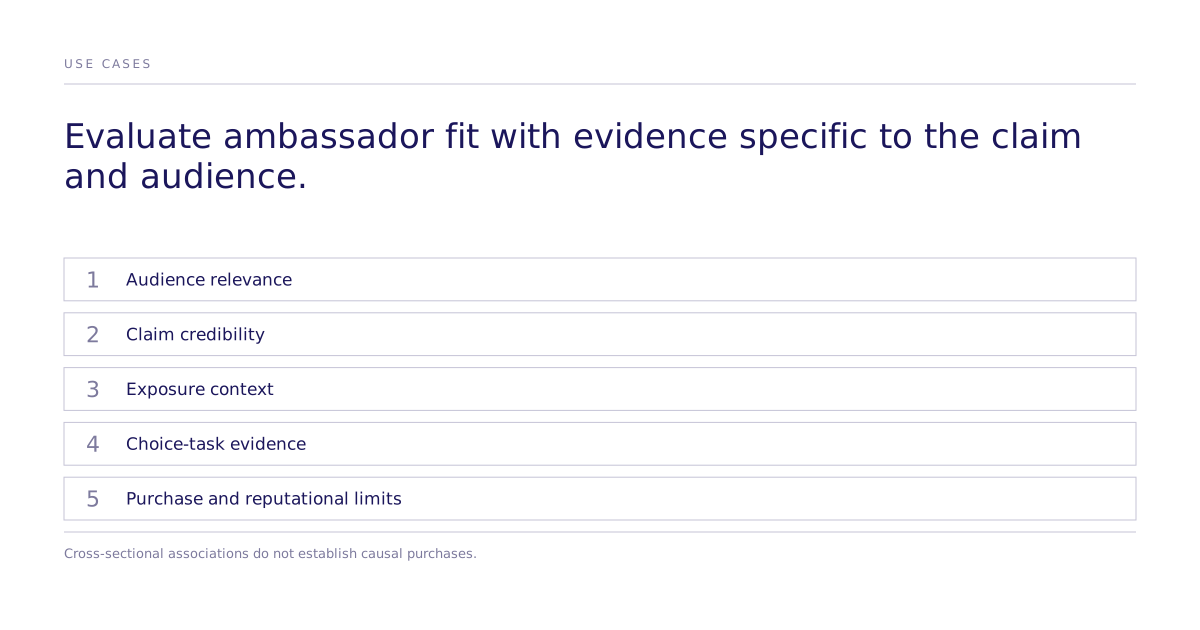
A proposed choice task can present ambassador alternatives with assigned attributes, category framing, and relevant competing offers. Define whether the outcome is a generated choice, human stated choice, or observed behavior. Rating tasks can also contain randomized interventions; response format does not determine identification. Mixed logit can represent preference heterogeneity, while ICLV can link indicator-based latent constructs to choices. Those models analyze the data; assignment and assumptions support the effect claim, and a latent association does not establish a causal mechanism.
How reliable is a simulated test before you sign?
The July 2026 causal-fidelity working paper (not peer reviewed) compares ranks of estimated choice parameters in replicated studies. It does not establish an ambassador-selection accuracy rate. Validate the actual claim, target audience, and exposure context.
What's the smallest test to run before the next ambassador contract?
Start with the ambassadors actually under consideration and the claim the contract would fund. Define alternatives, audience, exposure, and outcome; choose the study’s assignment and uncertainty method before reading results. An uncertain or small task effect may justify further research rather than selecting a winner. Check any proposed partner against legal, reputational, and purchase evidence relevant to the commitment. Review aggregate method comparisons for their scope or meet the team to define the evidence gap.