Feature Naming Is a Testable Decision, Not a Team Vote
A product or product-marketing leader choosing a feature name needs evidence of how the intended audience understands the candidates before the name locks into the UI, docs, and sales decks. Compare correct identification alongside category-fit, differentiation, and memorability, then validate finalists with customers in the relevant product context.
Why the decision matters
A feature name lives in the UI, the changelog, the sales deck, the help center, and customer conversations. Changing it can require updates to documentation, onboarding, and sales material. Test whether new users understand the name before committing to those dependencies.
Plan customer access and comprehension research alongside the release schedule. If the naming decision arrives before recruitment and analysis are arranged, the team may have little evidence beyond its own preferences.
What causes teams to pick a bad feature name?
Internal familiarity can hide naming ambiguity. The people who wrote the feature spec know what it does; a customer encountering a word in a navigation bar may lack that context. A comprehension task checks what a first-time viewer infers from the name alone. UXArmy’s concept-testing guide describes ways to compare concepts with a defined audience.
Use four axes to organize the naming decision:
| Axis | What it measures | Failure mode if ignored |
|---|---|---|
| Comprehension | Whether a new user can correctly guess what the feature does from the name alone | Support tickets asking what the feature is for |
| Category-fit | Whether the name signals the right mental category (a "Reports" name versus an "Insights" name) | Users expect the wrong kind of feature |
| Differentiation | Whether the name is distinguishable from similar-sounding features already in the product | Confusion between adjacent features in the nav |
| Memorability | Whether a customer can recall the name later, in conversation or in a support ticket | Customers can't find or reference the feature again |
A name can win on memorability and lose badly on comprehension, a tradeoff a single popularity vote hides.
Evidence
Separate candidate generation from evaluation: produce a working set, then compare it against a defined audience and rubric. SmashBrand’s product-naming framework discusses objectives, naming options, and consumer testing; it does not establish which naming style will win for your feature.
In a hypothetical comparison, a metaphorical name may score below a descriptive alternative on correct feature identification. Measure the interpretations rather than assuming the result: users might connect the metaphor to another function, while a descriptive name might be too broad. Inspect what each candidate communicates before choosing finalists.
Check both correct identification and variation across interpretations. Low variance can mean everyone makes the same wrong guess. Treat ambiguity as a reason to investigate with users rather than assuming it is the strongest predictor of tooltip need.
A name that is clear and inoffensive in one language can fail category-fit, or, less obviously, translate cleanly but lose its category signal in another market.
Options and comparison
| Approach | What it tests | Where it's weak |
|---|---|---|
| Internal team vote | Whether the team likes the name | Blind to the curse of knowledge; no comprehension signal from an outside perspective |
| Recruited customer interviews | Comprehension, category-fit, and emotional resonance from actual customers | Require customer access, a discussion guide, and time for recruitment and analysis |
| Assigned live comparison of candidate names | Usage and comprehension within the tested interface and audience | Requires an appropriate assignment design and a rollout plan that accounts for confusion or disruption |
| Controlled comparison before launch | Differences in comprehension and category-fit across assigned candidate names | Results depend on the task and audience; modeled comprehension also needs relevant human validation |
What is the recommended process for naming a feature?
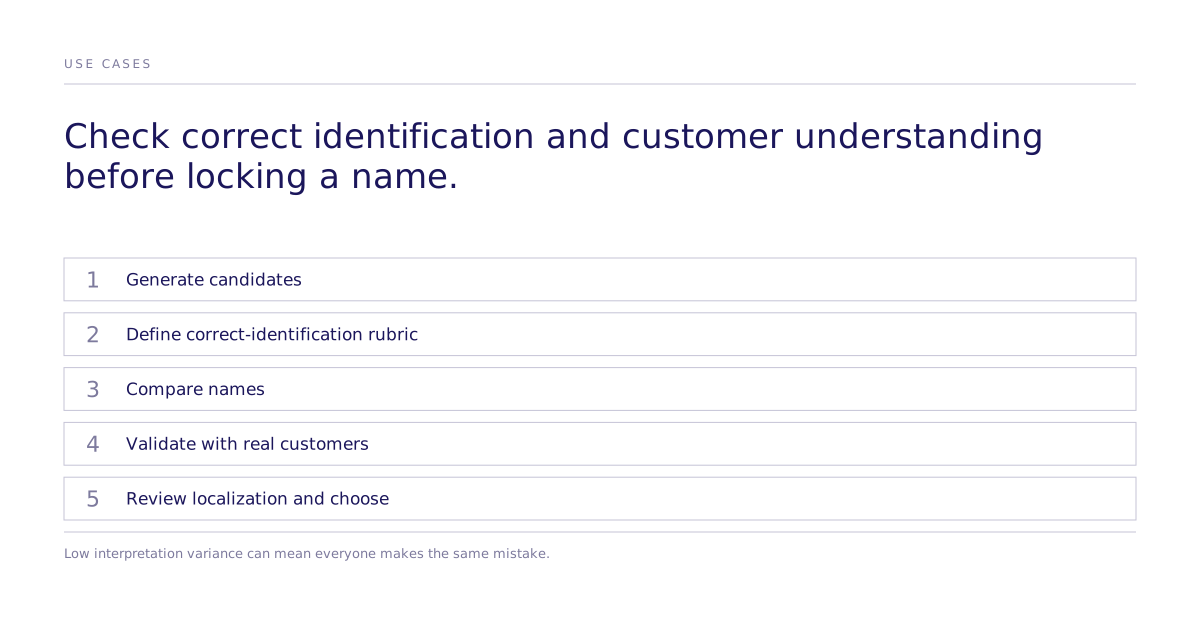
Define a scoring rubric for correct feature identification, then assign candidate names under comparable conditions. Subconscious can structure a simulated comparison, but its comprehension score is modeled. Specify uncertainty and validate finalists with real customers before locking the name.
A workable process:
- Generate a working set of candidate names spanning descriptive, metaphorical, proper-noun, and action-led patterns. Otherwise the comparison ends up testing several variations on the same idea.
- Define the population the comparison should represent: new prospects, recent signups, or existing customers, depending on who encounters the name first.
- Use the rubric to shortlist candidates. Inspect correct-identification rates, uncertainty, and the range of interpretations. Tight agreement can still reflect a shared wrong guess.
- Test finalists with actual customers before choosing. Review aggregate method evidence within its published scope and how Subconscious structures a study to plan the comparison.
For each market, verify language, role coverage, and calibration. Keep the same intended meaning while adapting the test to local terminology. Model scale alone does not show that a name is understood by buyers in every country.
What are the limitations of this method?
Simulated comprehension scores do not observe customer understanding. A controlled human task can provide human evidence, but a task conducted outside the product may still miss navigation context, brand associations, or localization problems. Check those conditions before choosing the name.
Scope a matched human comparison with recruitment and measurement arrangements confirmed in advance. Preserve the naming question while adapting the design to actual customers. The human results may support, contradict, or leave the simulated comparison unresolved.
Adjacent questions
Why not just pick the name the team likes?
Because the team already understands the feature. That's not evidence of how a new customer reads the name cold.
Does this replace talking to customers?
No. Use a comparison to narrow candidates, then validate finalists with real customers. Preserve rejected alternatives for spot checks when a model may have misunderstood the category.
What if the name needs to work in more than one market?
Run the same comparison against a population defined for each target market. A name that is fine in one language can carry the wrong category signal, or an embarrassing meaning, in another.
Book a naming-study discussion around your candidate names, target users, and validation needs, or review applied examples.