How Brand Strategists Choose Which Campaign Route to Greenlight
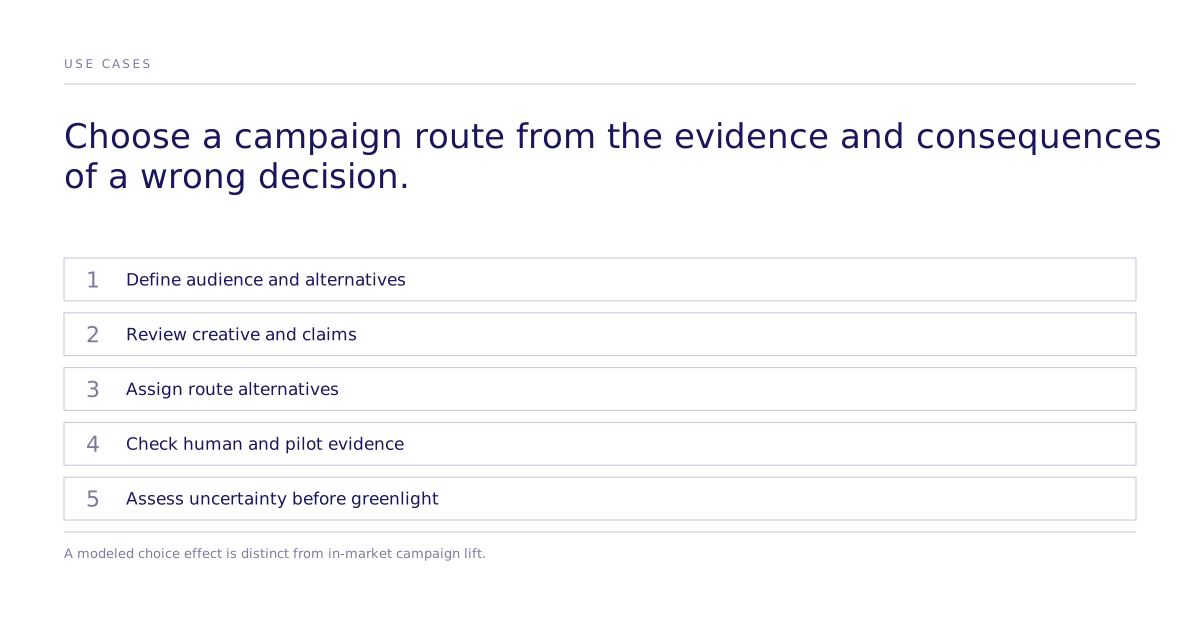
A campaign route can win internal debate and still fail to move the intended audience. Before locking production and media budget, define the response the route should change and the evidence needed to support that choice.
Why This Decision Gets Made on Taste
Committing production and media budget behind a campaign route is expensive to reverse. When that commitment rests mostly on internal taste and late-stage stakeholder opinion, the strategist inherits two risks: the route never resonated with the target audience, and there is no defensible evidence trail when someone asks why it was chosen.
The current BLS outlook forecasts employment growth for market research analysts and marketing specialists over 2025–2035. It does not measure which tasks AI performs reliably. A strategist still needs to define the decision and interpret the evidence.
[^bls]: Market Research Analysts: Occupational Outlook Handbook, U.S. Bureau of Labor Statistics.
What Does a Pre-Production Test Need to Answer?
A useful pre-production test does not ask "does this concept feel right." It answers a narrower question: given a defined audience segment, which campaign route or message causes a measurably different response, and how confident can the team be in that difference.
That requires four things before any test starts:
- The decision the test is meant to inform, stated as a sentence: which route gets budget.
- The audience segment, defined by who they are, their current behavior, and their alternatives, not a generic demographic label.
- The candidate routes or messages, treated as an explicit comparison set rather than one idea tested in isolation.
- A stated confidence bar for when the result is strong enough to act on.
Comparing the Ways Teams Test a Route Before Production
Different methods answer different parts of this question; none replaces the others.
| Method | What it tells you | Main risk | Best use |
|---|---|---|---|
| Internal review and stakeholder opinion | Whether the team and leadership like the route | No connection to how the target audience actually responds | Early filtering of clearly weak ideas |
| Open-ended exploratory feedback tools | Reactions, objections, and possible confusion points | Unstructured feedback alone does not identify an intervention effect; alternatives, assignment, and measurement depend on the design | Generating hypotheses and refining stimuli for a defined comparison |
| Controlled route comparison | Effects on the defined choice task | Synthetic-to-human transfer, audience coverage, stimulus fidelity, and measurement limits | Informing a greenlight when relevant validation supports it |
| Limited in-market pilot | Actual engagement under assigned conditions | Pilot cost, power, and differences from full rollout | Testing before committing the full production or media budget |
Subconscious can structure a comparison of candidate campaign routes across a specified audience. Define the endpoint as a modeled choice or stated response, and check calibration for that audience. Research and case studies document scope; actual campaign lift needs in-market evidence.
What Is the Practical Advantage of This Approach?
An explicit audience and comparison make the route-selection rationale easier to inspect. Exploratory feedback can also compare alternatives. An effect claim requires appropriate assignment and measurement, while a spending decision also depends on calibration, uncertainty, and relevant market evidence.
Scope a matched human study when relevant validation is missing. Preserve the campaign question while adapting recruitment, stimuli, measurement, and power to actual participants. A stated human response remains a different endpoint from in-market campaign lift.
Where Does This Method Stop?
A pre-production task may omit client context, execution quality, competitive activity, or the actual media environment. Use discovery and creative review for those gaps, and check campaign performance with relevant live evidence. A task result supports only the alternatives and outcome its design represents.
Putting It Into Practice
Before the next campaign route decision reaches a room full of opinions, write the decision as one sentence, define the audience segment precisely, and list the candidate routes as a real comparison set. Run the controlled test against that comparison before committing production and media budget, not after. How Subconscious works covers how to set up that comparison, and a demo walks through applying it to a specific campaign decision.