How to Choose an Email Subject Line Before You Commit List Volume
Choose the subject line and paired preheader around a defined audience and campaign goal. A modeled comparison can help select candidates for a live test, but actual clicks, replies, or conversions require recipient evidence.
Why the wrong subject line is expensive
An underperforming send can consume a contact opportunity and delay the next comparison. A small list may provide limited information about modest differences. Plan the endpoint, sample size, and decision rule before selecting variants.
Why does a live send-test alone struggle with this decision?
A live randomized send can measure recipient outcomes. Decide whether it should be the first comparison or follow a preliminary review or modeled screen:
- It needs sufficient information. Plan sample size for the chosen click, reply, or conversion outcome. Apple Mail Privacy Protection prevents senders from reliably observing whether protected messages were opened, so opens require careful interpretation.
- More arms require more information. Multi-arm tests are possible. Account for sample size, expected effect, variance, and multiple comparisons before choosing the number of variants.
- Contact has a cost. Each arm reaches actual recipients. Account for contact limits, unsubscribes, and complaint monitoring in the sending plan.
How can preliminary screening inform a live test?
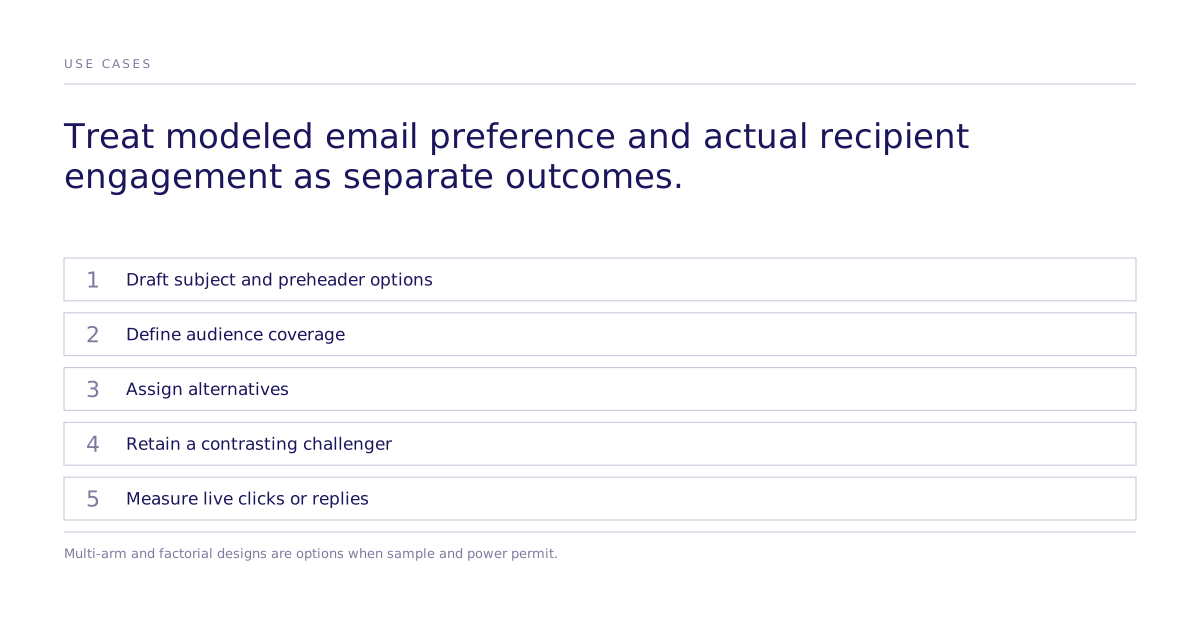
A modeled screen is one proposed way to select candidates for live testing. Keep a contrasting challenger and audit some rejected variants to check for false negatives. Improved clicks, replies, or conversions need an appropriately assigned live comparison; selecting the top modeled score does not establish that improvement.
Subconscious can compare subject-line and preheader alternatives in a modeled choice task. Confirm audience calibration, then use a matched human study or live send to check transfer. Preference and self-reported reasons do not establish actual opening or reply behavior.
Options for testing a subject line
| Method | Variants you can realistically compare | List volume required | Where the result comes from |
|---|---|---|---|
| Team judgment (Slack thread, gut pick) | Whatever the team happens to write and like | None | Opinion, not observed behavior |
| Live randomized send | Two or more arms when information and power permit | Enough delivered messages for the chosen endpoint | Actual recipient clicks, replies, or conversions |
| Modeled comparison followed by an assigned live send | A working set, with calibration and review considered before shortlisting | No recipient send in the modeled step; the live comparison still needs sufficient information | Generated task responses first, actual recipient outcomes in the live test |
A practical decision process
- Generate a wider set of candidate subject lines and preheaders than feels comfortable.
- Describe the relevant audience and context. Include role, company stage, tooling, and campaign purpose where relevant, then check whether the model is calibrated for that audience. Detail alone does not establish fidelity.
- Compare the candidates in a defined task. Record modeled preference and proposed interpretations, including expected email contents and reasons a line might be skipped. Check those hypotheses rather than treating generated explanations as actual recipient reasoning.
- Narrow to a small number of strongest candidates, refine the winning pattern, and take one structurally different challenger forward as well.
- Confirm with a live send.
Does this apply to B2C as well as B2B?
The process can apply to B2C or B2B when the audience and campaign context are represented. Check important segments separately; do not assume every consumer decision is more emotional than every business decision.
Limitations and failure conditions
- Deliverability is a separate measurement. A modeled preference task does not observe inbox placement. Scope a dedicated placement check and monitor actual delivery conditions.
- Brand voice is a human call. A variant that scores best on open intent can still be off-brand. Have a person check the top candidates against brand voice guidance before shipping.
- Simulated comparison does not replace a live send. It informs which variants deserve real list volume; it does not confirm deliverability, sender reputation, or actual recipient behavior on its own.
Adjacent questions
What about subject lines with personalization or merge tags? Test the merge-tag text as it will actually render for the recipient, ideally several sample versions with realistic name, company, and trigger context, so a forced-feeling personalization shows up before the send.
Should the preheader be tested separately? Test the rendered pair for final selection. Use a factorial assignment when estimating separate subject, preheader, and interaction effects would change the decision.
Is there a list size below which this does not matter? The useful information depends on sample size, effect size, variance, and the chosen endpoint. A small list can leave differences unresolved. Preliminary screening may help choose candidates when calibration fits, but it does not repair inadequate live-test power.
Teams that want to see how this fits alongside other testing programs can review how Subconscious structures a study, look at case evidence, read more on the underlying research, or book time to walk through a specific campaign.