How to Evaluate Customer Simulation Platforms in 2026
When evaluating a customer simulation platform, request relevant human or observed-outcome validation, the exact metric and study set, and the method’s unsuccessful cases. Realistic personas and a headline replication rate do not establish validity for a new decision.
Without that evidence, treat simulated output as a hypothesis to investigate, not a basis for a launch, pricing, or messaging decision. A polished response can look convincing while untested against what people choose.
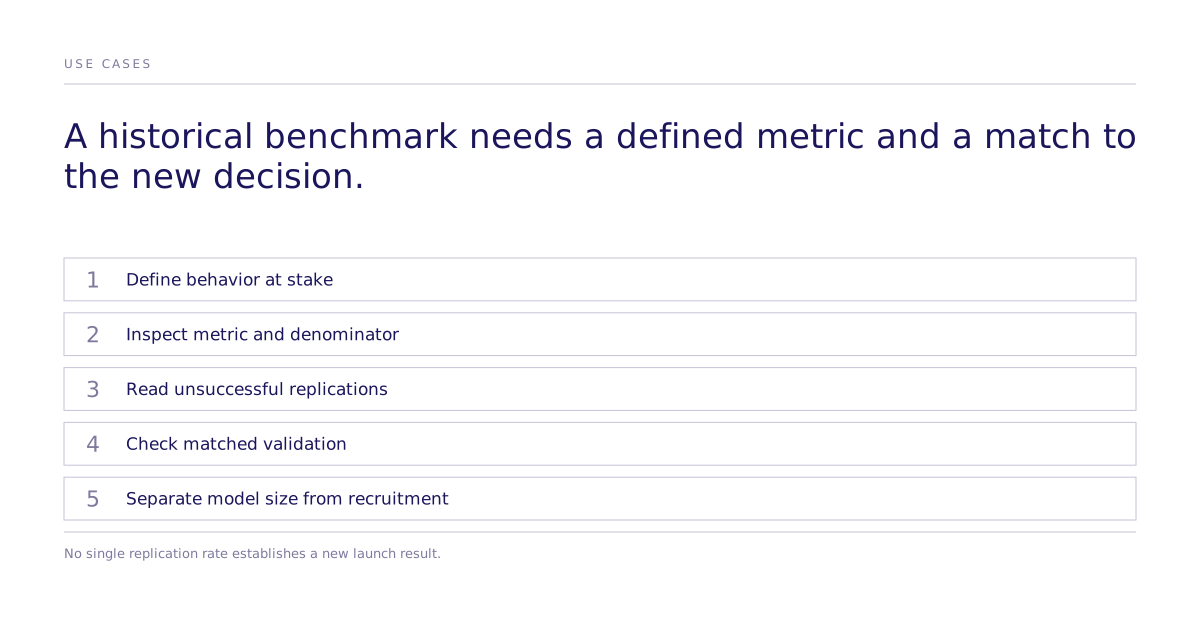
What should you start with when choosing a platform?
A buyer should define the action before comparing platforms. “Learn what customers think” is a topic. “Determine whether message B increases preference over message A for this buyer group” is a decision.
Stated principles and contextual choices can diverge. Gu, Wang, and Han’s 2025 preprint compares LLM answers to general-principle prompts with forced binary choices in contextualized scenarios. Its use of “revealed preference” refers to model choices, not observed human purchases.
"a minor change in prompt format can often pivot the preferred choice"
Gu, Wang, and Han, May 2025 arXiv preprint (source)
Open-ended responses can propose language, objections, and hypotheses. They can also be collected under an assigned design. For an intervention-effect claim, inspect assignment, outcome, assumptions, and relevant validation independently of the response format.
What should you require instead of a confidence claim?
Require the exact replication metric: direction agreement, parameter correlation, magnitude error, and interval coverage answer different questions. A useful report states the denominator, studies included, failures, and tested populations.
This is different from a general accuracy score, a realistic transcript, or a claim that a panel resembles its target audience.
| Evidence artifact | What it can support | What it cannot establish |
|---|---|---|
| Plausible simulated dialogue | Early exploration of language and hypotheses | Which action will change customer choice |
| An accuracy score without a defined replication method | A claim to examine during diligence | Reproduction of real human study outcomes |
| Study-level replication rate with disclosed method and limitations | Evidence that the simulation has reproduced tested human results | Guaranteed performance for an untested launch |
| A comparable real-human validation study | A direct check of the simulated result for the same causal question | Automatic proof of future market performance |
Ask the platform provider to show the evidence, not merely summarize it. The answer should make unsuccessful reproductions and known method limits visible. If the denominator is unclear, the headline rate is not decision-grade.
Apply the filter to the decision in front of you
The same evidence standard should produce a different experiment for each business question.
- Launch decisions: compare a defined launch treatment with a defined alternative for a named buyer population and outcome. Do not accept broad enthusiasm as a substitute for the comparison.
- Pricing decisions: test specific price presentations or offers against each other. Do not assume that a simulation automatically optimizes pricing or produces substitution and cannibalization matrices.
- Messaging decisions: compare concrete messages using a specified outcome. Theme summaries can propose interpretations to investigate; they do not establish the causal mechanism behind a response.
Request current setup and execution estimates for the proposed study. Model size and fast execution do not establish fidelity or delivery readiness.
Why should audience scale and human validation be read separately?
Audience reach, simulated experiment size, and recruited human participant count describe different parts of a study. They should never be combined into one scale claim.
Check modeled coverage of the relevant buyer population separately from recruited participant count. Require calibration evidence for the actual question; graph size alone does not establish precision.
Keeping those quantities separate lets a buyer ask a clean question at each stage: Is the target population defined correctly? Is the simulated experiment designed around the intended action? Does a comparable study with real participants reproduce the result?
Put Subconscious through the same test
Subconscious’s July 2026 causal-fidelity working paper, not peer reviewed reports mean Spearman rank correlation on estimated choice parameters. Read the leaderboard using that metric, rather than as a fraction of studies reproducing both direction and outcome.
A proposed simulated comparison needs defined alternatives, population, and measurement, plus relevant calibration and validation. Inspect unsuccessful cases as well as favorable results. Its modeled task outcome does not replace usability observations, clinical endpoints, or an actual launch measure where those are required.
Confirm which exploratory and experimental workflows the proposed engagement supports and request its current deliverables. Pricing optimization, substitution and cannibalization estimates, and decision recommendations require their own specified methods and evidence; do not infer them from a general validation study.
Make the evidence standard part of procurement
Before committing budget, require every platform under consideration to answer the same questions:
- What exact human studies form the replication set?
- How is replication accuracy defined?
- Which direction and outcome must the simulation reproduce?
- Which results failed to reproduce?
- Which populations, behaviors, and decision types remain untested?
- How will independent human or observed-outcome evidence be obtained for the proposed question, with recruitment, measurement, and design adaptations confirmed?
Use how we work to inspect the study path. If your decision is already framed as defined alternatives, a target population, and a measurable behavior, request a demo to evaluate the method against that decision.