How to Evaluate Synthetic-Panel Tools Before You Commit Budget
An insights, marketing, or product-research leader evaluating synthetic panels needs to match the pending decision to a study design and validation plan. Inspect sampling, assignment, measurement, uncertainty, and governance separately from persona count or interface style.
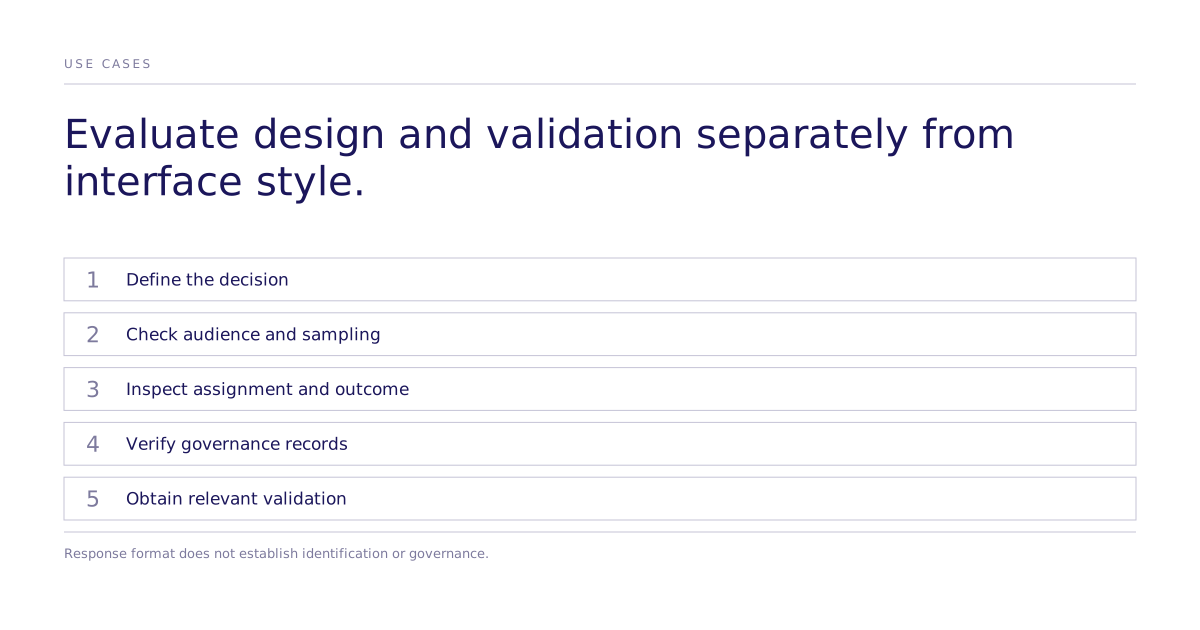
Why is persona count the wrong shortlist criterion?
Synthetic tools differ in task design and validation. Inspect the current vendor’s assignment plan, defined alternatives, endpoint, and human baseline. A conversation interface does not establish that a platform lacks controlled experiments.
Before signing a contract, specify what a pricing change, claim-substantiation study, or launch decision needs to establish. Check whether the proposed study supplies that evidence and what remains unresolved.
The architecture question underneath the marketing language
A chat interface can collect free-text or rated responses under different sampling and assignment plans. If stimuli, question framing, or population composition vary without suitable controls, response differences may mix several explanations. Inspect the actual design rather than inferring those controls from the interface.
A controlled experiment assigns alternatives to comparable respondents and defines an outcome. Check order, carryover, respondent dependence, and assignment assumptions; holding wording and population constant alone does not identify an effect.
What the underlying research method has to answer for
Human health-choice reviews compare DCE predictions with later choices and find uneven external validity across designs and contexts (Zhang and colleagues’ review; Quaife and colleagues’ earlier review). These human studies do not validate LLM respondents or a vendor’s new commercial task.
Zhang and colleagues report pooled sensitivity of 89% (95% CI 77–95; I² 97%), specificity of 52% (95% CI 32–72; I² 95%), and an SROC AUC of 0.81 (95% CI 0.77–0.84) in ten meta-analyzed human health-choice studies. Sensitivity and specificity measure different prediction outcomes; the high heterogeneity limits generalization.
Read these results as external-validity evidence for the included human health tasks, with their study settings and analysis assumptions.
Review Subconscious’s published aggregate method comparisons using their defined metric and study set. Request the equivalent source records from any vendor, including unsuccessful cases and relevance to the proposed task.
Three approaches, one table
These three approaches are a proposed procurement framework. A platform or study can combine them:
| Approach | What it answers | Output | Governance fit |
|---|---|---|---|
| Open-ended responses | Themes, objections, and interpretations under the chosen task | Human or generated free-text and rated responses | Verify logging, access controls, consent, and traceability in the actual implementation |
| Assigned discrete-choice task | Choice differences between the specified alternatives under its identification assumptions | Estimated task effects and supported uncertainty | Verify design records, calibration, relevant validation, and governance |
| Hybrid synthetic-plus-human pipeline | Questions examined through modeled and human stages | Stage-specific estimates or exploratory findings | Evidential strength depends on both stages’ design, calibration, transfer limits, and actual governance |
Four questions before any vendor conversation
- What must the study establish? Exploration, descriptive prevalence, a prediction, and an intervention effect require different evidence. Define the endpoint and decision before choosing a tool.
- What population does the decision depend on? Specify relevant behavior, demographics, roles, industry, and buying context. Inspect sampling and comparability across alternatives; population labels alone do not establish coverage.
- Who owns the evaluation? A single analyst running exploratory panels has different requirements than an insights team that needs role-based access, procurement review, and a documented audit trail for every result.
- How will the result be validated? Ask for the benchmark, the human baseline it was measured against, and the scope where the method is known to fail. A vendor that cannot answer this is not ready for a decision that needs defensible evidence.
Running a pilot instead of trusting a demo
Pilot against a relevant known outcome or arrange independent human measurement when the new decision has no ground truth yet. Scope the schedule and budget directly. Assess calibration, uncertainty, delivery, and governance rather than assuming a universal two-week pilot.
How does Subconscious approach the same evaluation?
Subconscious structures defined alternatives and outcomes in assigned simulated comparisons. Specify the estimator and uncertainty method during scoping; a modeled effect still needs relevant validation.
Confirm audience coverage for the proposed test and scope matched human evidence when needed. A modeled population is distinct from a recruited panel; preserve the decision question while adapting recruitment and measurement.
What does a causal comparison not settle?
An assigned comparison does not establish that a vendor’s implementation, contract, or data handling meets procurement requirements. Verify logging, access controls, traceability, and applicable review requirements directly, including with Subconscious. Governance depends on the actual implementation, not whether the outcome is free-text or a choice.
Real-human validation is a distinct claim from simulated audience reach, and neither one is automatic proof of market performance. A causal experiment on a simulated population estimates a likely effect; it does not replace the pilot, the human confirmation study, or the buyer's own judgment about whether the evidence is strong enough for the decision at hand.
Deciding what to evaluate first
Define the required inference before comparing vendors. Inspect design, validation, uncertainty, and governance against that requirement. Review how Subconscious structures a study, or scope the proposed decision.