How Independent Strategists Back a Recommendation With Evidence
A solo strategist or fractional CMO is judged against agencies with full research departments, without the headcount to match them. The gap shows up at the exact moment a client asks "how do you know?"
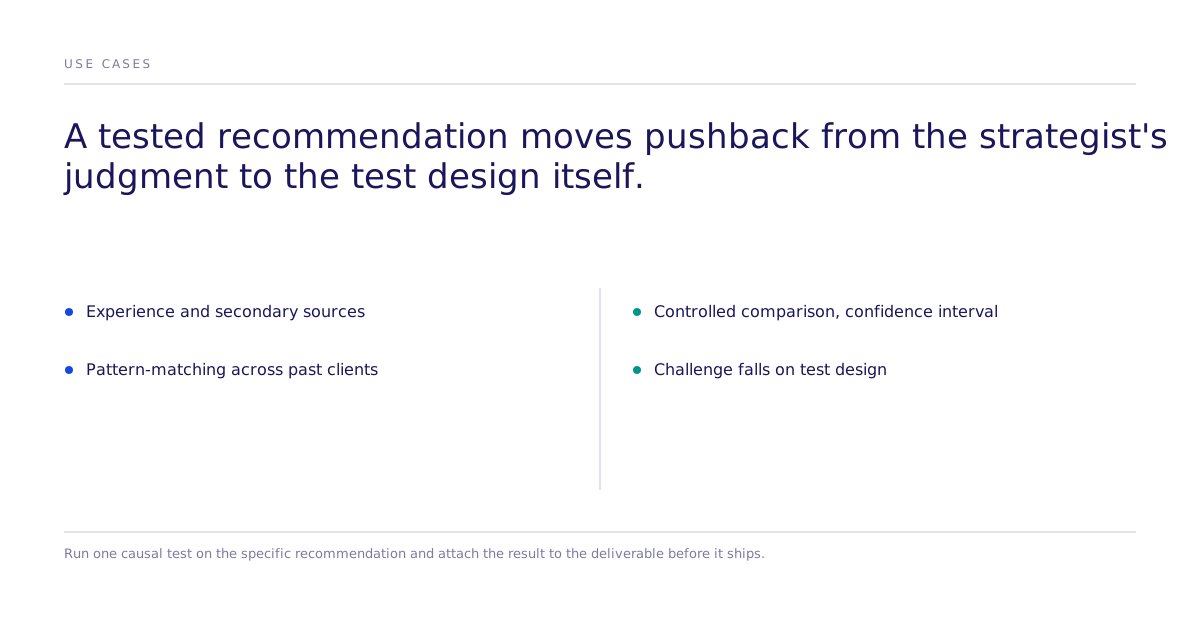
The credibility problem, not the staffing problem
A freelancer without a research budget usually has two options: skip primary evidence and lean on secondary sources and experience, or find a way to test the specific recommendation before it ships. The first option is common because traditional qualitative research is priced for agency retainers, not solo project fees. A market breakdown of research costs puts custom qualitative work into four- and five-figure territory per engagement, well past what a single freelance scope can absorb (User Intuition, market research cost breakdown).
That math is also why this buyer segment keeps growing: independent and fractional operators are a larger share of how companies buy marketing leadership today than a few years ago, so more solo practitioners are pitching against agency teams for the same engagements (GTM8020, fractional CMO market statistics).
What's missing from a recommendation based on experience?
A recommendation built on secondary research and pattern-matching from past clients can still be correct. The problem is that it reads the same whether it is correct or not: nothing in the deliverable distinguishes a well-informed guess from a tested claim. An agency that includes research in its retainer can point to a specific finding tied to a specific audience. A solo strategist working from judgment alone cannot make that distinction visible.
| Basis for the recommendation | What backs the claim | What the client can push back on |
|---|---|---|
| Experience and secondary sources | The strategist's pattern-matching across past engagements | "How do you know that's true for *our* customers?" |
| A causal test of the specific action | A controlled comparison against buyer behavior, with a confidence interval where supported | The test design, not the strategist's judgment alone |
Where does a causal test fit into a solo practice?
Subconscious runs controlled experiments that estimate which action (a positioning line, a message, a price) moves which outcome, for which segment, with confidence intervals where the design supports them. For a solo operator, that turns one specific recommendation from "my read of the market" into a claim with a stated method behind it, without requiring an in-house research team. How Subconscious runs a study covers the mechanics of setting one up.
The stakes-dependent version of this matters too: when a client's decision is big enough to justify it, the same causal question a strategist tested first can move to real-human validation, testing or validating with real participants without changing the underlying question. That option is worth raising only when the size of the decision calls for it; most positioning and messaging checks inside a project fee don't need it.
Building the habit into engagements
A workflow pattern makes this durable across projects rather than a one-off for a single deliverable:
- Reuse a small set of question structures across engagement types (positioning, messaging, content direction) instead of designing a new study from scratch every time.
- Attach the test result to the deliverable directly: a strategy document that names what was tested and what the result was, not just a conclusion.
- Run one test early in a prospective engagement, before the contract is signed, so the proposal itself shows a tested claim rather than a promise to test later. Case studies show what a finished write-up of this kind looks like.
What doesn't this approach solve?
Publishing what a method can't do is what keeps the claims next to it checkable. This approach doesn't remove the cost question. Subconscious has no published freelancer- or solopreneur-priced subscription tier, so a strategist cannot promise a client a specific price comparison against a project fee, and none is claimed here. It doesn't deliver same-day or rapid turnaround; a causal study still requires a properly designed experiment, not an instant lookup. It also isn't a recruitable pool of ready-made audience profiles a strategist can query on demand; the study measures behavior under controlled conditions, and calling it an on-demand roster would misstate how the method works.
The advantage for a solo practitioner is narrower and more durable than a shortcut on cost or speed: one tested claim, cited correctly, is something a client can't get from judgment alone, from anyone, agency or freelancer. Book time to scope a study if a specific client decision is the reason to start.