How to Vet a Creator Partnership Before Signing
A creator partnership should be chosen on the creator-content concept, not reach alone. Compare finalists under the same buyer definition, product framing, and choice task. Then validate the preferred final creative with real people before committing the partnership fee and production budget.
The cost of choosing poorly compounds. The creator fee is sunk. Production spend follows. The campaign can still read as forced or off-brand to the buyer it was meant to move.
Why does choosing a creator partner require a causal test?
Follower count, engagement rate, audience demographics, and past partnerships describe a creator's history. They do not establish what will happen when that creator presents this product with this message to this buyer.
In a 2026 survey of more than 600 marketing professionals, 72.2% of respondents who answered expected influencer budgets to increase by 50% or more (Influencer Marketing Hub). The report also cautions that intent does not guarantee execution.
The evidence available before signing answers different questions:
| Evidence | Useful for | Cannot establish |
|---|---|---|
| Follower count and engagement rate | Historical reach and audience activity | Whether the campaign concept changes buyer choice |
| Audience demographics | Broad audience composition | Whether the creator's tone fits the brand and offer |
| Past partnerships | Category history and execution style | Whether this buyer trusts this recommendation |
| Controlled creator-content comparison | Relative buyer response with key conditions held constant | Real-world views, clicks, or conversions |
The decision is not “Who is the best creator?” It is “Which creator-content concept causes the strongest relative buyer response for this campaign?”
How do you build the comparison around one contract?
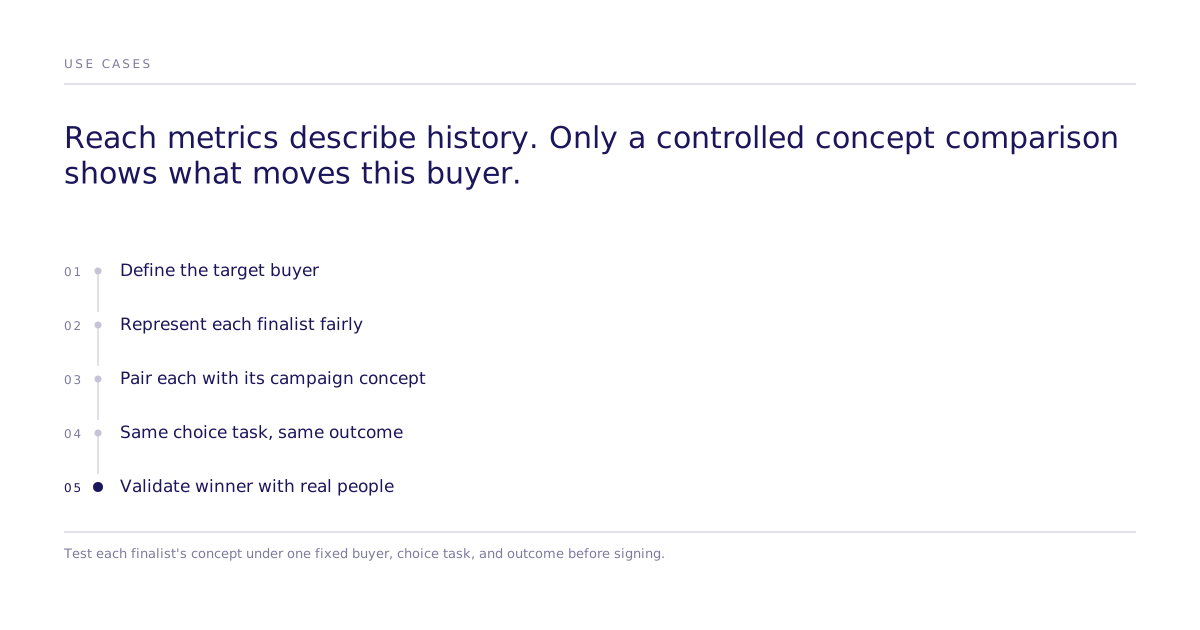
A clean comparison changes the creator-content alternative while holding the buyer definition, product, offer, choice task, and outcome constant.
- Define the target buyer. Use the traits that matter to the purchase decision. For a clean-beauty campaign, a planning example could focus on women ages 25-35 with relevant category interests. That range is an example, not a Subconscious requirement.
- Represent each finalist fairly. As a planning example, assemble 3-5 representative posts per creator across the formats the campaign may use. Do not compare one creator's strongest work with another creator's weakest work.
- Specify the campaign concepts. Pair each creator with the proposed framing, product placement, benefit, and call to action. General creator appeal is not the decision being funded.
- Use the same choice task. Ask the defined buyer group to choose between alternatives under the same conditions. Record the outcome that would change the signing decision.
This structure turns a vague preference exercise into an auditable, decision-specific experiment: a reviewer can see what changed, what stayed fixed, and which outcome determined the recommendation.
Read the result as a directional decision
Subconscious helps teams test messaging and go-to-market actions before committing capital. For creator vetting, the supported use is a causal comparison across creator-content alternatives for a defined buyer segment.
The result should identify the stronger relative choice and the conditions under which it was observed. Confidence or uncertainty language belongs only when the specific study design supports it. The result is not a universal creator score. It answers the contract question that was tested.
The Subconscious research approach is useful here because it keeps the decision tied to controlled alternatives rather than treating historical engagement as proof of future effect.
Why should fit, fraud, and performance be kept separate?
The comparison supports one part of creator due diligence. It should not absorb questions that require different evidence.
- Creator-content fit: The experiment compares buyer response to the message and creator combination.
- Audience authenticity: Follower or audience fraud requires separate verification.
- Campaign performance: The comparison does not predict an individual creator's views, clicks, or conversions.
- Final creative: A preferred concept is not automatic proof of market performance. Subconscious can test or validate studies with real human participants. A team can move from the simulated experiment to real-human validation without changing the causal question.
These boundaries prevent a relative concept result from being stretched into a claim about audience quality or guaranteed campaign outcomes.
Put the signing logic in one decision memo
A useful signing memo records:
- the creator-content alternatives;
- the target buyer and behavioral outcome;
- the variables held constant;
- the directional result and supported uncertainty;
- separate audience-authenticity checks;
- the condition that triggers real-human validation of the final creative.
Bring the shortlist, representative content, proposed campaign framing, and the exact contract decision to the Subconscious study-scoping process. If the alternatives cannot be expressed as controlled choices, the partnership is not ready for this method.