Persona Simulation Tools in 2026: What They Answer, and When You Need More
A marketing, product, or research leader choosing a persona simulation tool in 2026 needs evidence matched to the question, outcome, and cost of error. Inspect how the actual workflow handles audience representation, assignment, estimation, and validation before using its responses to support a launch, feature, or price decision.
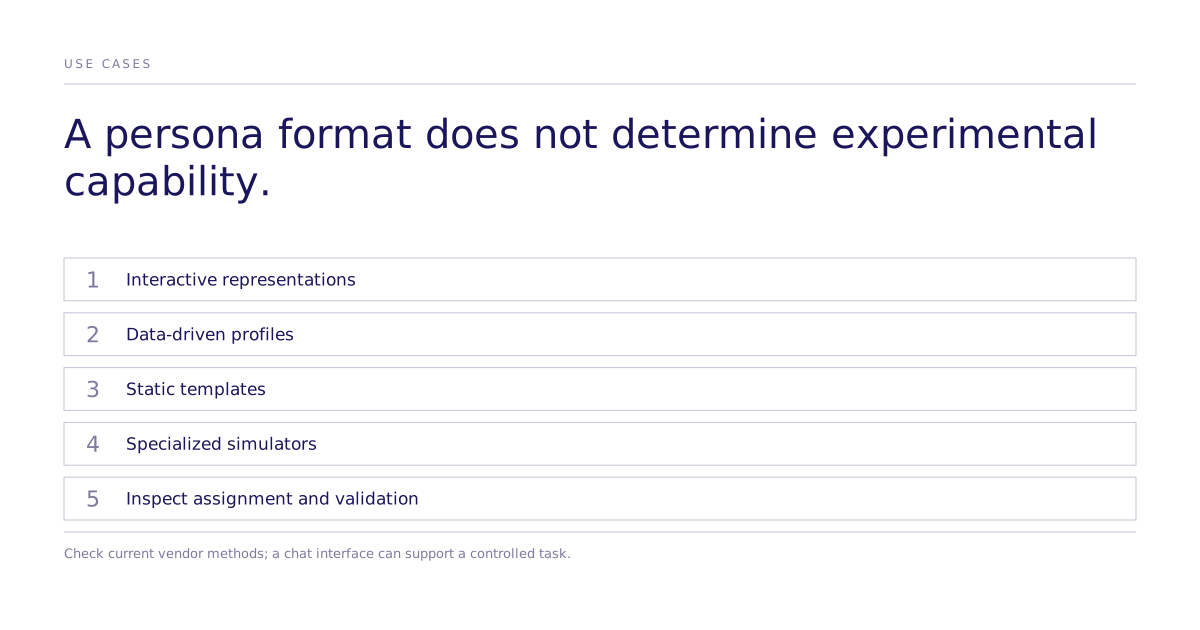
What do persona simulation tools do?
Persona simulation tools use AI and data to build queryable, virtual stand-ins for customers, users, or stakeholders. A team can chat with the stand-in, run it through a group setting alongside other stand-ins, or ask it to react to a message. That differs from a static persona document, a profile someone reads once for alignment; a simulation is something a team can interrogate repeatedly as questions change.
The following four groups are a buying framework for this article, not an exhaustive market census.
| Category | What it does | Best for | Key limitation |
|---|---|---|---|
| Interactive AI persona platforms | Queryable characters and, in some tools, multi-character settings | Drafting hypotheses, messages, and possible objections | Unstructured chat alone does not establish an effect; inspect assignment, outcomes, estimation, and matched validation |
| Data-driven and specialized generators | Profiles built from analytics, CRM, or social-listening inputs | Representing supplied customer evidence, with updates where supported | Inspect data provenance, coverage, calibration, and actual query capabilities |
| Automated template builders | Structured persona documents, such as goals and demographics | Workshops and alignment sessions needing a shareable artifact | A static document alone does not simulate responses |
| Specialized simulation tools | Task-specific or scripted simulation workflows | A defined technical or business task | Confirm access, integration requirements, and evidence for the actual task |
Choosing a category
Choose an interactive persona platform when its actual workflow fits hypothesis drafting or exploring possible objections. A hypothetical shortlist from ten headlines to three still needs relevant evidence before deciding which headline will perform with customers.
Choose a data-driven generator when the team already has analytics, CRM, or social-listening data and wants personas that update as that data changes.
Pick a template builder when the deliverable is a deck-ready profile for a workshop or pitch, not something to query.
Choose a specialized simulator when the use case is narrow (documentation testing, code-first scripted scenarios) and the team has the engineering capacity to integrate it.
Four questions to push on with any vendor
- Interactivity. Does the persona respond to queries the team runs directly, or does it just sit as a static document?
- Validation. Does the platform publish how its simulated responses compare to real human responses, and against what benchmark?
- Speed. Request a schedule that includes setup, design, review, and any human validation for the same scope.
- Team access. Can marketing, product, and sales run the tool directly, or does every query route through a research specialist?
When does a directional read stop being enough?
A single chat response does not establish an intervention effect. Some persona and simulation systems support assigned comparisons and human validation; inspect the current method rather than inferring capability from interface style.
Subconscious structures assigned choice comparisons for specified alternatives and audiences. Agree on estimation and uncertainty during scoping. The ISPOR statistical-methods report concerns analysis of choice data, not certification of a synthetic population. See /research and /case-studies for documented scope.
Check target-segment coverage and relevant calibration separately from recruitment. A modeled audience is not a participant pool.
What are the limitations of persona simulation tools?
A simulated comparison does not replace discovery calls or observe market performance. Scope independent human validation separately, confirming participant sourcing, feasibility, measurement, and recruitment responsibilities before promising delivery. Preserve the research question while adapting the design to actual people.
Use exploratory conversation to develop questions and alternatives, then inspect the evidence required for the next commitment. Review how Subconscious structures a study or book time to scope the audience, alternatives, and evidence gap.