Pre-Testing Out-of-Home Ad Copy Before the Production Order Locks
Test OOH copy before production when evidence can change the order. Digital inventory can rotate variants; physical creative can be replaced at a cost. Geographic and time-based tests may also be options.
What makes a booked static installation costly to change?
For a booked static installation, replacing creative can require new production, installation work, lead time, and contractual approval. Use the actual campaign duration, production quote, and media commitment to assess the downside. Digital inventory and physical replacement provide different options for adjustment.
What must copy do under the planned exposure conditions?
Attention depends on distance, speed, visibility, placement, and format. Test the finished layout under exposure conditions that resemble the actual location rather than assuming universal seconds for highways, platforms, and airports. The linked five-second design guide is a practitioner rule, not a measured viewing-window study.
Design and layout compound the problem. OOH copy never runs alone: it sits inside a specific typographic hierarchy next to an image, and a line that reads well in the brief can be undermined by the art direction around it, or a flat line can be rescued by a strong photograph.[^five-second] Teams that pre-test only the words, not the words inside the finished layout, miss this until the campaign is already live.
Which audience and reading conditions should the task cover?
Include exposure conditions and customer context relevant to the campaign: viewing distance, repeat exposure, familiarity with the brand, and purchase interest can all matter. Justify the audience and conditions rather than treating every OOH placement as the same upper-funnel task.
| Illustrative audience or condition | Exposure to investigate | Question for the test |
|---|---|---|
| Repeat commuter | Repeated views under location-specific timing | Does the message remain identifiable across realistic brief exposures? |
| First-time visitor | First exposure with limited brand context | Can the viewer identify the intended message? |
| High-intent category shopper | Already considering the category | Are the brand and offer understood and credible? |
| Local resident | Familiar with the location and local context | Does the wording create a misleading local implication? |
| Category-aware non-buyer | Category knowledge without a current purchase | Is the message understood without assuming purchase intent? |
A Test Sequence Built Around the Production Timeline, Not the Brief
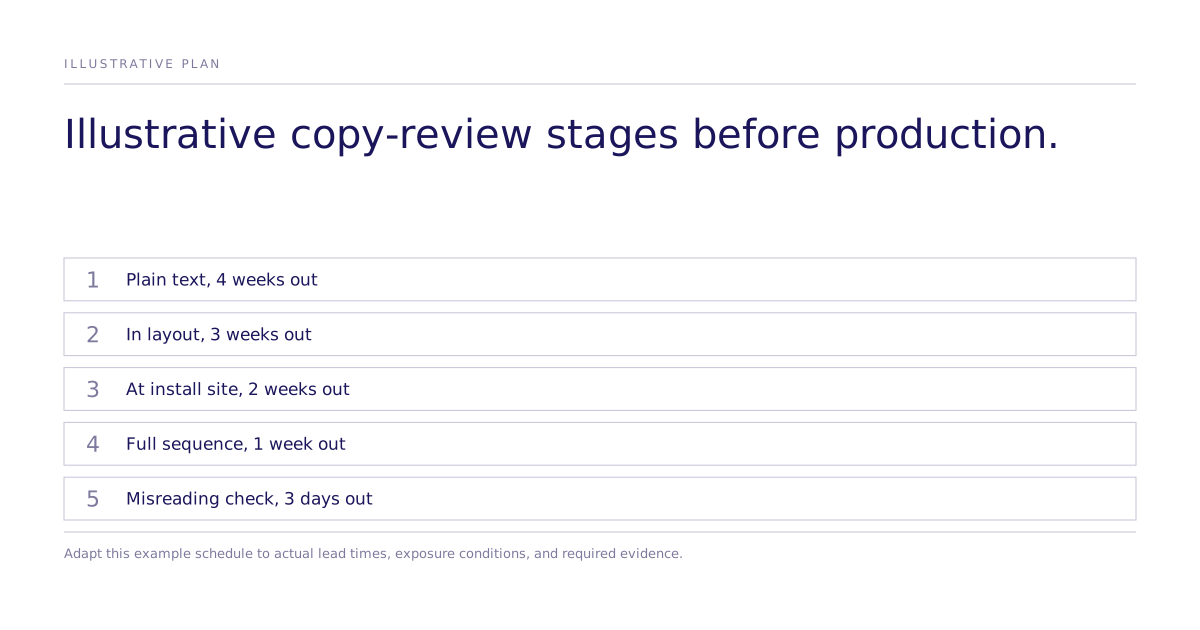
The following schedule is an illustrative planning example. Adapt each stage to the actual production calendar, review capacity, and required evidence; these dates are not a delivery commitment.
- Four weeks out: test headline candidates as plain text before any art direction is locked, and check whether each reading condition can state what the ad said within its actual attention window.
- Three weeks out: test the headline inside the real layout, with image and logo in position, since the layout frequently changes what the copy means.
- Two weeks out: test the copy against the actual install location, such as a highway, a metro platform, an airport gate, or a specific neighborhood bus stop, because the same line can read as confident in one location and tone-deaf in another.
- One week out: if the campaign runs as a family of executions across a route or a city, test the full sequence for whether it builds or contradicts itself.
- Three days out: run a final check for the worst reasonable misreading: what the line could mean out of context, and what local reaction a team working from headquarters would not anticipate.
If readers cannot identify the message under the planned exposure, revise the copy and layout together.
How Does Subconscious Run This as a Causal Test?
For a simulated comparison, randomly assign copy alternatives and prespecify the generated message interpretation or stated-choice endpoint, estimator, and supported uncertainty. A model’s statement that it remembers an ad does not measure human recall.
When human comprehension or recall is required, scope a timed human exposure study using the actual layout and relevant viewing conditions. Randomly assign alternatives, define the comprehension or recall measurement and delay, and confirm participants, recruitment responsibilities, and feasibility. Review the study workflow.
Where This Method Stops
Interpret generated responses within the simulated task. Human comprehension and recall require their own measurements under an appropriate design. This scoped copy comparison does not establish media-plan ROI or a location-buying recommendation. Combine it with physical mockup and installation-context checks.
Next Step
Apply the same planning discipline to assets costly to replace, including event signage, mailed creative, and packaging. Obtain evidence early enough to revise the actual production order. Review method evidence within its documented scope and applied studies, or scope the campaign.
[^five-second]: Billboard Design & The Five-Second Rule, Effortless Outdoor Media.