Pre-Testing a Rebrand Announcement Before It Goes Public
A rebrand announcement is a single, public, largely irreversible event. The name either lands or it doesn't. The "why now" story either reassures the room or invites the comments section to write it instead. A version that misreads even one audience can unsettle the brand recognition the rebrand was meant to strengthen.
The people who decide whether that story lands are not the marketing team. They are existing customers, prospects mid-evaluation, former customers, employees, and press or analysts, each reading with different anxieties. Most teams write one draft optimized for one of those groups, usually prospects, and are surprised when employees feel blindsided or customers read the news as a warning sign.
The buyer's decision
The person accountable for this is typically the CMO or head of brand and communications running the launch sequence: the name, the narrative, the founder letter, the press release, the social rollout, and internal comms. By the time an announcement is being drafted, the decision to rebrand has already been made. What remains open is which version of the "why now" story to commit to, and whether the tone and sequencing hold up across every audience that reads it.
Research on corporate rebranding backlash finds that even changes made for defensible strategic reasons can still trigger public pushback when the reasoning behind them isn't made legible to the outside audience (University of Miami News). Research into the internal side of rebranding points to the same root cause from the other direction: launches misfire when the people inside the company, and the customers who feel like insiders, are not treated as part of the story the rebrand is telling (Journal of Business Research). Neither failure is about the logo. Both are about who the announcement was written for.
"Townsend said research shows that millennials—with their considerable purchasing power—are exceptionally cause-driven and ready to financially reward companies they respect."
Claudia Townsend, University of Miami Herbert Business School, News@TheU (source)
Why this is a reader-modeling problem, not a design problem
Three patterns send rebrand announcements sideways:
- The "why now" gap. Nearly every reader lands on the same unspoken worry first: has something gone wrong internally, and is this rebrand just a cover story? An announcement that doesn't answer that in the first two sentences leaves the audience to answer it themselves, publicly.
- Audience mismatch. Optimizing the copy for one audience, and assuming the others will follow along, is the most common single mistake.
- Tone contradiction. How the announcement sounds carries as much brand meaning as what it says. A rebrand built around maturity announced in an irreverent voice, or the reverse, undercuts the strategic reason for the change before anyone reads past the first paragraph.
All three are testable before publication: each is about how a defined audience reacts to specific copy, not about taste.
Who reads a rebrand announcement in the first 72 hours?
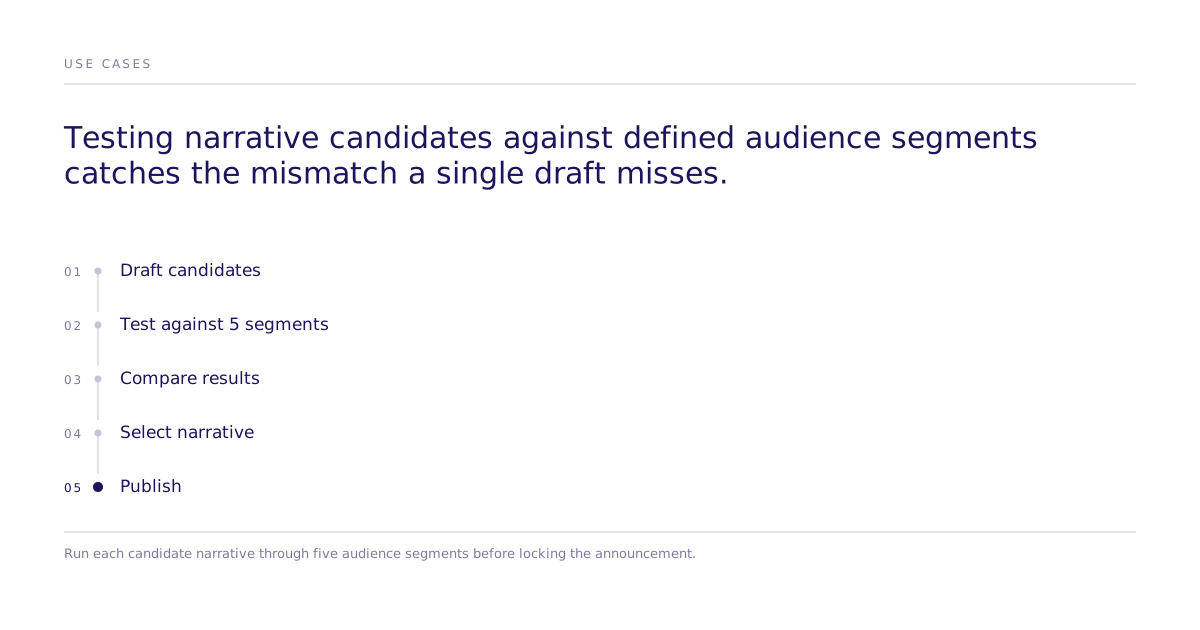
A rebrand test is broader than a normal message comparison: it covers five distinct personas encountering the announcement in the first 72 hours, not one buyer segment.
| Audience | What they're reading for |
|---|---|
| Existing customer (1+ year) | Reassurance that nothing they rely on is breaking, and that the reason for change is real |
| Prospect mid-evaluation | Whether the rebrand signals growth and confidence, or a company trying to fix something unnamed |
| Former customer (churned 6-12 months ago) | Whether the announcement acknowledges the earlier product honestly enough to reopen consideration |
| Employee or alumnus | Whether the story matches the culture they know well enough to share it themselves |
| Press or analyst | Strategic intent and a quotable line; what commentators say within two days of publication sets the lasting narrative around the rebrand |
How does Subconscious test a rebrand narrative?
Subconscious runs controlled experiments comparing narrative and message alternatives against simulated audience segments defined by role and relationship to the brand: existing customer, prospect, former customer, employee. Given a small number of candidate narratives, such as a growth story, a maturity story, or a customer-obsession story, the platform estimates which version is more likely to land with each segment before publication.
This is decision-specific message and positioning testing against a defined population and a defined outcome, not a general opinion generator reacting to a logo. Subconscious can run these comparisons against a person-level audience graph covering 800 million real people, moving from a simulated comparison to real-human validation without changing the underlying causal question once a simulated round has narrowed the field.
A pre-launch cadence, as a planning example
A team running this discipline against a launch might sequence it across six weeks of lead time: test the core narrative six weeks out, test the name and tagline in isolation four weeks out, test the full announcement draft three weeks out, run a red-team pass on likely criticism two weeks out, and test the complete sequence together one week out. The cadence is a scheduling choice; the order matters.
The announcement itself is rarely one piece of copy. It's a sequence: teaser, hero post, founder letter, customer email, social rollout, press embargo lift. Sequences fail in ways a single draft never reveals, since a later touch can quietly contradict an earlier one. Testing the narrative early and the assembled sequence separately catches two different failure modes. Early testing surfaces which "why now" story resonates before a single asset is written; late testing surfaces whether the assets built on it still agree with each other by the time the last one ships.
What are the limitations of this testing?
Subconscious does not offer a packaged "rebrand testing" product or a workflow that recruits a company's actual former customers, employees, or press contacts as a live panel. The audience segments are simulated populations built from defined characteristics, not a reconstruction of a specific company's actual customer list. Reproducing a precise real-world audience needs a configured study, not a standard output.
Confidence-interval reporting, automatic segment ranking, and decision-memo generation are not standard current capabilities. Testing a narrative or a tone is not the same as predicting whether a specific announcement will trigger press coverage or social backlash, and it doesn't substitute for legal, HR, or executive judgment about rebrand timing and disclosure. What it changes is whether the team is arguing from opinion or from a comparison of tested alternatives before the launch goes public.
Next step
Before a rebrand announcement goes out, the useful question is narrower than "will people like this": which of a small number of concrete narrative and tone alternatives holds up across the audiences who will actually read it. Comparing those alternatives against a defined population, before the copy is final, turns "we think this will land" into a testable claim. See how Subconscious runs these comparisons or book time to scope one against an upcoming launch.