Pre-Testing a Thought Leadership Thesis Before It Goes Out Under the Firm's Name
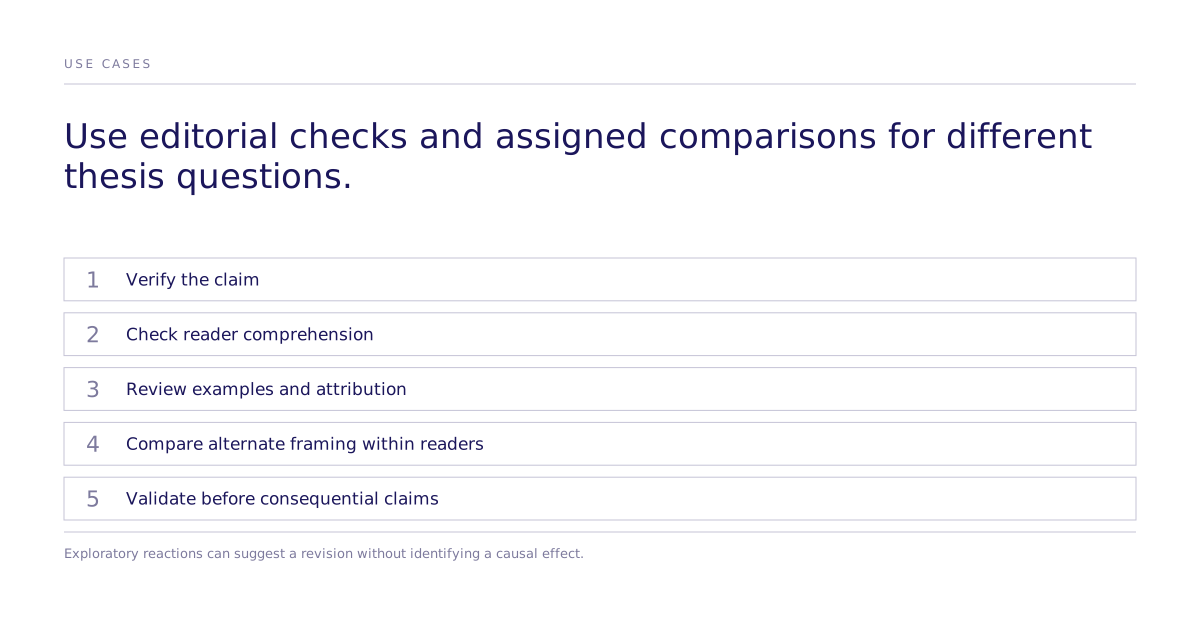
An agency or consulting firm deciding whether to publish a thesis needs to verify the claim, its relevance to intended readers, and the consequences of attaching the firm’s name to it. Polished prose alone does not establish a useful or accurate argument.
A polished draft can still carry a vague or irrelevant thesis. LinkedIn and Edelman’s thought-leadership research provides survey context about readers’ reported influence; it does not predict this post’s reach or conversion.
Which thesis problems should the team check?
Three possible thesis problems to investigate are relevance, audience fit, and originality:
A vague thesis can leave readers unsure what the firm is arguing. State a concrete, supportable claim and its implication for the intended reader. Distribution and engagement still need their own evidence.
Internal agreement does not establish reader comprehension. Check whether examples, terminology, and implications fit the clients and prospects the post is intended to reach.
Check whether the claim adds evidence or a useful implication beyond existing arguments. Verify originality against relevant sources rather than assuming firm content is generally years out of date.
How do you compare reactions before the post ships?
Define relevant reader groups and the actual response endpoint. Cross-group reactions can reveal interpretations; a framing-effect estimate requires appropriate assignment within groups rather than treating role differences as effects.
| Reader | Possible concern | Question to investigate |
|---|---|---|
| Intended client or prospect | Judgment relevant to an actual decision | Does the claim provide a supportable, useful implication? |
| A practitioner at a comparable firm | Whether the argument is obviously right, obviously wrong, or a lukewarm restatement of consensus | Whether engaging publicly says something about their own position |
| An academic or a journalist covering the category | Originality and a quotable line | Whether the claim is worth citing |
| Someone doing the work the firm advises on, day to day | Whether the author still understands what the work is actually like | Whether the examples read as lived or as advised-from-a-distance |
| An early-career reader building their own reputation | Content that makes them look sharp to their own network | Whether sharing it reflects well on them |
Randomly assign concrete alternative framings within each reader group under consistent exposure. Prespecify generated agreement, comprehension, or sharing-intent responses, estimation, and uncertainty. Nonrandomized reactions are exploratory, and generated intentions do not establish live sharing or distribution.
How do you test the thesis at each stage?
Fit review checkpoints to the actual publishing schedule, leaving time for factual verification and revision:
Before drafting: the thesis check. State a supportable claim in one sentence and examine evidence, implications, and possible objections. Cross-reader reactions can suggest revisions; they do not establish which claim will achieve live distribution.
First draft: the framing check. Ask what the opening communicates and who it appears to address. Use relevant reader feedback to investigate a mismatch before revising the complete draft.
Second draft: the example check. Verify that examples are current, accurately attributed, and relevant. Generated reactions do not replace checking the underlying sources.
Pre-publish: the sharing-intent check. Ask about willingness to share under the specified task, without treating it as observed behavior or assuming which reader group drives distribution. Confirm how the claim appears in its actual publishing context.
Post-publish: the rebuttal check. Once the post is live, compare reactions in the voice of a public critic: the strongest counter-argument, and what a skeptic would write in response. This lets a firm plan the follow-up post instead of losing the thread when the pushback starts.
Which editorial problems should the team investigate?
Potential editorial problems to check; these are hypotheses rather than findings from documented multi-firm tests:
- An unclear position. Keep necessary caveats while making the supported claim and uncertainty understandable.
- An opening without a clear claim. Check whether the opening communicates the argument to intended readers.
- Missing practitioner context. Verify that examples accurately represent the work and constraints they describe.
- The post proves the claim but skips the implication. Three case studies and no answer to "what does this mean for my company" reads as correct but useless.
- An unclear next step. Check whether the call to action follows the argument and serves the reader’s actual question.
The second use: deciding whether a practice area is worth building
Before building a practice area around a thesis, inspect client needs, demand, delivery feasibility, and independent evidence. Partner debate and conference feedback can generate hypotheses, but agreement alone does not establish a viable service.
A simulated comparison offers another way to challenge the framing, but it shares model and input assumptions. Independent customer evidence is needed before using audience agreement to justify a new practice area.
Scope independent human evidence for consequential claims, confirming recruitment, exposure, and measurement. Preserve the framing question while adapting the study design. Audience agreement does not establish demand for a practice area; review method evidence within its reported scope.
A controlled comparison of reactions does not replace an editor's judgment or a subject-matter expert's critique of whether the argument is sound. It estimates which claim resonates with which reader, not whether the claim is factually correct.
Where to start
Review the thesis backlog for supportable claims, relevance, and evidence gaps. A task comparison can inform revision when its design and validation fit, but does not establish which ideas will achieve actual distribution.
Verify the thesis and use reader evidence to improve the draft. Review the decision-testing workflow, or scope a comparison for a specific claim. Company background is here.