Pre-Testing a Webinar Registration Page Before You Spend the Media Budget
A webinar registration page fails quietly. Traffic volume matches what the channel forecast, nothing looks broken on a quick read, and yet registrations still land at half the expected rate. Blame lands on the topic, the speaker, the time slot, or the algorithm instead.
That is the decision a demand-gen lead who owns the webinar program and its paid-promotion budget has to make before launch: ship the headline, agenda framing, and audience segmentation as drafted, or test which variant drives registration intent first. Getting it wrong is not cheap. Thousands of euros in paid media can run against a mismatched headline or the wrong audience segment, registrations and attendance come in low, and the speaker's and sales team's follow-up time is spent chasing a campaign that never had a shot.
Why the page is the usual suspect
Registering for a webinar costs more than a click. A visitor hands over an email address, blocks time on a calendar, and often adds a job title and company on top. Each of those is a small commitment, and the decision to give it happens in about the time it takes to skim the fold. Most drafts spend that time describing what the webinar is, rather than why a specific visitor should give up ninety minutes for it. Three patterns account for most of the underperformance:
- Topic-headline mismatch. The team picks a topic the audience cares about, then writes a headline that describes the topic abstractly instead of naming the specific problem it solves.
- Speaker-agenda mismatch. A senior speaker is announced and featured prominently, but the agenda is written at a level that doesn't match the audience the speaker's name draws in.
- The recording gap. A large share of any B2B webinar audience registers planning to watch the recording rather than attend live. Pages that don't say so explicitly leave that intent on the table.
None of these show up in a dashboard until the campaign has already spent against them.
How do you test a webinar registration page before the budget commits?
The fix is to run the registration page as a causal experiment against defined buyer segments before committing paid-media spend, rather than an internal stakeholder read of a draft. Structuring the test around buyer segments common to a B2B webinar audience (a skeptical practitioner who has seen too many product pitches disguised as content, a curious manager who forwards rather than attends, a senior buyer at a target account evaluating credibility signals, and a lukewarm contact from an existing list) isolates which page element drives the registration decision for which audience, instead of an average reaction across an undifferentiated group.
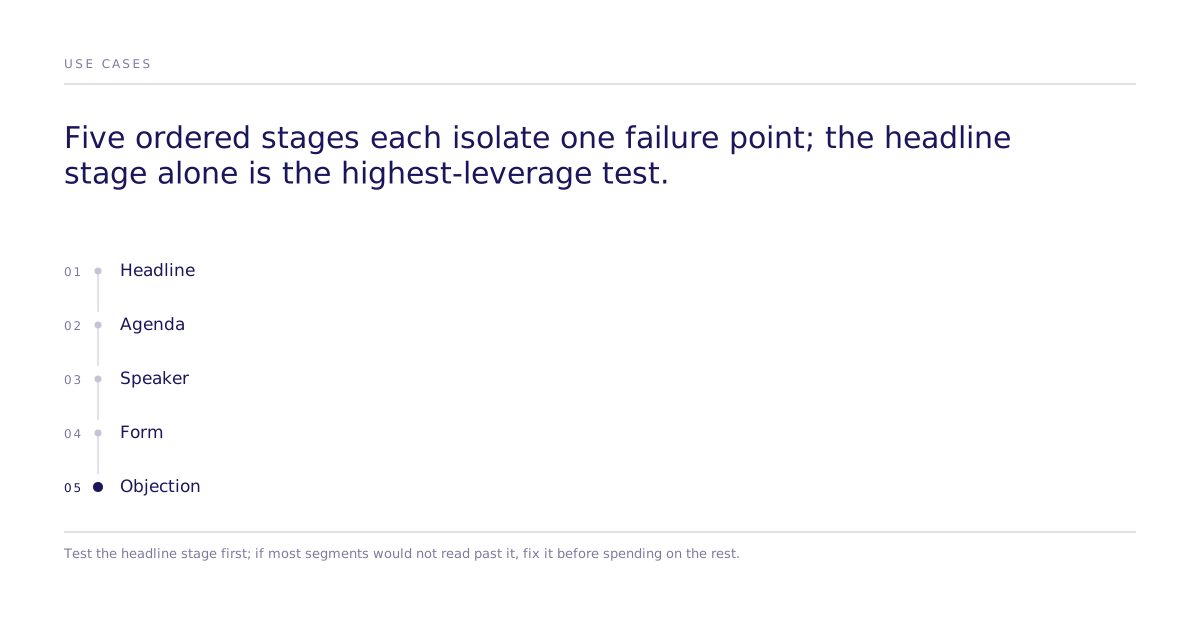
The test itself runs in stages that mirror how a visitor actually reads the page:
| Stage | What's shown | What it isolates |
|---|---|---|
| Headline | Headline, subheadline, speaker names only | Whether the headline alone earns a second look |
| Agenda | The bullet list of what the session covers | The gap between what a segment expects to walk away with and what's planned |
| Speaker | Speaker bios | Whether the bio reads as "here to teach" or "here to sell" |
| Form | The registration fields | Which field would cause abandonment |
| Objection | The full page | What single missing element would move a "no" to a "yes" |
Running the headline stage alone is the highest-leverage step: if a majority of segments say they wouldn't read past it, the rest of the page's quality doesn't matter yet.
What does this test replace, and what doesn't it do?
This is a pre-launch message test, not a live on-page A/B test and not a prediction of show-up or attendance rates. It estimates directional response to copy and framing across defined segments before spend commits, and it does not guarantee a specific conversion lift. Where the underlying study design supports it, results can include confidence intervals and segment-level differences, as properties of the study rather than a default output.
The same test can also move from a simulated read to real-human validation without redesign: once a page has been tested against segment definitions, it can be rerun with real participants, using the same headline, agenda, and form variants. That step matters when the decision is expensive enough to warrant a real-human check before the media budget commits, and it draws on studies run against a person-level audience graph covering 800 million real people. That graph describes the population available for controlled studies, not a pool of people pre-recruited and waiting to register for a specific webinar.
What "worth fixing" looks like in cost terms
Public industry data on typical webinar economics gives a sense of scale, even without a Subconscious-specific benchmark: Zoom's 2025 webinar statistics roundup sizes the promotion and production spend that a single webinar campaign typically carries, and the Wistia webinar analytics benchmarks size typical registration-to-attendance rates. That spend and attendance run against the page regardless of whether the page was tested. A registration page that underperforms doesn't just cost registrations; it costs attendance quality, the sales team's post-event follow-up time, and the data the next campaign would have used to plan better.
Where can you run this test?
A demand-gen lead can scope a single test around one campaign's registration page (headline, agenda, and speaker framing) before the promotion budget commits. Read more on how the test design and segmentation approach works, or see the underlying experiment methodology. To scope a specific page, book time to walk through it.