Is a Ranked Tool List Enough Evidence for a Launch Decision?
A product marketing or launch leader shortlisting AI audience-simulation tools ends up with the same artifact: a ranked list, each entry backed by a self-reported accuracy percentage. The question that matters is not which entry ranks first, but whether that list is sufficient evidence to commit launch budget, or whether the decision needs a controlled experiment first.
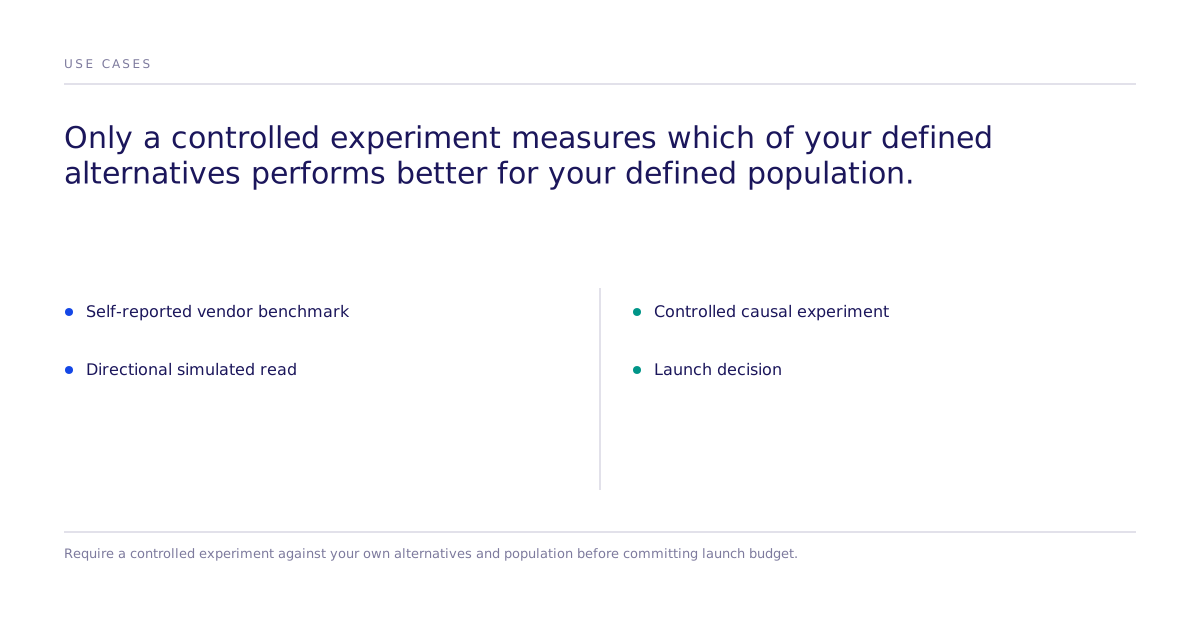
It is not sufficient on its own. A self-reported accuracy percentage tells you how a vendor scored against its own benchmark, under conditions the vendor chose. It does not tell you how your specific launch alternatives would perform against your specific target population. Only the second question is the one a launch decision depends on.
What does guessing wrong on a launch decision cost?
Positioning, messaging, or budget gets committed on the strength of a vendor's accuracy claim or category ranking. The launch runs. Only after the spend and the go-to-market time are gone does the team learn whether the underlying read was correct. A ranking is a screening signal, not a decision input, and treating it as one moves the discovery of a bad call from before the spend to after it.
What a shortlisting checklist actually verifies
Before evaluating any audience-simulation platform, the criteria below separate a defensible pick from a plausible-sounding one:
- Response fidelity. Whether outputs reflect how a defined segment actually reasons, or read as generic model output dressed in a persona label.
- Segment comparison. Whether the tool can run the same question across multiple segments and show where they diverge. That divergence is usually where the insight lives.
- Validation methodology. Whether the vendor publishes how it measures accuracy against real human responses, not just the resulting number. A platform that cannot describe its measurement method is asking you to trust a score it defines.
- Time to first read. How long from setup to an actual answer, and whether that answer is directional or measured.
- Compliance posture. Data residency and processor agreements, relevant for any team handling EU customer data.
- Pricing transparency. Published tiers versus "contact us" indicates how a vendor treats disclosure, including on its accuracy claims.
This category has marketed itself on turnaround: same-day or same-hour reads against multi-week traditional recruited-panel research, with a single self-reported accuracy score against a historical benchmark the vendor chose. Independent replication work complicates that pitch: a study comparing synthetic responses against academic survey benchmarks found agreement in some conditions and real gaps in others, depending on question type and population (Greenbook, "Testing Synthetic Data Against Academic Benchmarks: A Replication Study"). Treat any single blended accuracy number, from any vendor, as a claim to interrogate rather than a verified figure to shop by.
Why doesn't a self-reported score answer the launch question?
A ranked-list accuracy percentage is a single scored output, measured on the vendor's own historical benchmark. It answers "how well did this tool do on average, on the questions it chose to report." It does not answer "will alternative A or alternative B outperform for the audience I am about to launch to."
| Evidence type | What it produces | What it tells you about your launch |
|---|---|---|
| Self-reported vendor benchmark | A single accuracy score against the vendor's own historical dataset | How the tool scored on its chosen test set, not your alternatives or your audience |
| Directional simulated read | A ranked or scored output for one stimulus | A plausible signal, not a measured comparison between defined alternatives |
| Controlled causal experiment | A measured effect, with a confidence interval, from a defined population choosing between defined alternatives | Which specific alternative performs better for your defined population, and how confident you can be in that difference |
The first two rows describe most of what a vendor-ranking exercise produces. The third is what a launch decision needs before budget moves.
How does Subconscious test the launch decision instead?
Where an open-ended simulation tool produces a single scored or ranked output, Subconscious runs a controlled discrete-choice experiment: it defines the actual launch alternatives, defines the population, and returns a measured causal effect with a confidence interval rather than a directional score. The output is not "this concept scored well." It is a measured answer to "which of these defined alternatives performs better for this defined population, and by how much."
A number reported without its scope is marketing copy; naming the scope is what makes the number usable. Subconscious can run controlled studies against a person-level audience graph covering 800 million real people. That figure describes the scale of the simulated population available for an experiment, not a recruitable panel of 800 million people willing to participate in a study. Recruited real-human validation is a separate, smaller step that uses actual participants.
See the replication leaderboard for how these experiments are structured and the claims tested so far.
Limitations
Naming what a method does not cover is what lets a buyer check the claim before they rely on it. A controlled causal experiment answers the alternatives-and-population question. It does not replace direct customer discovery, observed in-market or beta behavior, or the judgment of the launch team making the final call.
Publishing the extra step required at high stakes is what lets a buyer price the decision correctly. When a launch decision turns on it, Subconscious can move from a simulated experiment to real-human validation without changing the underlying causal question. That step matters when the stakes justify it; it is not required for every directional read, and running it does not turn the original causal-effect experiment into an observed usability session or a guarantee of market performance.
Next step
If a launch decision is riding on a ranked list of vendor accuracy claims, the smaller, cheaper move is to run the actual comparison first: define the alternatives, define the population, and measure the effect before the spend happens. See /how-we-work for the process, or /demo to walk through a specific launch decision.