Screen Landing Page Hero Copy Before You Spend Traffic on It
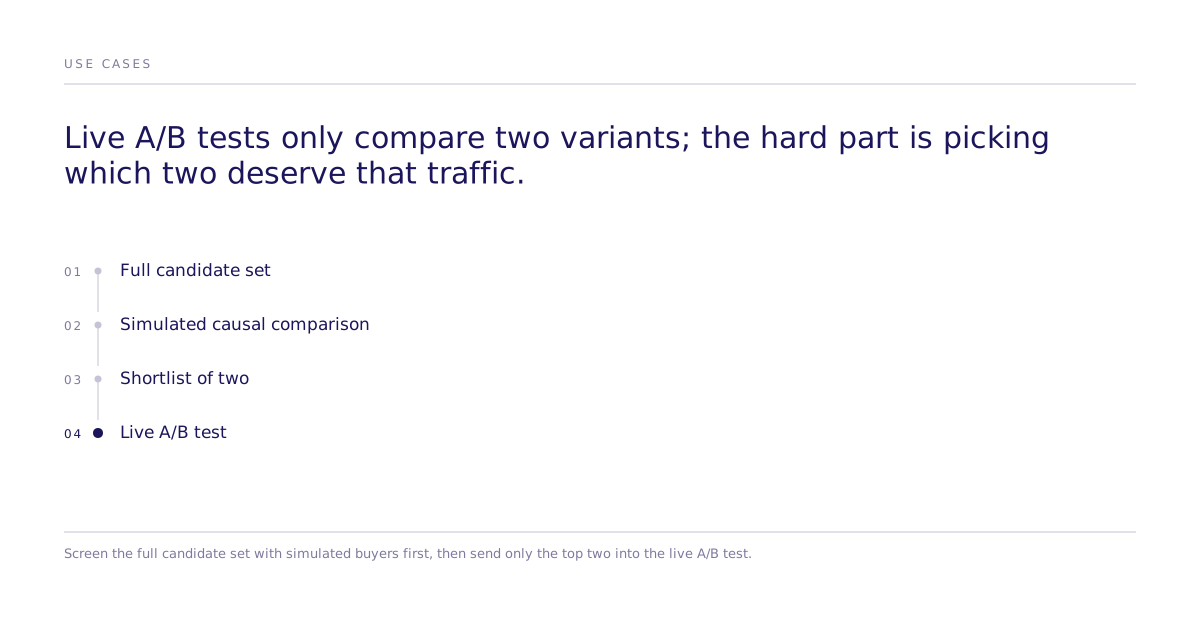
A growth lead with six hero headline candidates and one landing page has a narrowing problem, not a testing problem. A live A/B test can compare two or three variants at a time. It cannot cheaply tell you which two deserve that traffic in the first place.
For a B2B page that clears a few hundred sessions a week, a live test that starts with the wrong pair can run most of a quarter before it reaches significance, a quarter spent proving a headline was weak rather than shipping the one that wasn't.
The candidate problem, not the test problem
Hero copy carries outsized weight relative to how little of it there is: a headline, a subhead, a call to action. Small wording changes move signup and demo-request rates more than most landing page redesigns do, which is exactly why teams over-invest in debating a handful of options and under-invest in generating and screening more of them.
The live test works fine once a team is down to two strong contenders. The expensive part is everything before that: picking which two out of six, eight, or twelve deserve real traffic.
How do you narrow candidates before a live test?
A structured pre-test workflow separates candidate generation from candidate validation:
- Write out the candidate set. Vary one dimension at a time (outcome framing versus mechanism framing, a comparative anchor, urgency level, specificity) so the differences are legible rather than accidental.
- Run a controlled causal experiment on simulated buyers matching the target ICP. Ask each simulated respondent to react to headline, subhead, and CTA as a real prospect would, and compare preference and stated intent across variants.
- Take the top two into a live A/B test. The simulated round does the discovery work; the live test does the final validation, on a pair that has already cleared a bar.
This is Subconscious's general fit for the decision: run the causal comparison on simulated buyers first, then move the same question to real-human validation without redesigning the experiment, so the variant reaching the live test has already been screened rather than guessed.
What does a simulated round tell you that a live test can't?
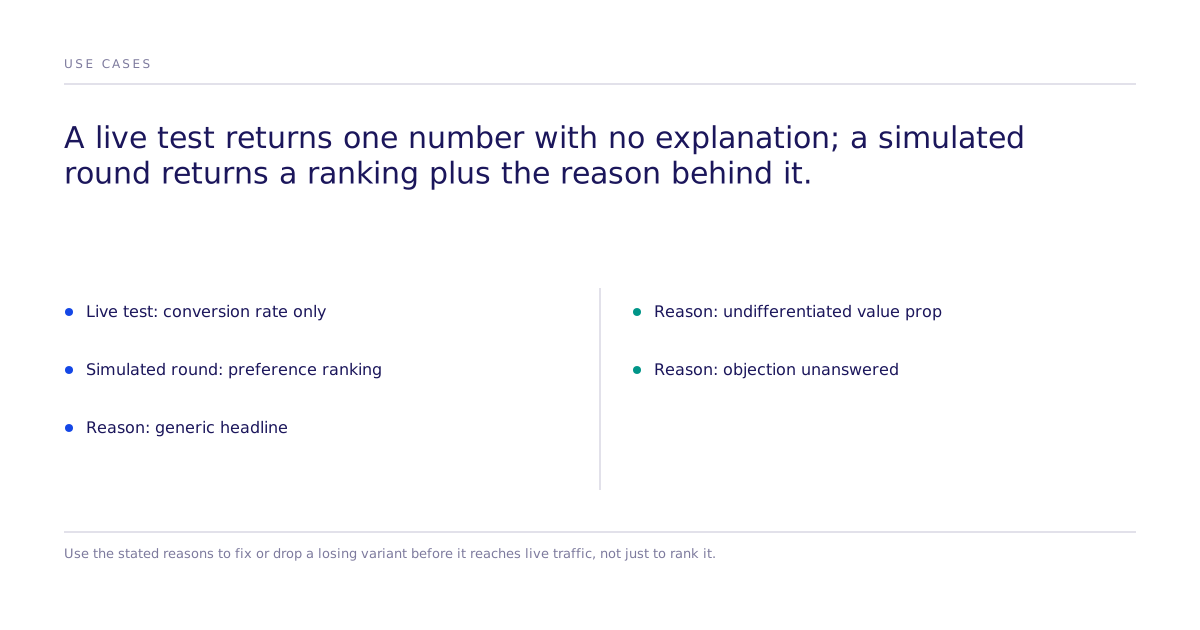
A live A/B test returns one number, conversion rate, and nothing about why the losing variant lost. A structured comparison of messaging variants can also surface qualitative reasons: whether a headline reads as generic, whether the value proposition lands as differentiated, or which specific objection the copy fails to answer.
How much to trust the simulated ranking
The limits below are published next to the workflow's claims for the same reason a leaderboard lists misses beside hits. A simulated preference ranking is a directional signal for narrowing candidates, not a statistically equivalent replacement for a live A/B test at scale. Methodology-level research on LLM-based synthetic respondents shows they can reproduce human survey response patterns at meaningful reliability (Maier et al., 2025), which supports using simulated preference this way. That is different from claiming a specific accuracy rate for hero-copy testing itself, a number Subconscious can't back for this workflow; the reliability finding describes the general mechanism, not a guarantee for any one comparison.
"SSR achieves 90% of human test-retest reliability while maintaining realistic response distributions (KS similarity > 0.85)"
Maier and colleagues, arXiv:2510.08338 (2025) (source)
"SSR achieves 90% of human test-retest reliability while maintaining realistic response distributions (KS similarity > 0.85)"
Maier and colleagues, arXiv:2510.08338 (2025) (source)
Where a live test is still the right first move
Three cases where screening with simulated buyers adds little:
- The page already gets enough traffic to detect a large expected lift directly, so just run the live test.
- The hero depends on a live product capability or integration a simulated respondent cannot evaluate without using the product itself.
- The variant tests a pricing or social-proof claim the simulated respondent has no ground truth for.
Outside those cases (headline framing, value-prop ordering, CTA wording, the sequencing of proof and benefit), screening before the live test is the cheaper path to a defensible shortlist.
Where does the causal test fit into your stack?
The simulated round is a step before an existing experimentation tool, not a replacement for it. Whatever platform runs the live A/B test, Optimizely, VWO, PostHog Experiments, or an internal flagging system, stays where it is. The screening step changes what goes into that funnel: a shortlist of two candidates that have already cleared a directional bar, instead of a set picked by internal debate.
Limitations and next step
Naming this workflow's failure modes here is what lets a buyer check it before spending traffic on it. This workflow does not replace live A/B testing, does not carry a specific claimed accuracy percentage for hero-copy decisions, and is not a substitute for the time a proper causal experiment takes to design and run. It narrows the candidate set; the live test still decides the winner.
For a team with more hero candidates than traffic to test them honestly, research covers the underlying causal methodology, and how we work walks through how a simulated comparison moves into real-human validation without changing the question being asked. Case studies cover applied examples across categories, and a demo is the fastest way to see the narrowing step run against a real candidate set.