Set the Evidence Tier Before a Simulated Finding Reaches a Launch Decision
A research leader should set the evidence threshold before a simulated finding can support a public claim, price change, or budget-committing launch. The threshold should rise with the cost of being wrong, or a plausible market read can reach a decision before the underlying behavior has been tested.
What Is a Simulated Finding Allowed to Change?
The first question is not which method produced the finding, but what action it is allowed to support. Internal exploration, shortlist selection, a public claim, and committed launch spend carry different consequences and should not share one proof standard.
Human validation requires a defined audience, feasible recruitment, appropriate exposure, and relevant measurement. The Compass pretesting guide describes planning feedback from a communication’s priority audience; it does not validate a simulated population.
Four evidence tiers for one business decision
This illustrative framework relates evidence to possible decision uses. The tier name alone does not establish validity:
| Evidence tier | Decision use | Boundary |
|---|---|---|
| Exploration | Frame hypotheses, objections, and alternative explanations | Internal consideration only |
| Assigned simulated task | Compare defined alternatives under a specified design | Generated task estimates require calibration, supported uncertainty, and relevant validation |
| Decision review | Check the audience definition, test wording, business context, and cost of error | The accountable owner sets the required proof |
| Independent human evidence | Evaluate the question with actual participants and appropriate measurement | Interpret the actual design and outcome; human responses do not guarantee market performance |
Fluency is not evidence. A clear explanation can help define what to test, but it cannot establish that one action caused a different behavioral response.
Keep the causal question stable as proof increases
Subconscious can structure randomized comparisons of specified alternatives within a modeled audience. Prespecify the generated-choice outcome, estimator, and supported uncertainty. Check calibration and method evidence within its reported scope.
Confirm modeled coverage and calibration separately from human recruitment. Real participants contribute human evidence only when the study actually includes them.
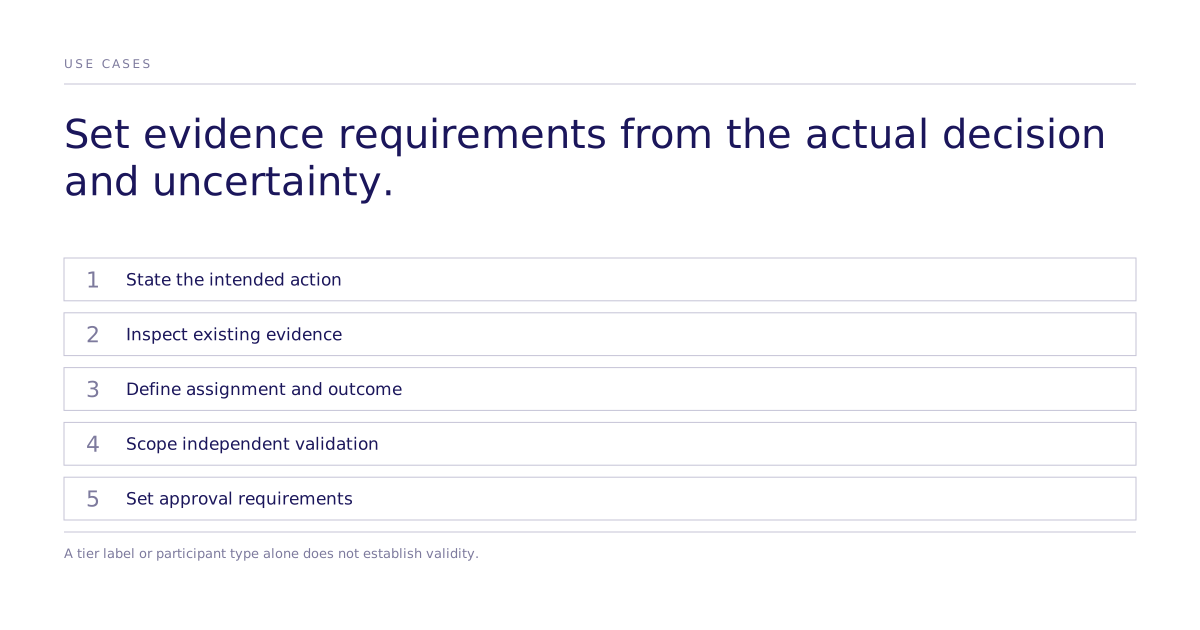
Scope additional human or behavioral evidence when the decision’s uncertainty and downside require it. Preserve the question while adapting participants, exposure, and measurement. Existing relevant evidence may already address the gap; neither modeled nor human task results guarantee launch performance.
Who Sets the Evidence Threshold for a Launch?
Subconscious does not choose the evidence threshold for a launch, replace executive judgment and accountability, or substitute for the decision owner's knowledge of the commercial stakes. Nor can it make one experiment answer a different question from the one the team tested.
The buyer owns five checks:
- Name the action under consideration.
- State the cost of choosing poorly.
- Set the minimum evidence tier before any result is reviewed.
- Use lower tiers only to narrow the decision.
- Require additional evidence when existing validation does not support the public claim or material commitment; choose a feasible design matched to the remaining uncertainty.
Put the rule into the launch process
Choose an active launch, pricing, or messaging decision and state its evidence requirements before reviewing a new result. Inspect the study workflow and documented designs, then scope any remaining evidence gap.