Should You Send Your First Cold Outbound Email As-Is, or Test It First?
A hand-built prospect list gives a founder one real shot per name. Once a prospect deletes a bad first cold email, a second one from the same sender gets deleted too. What matters before the send button is pressed is not whether the draft reads well to the person who wrote it, but whether the subject line, opening line, and ask have been checked against how the actual buyer reads a cold email, because a misjudged draft does not just cost this campaign, it costs the next one on every name that already saw the first attempt.
The three jobs one email is asked to do
A first cold email usually tries to do three things at once: describe the product, ask for a meeting, and explain why this particular prospect should care. Those jobs compete. A product description long enough to be clear crowds out the ask. An ask direct enough to get a reply can undercut the personal case for writing at all. A first-time outbound sender rarely separates the three, and the result is a single long email that handles none of the jobs well. Founders also spend their effort in the wrong place: a common pattern is roughly ten percent of drafting time going into the subject line and ninety percent into the body, even though the subject line decides whether the body gets read at all.
Why founder feedback misses the point
The usual first check on a draft is showing it to other founders. Other founders can judge whether the product description is clear, the ask is well-framed, and the story is compelling. None of that answers the question that actually decides whether the email works: will a buyer who has never heard of the company read past the first line? A senior buyer receiving on the order of twenty cold emails a week typically decides within seconds whether to keep reading, and founders showing each other drafts cannot reproduce that read, because they already know the context the buyer does not have. The only way to check before the list is spent is to test the draft against the buyer's actual reading behavior.
What does a pre-send comparison check?
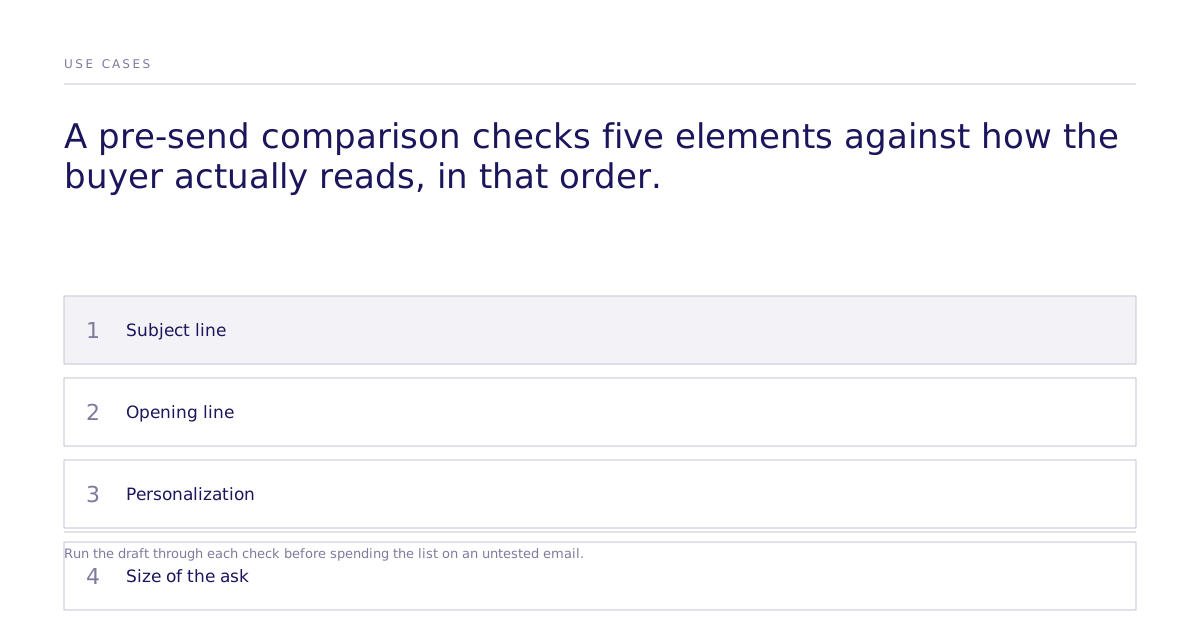
A controlled comparison puts each version of the subject line, opening line, and ask in front of the same target buyer segment and reads which change moves whether the buyer opens, keeps reading, or replies. That produces a causal answer about which element is doing the work, in the order a buyer actually encounters the email.
| Check | What it tests | What a failed check tells you |
|---|---|---|
| Subject line | Whether the buyer opens the email at all | The subject line, not the body, is the actual conversion event |
| Opening line | Whether the buyer can tell what the email is asking for | A vague opening will not be saved by a strong body |
| Personalization | Whether the specific detail reads as researched or as a mail-merge field | Buyers can tell a real reference from a templated one |
| Size of the ask | Whether the request is reasonable this early (a short reply or a brief call, not a thirty-minute meeting) | An over-ask reads worse than an under-ask |
| Predicted reply | What the buyer would actually write back | Shows whether the problem is the message, the targeting, or both |
Independent research on cold-email performance supports checking the subject line first: personalized subject lines outperform generic ones on open rate (Snov.io, 2026), consistent with treating the subject line as the point where most first campaigns are won or lost rather than an afterthought.
Patterns that repeat in untested drafts
A few failure patterns show up often enough to check for directly:
- Leading with the company, not the prospect. The email opens with company background and product description before reaching the prospect's problem. A single number that leaves out its limits functions as marketing. As a planning example, one prior case that moved the prospect's problem to the first line saw open-to-reply rates increase by a factor of three or more; that describes a single instance, not a guaranteed result.
- A soft-sounding ask that is not soft. "Would love to share a quick demo" reads to a buyer as a request for real meeting time, not the low-commitment favor it is meant to sound like. A genuinely soft ask is a yes-or-no question about whether a problem exists right now, closer to a two-line reply or a fifteen-minute conversation than a thirty-minute call.
- No proof at all. An email with no customer name, no metric, and no concrete detail reads as one more unverified pitch. Naming the actual stage honestly, including an early one, reads better than a vague claim of traction the buyer cannot check.
- The wrong channel for the message. Some prospects on a hand-built list of, say, 200 to 800 names read more like a warm introduction or a direct message than a cold email. Sending everyone the same email regardless of channel fit lowers the response rate for the list as a whole.
Is the list being tested too?
The same comparison that evaluates the email also evaluates the list. If a draft reads well for one part of the target segment and poorly for another, that gap says as much about who is on the list as it does about the message. This matters most for a first campaign, where the list and the message are usually built by the same person, in the same sitting, on the same assumptions. Testing the message against the segment separates those two variables, something a single reply rate from the live send cannot do.
How is the comparison run as a causal experiment?
Subconscious can run this comparison as a randomized experiment: the same target buyer segment sees each version of the subject line, opening line, and ask, and the result isolates which specific change moves open and reply behavior, rather than relying on founder or peer opinion about which draft feels right. Where the decision benefits from checking a simulated read against real people, Subconscious can also test or validate the same study with real human participants without changing the underlying question. See how this fits into a broader research workflow.
What this does not cover
Naming what a method cannot do is what lets a buyer check the claim against reality. Testing a draft before it sends does not replace deliverability engineering, list-building judgment, or a founder's read of an individual prospect relationship. It tests a message and targeting hypothesis before the list is spent. It does not guarantee a reply rate, and it does not substitute for running the actual campaign and reading what comes back.
The email is going to send either way. The question worth answering first is whether the draft in front of you is the one that deserves the list's one shot, or whether a specific line in it is quietly costing the reply. Book time to run the comparison before the next send, or see the underlying research approach behind it.