Simulated Personas vs. Causal Experiments: What to Trust Before a Launch Decision
Before a launch decision, inspect how a simulated response was produced and what outcome it estimates. A plausible persona answer can suggest hypotheses. A defined randomized task can estimate a modeled comparison. Neither form alone establishes how customers will respond to the launch.
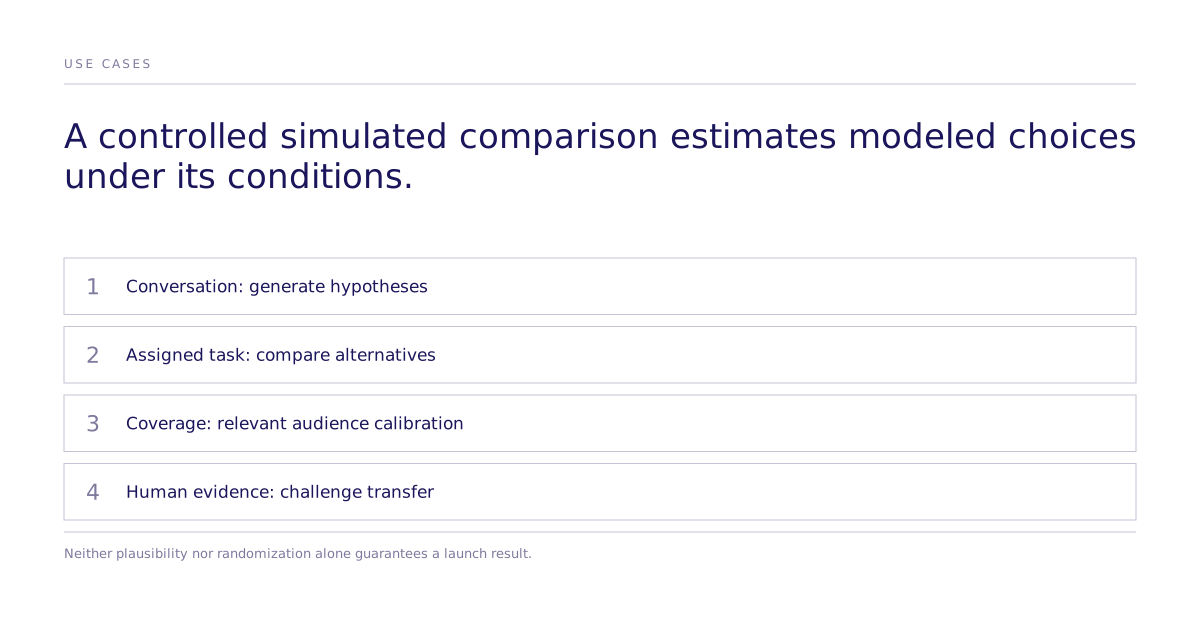
What evidence does a simulated persona response supply?
A buyer profile, customer-data summary, or role prompt can supply context for a generated response. Inspect the inputs and their provenance. A convincing biography or answer does not establish population coverage, a treatment effect, or human validity.
A single unassigned persona conversation supplies a proposed reaction to the prompt. Repeated conversations can produce a response distribution, and conversational tasks can use randomized assignment. The response format itself does not establish the design or whether generated reactions predict human choices.
Subconscious can structure randomized comparisons of specified alternatives within a defined modeled population. Prespecify the generated-choice endpoint, estimator, and supported uncertainty. The estimate concerns that task; inspect calibration and relevant independent evidence before translating it to a launch outcome. Review the research within its reported scope.
Three moments where this decision shows up
A concept needs a directional read before a fielded study is scheduled
Request a scoped schedule based on audience access, stimuli, recruitment, fielding, and analysis. Compare feasible human and simulated methods against the decision’s evidence requirements and deadline.
A simulated comparison can estimate modeled choices for defined concepts. Market-share forecasts need competitive offers, population coverage, a choice model, and relevant behavior validation; fielding a stated-choice sample alone does not make them precise.
What if access to the relevant stakeholders is difficult?
Access to executives, journalists, regulators, or investors can constrain a particular study. Check feasible interviews, recruited studies, existing evidence, and their costs before choosing a simulated comparison. A modeled role’s response does not establish the views of actual named stakeholders.
What decisions are too small to justify a study but costly to get wrong?
For a campaign or pitch decision, scope the evidence to reversibility, uncertainty, and cost of error. Confirm calibration for the intended buyer segment; a broad model does not by itself justify acting without a human study.
Where a simulated read still falls short, chat-based or causal
- Novel categories. Check whether relevant calibration and behavioral evidence exist. Exploratory interviews or observation may help define an unfamiliar need or task before a comparison is designed.
- Human-population validity. A modeled experiment can produce precise task estimates while retaining model error or coverage gaps. A fielded human sample also needs appropriate recruitment, assignment, and measurement. Report uncertainty and inspect relevant validation before making claims about buyers.
- Observed experience. A generated verbal response does not observe a person using the product. When physical interaction or contextual behavior matters, choose an appropriate observational or behavioral method; neither a verbal answer nor observation alone establishes an unspoken emotion.
A randomized simulated task estimates its defined modeled outcome under the assignment and analysis assumptions. Clinical outcomes, usability behavior, and market performance require evidence matched to those endpoints.
Three ways to test the same decision
| Method | What it actually tests | Where it's strong | Where it falls short |
|---|---|---|---|
| Fielded human study | Actual participants’ measured responses under its specified method | Relevant human experience and behavior when appropriately measured | Recruitment, assignment, measurement, uncertainty, and market transfer still need evaluation |
| One unassigned AI persona response | A generated reaction to supplied context | Developing possible objections or hypotheses | Does not alone establish a treatment effect, a population distribution, or human validity |
| Randomized modeled comparison | Effect of assigned alternatives on a specified generated-task outcome | Comparing defined options with supported uncertainty | Model error, audience coverage, and human or market transfer require relevant evaluation |
Validating a simulated read before it drives a decision
Three checks before it feeds any real decision:
- Relevant backtest. Test several known outcomes with held-out evidence and a disclosed metric. One match does not validate all new questions; one mismatch identifies a limitation to investigate. Northwestern researchers discuss limits of LLM-based behavioral research, including fit to the population and task.
- Internal cross-check. Compare generated responses with relevant product evidence already available, such as support tickets or survey feedback. Differences can identify hypotheses to investigate; these sources are not interchangeable endpoints or automatically representative samples.
- Matched human validation. When existing evidence does not resolve material uncertainty, scope an independent human study on the same question. Confirm recruitment, exposure, measurement, and delivery responsibilities. The causal question can remain while stimulus delivery and the design are adapted.
The smallest next step
Pick a specific decision and define the intended population, context, alternatives, and outcome. Decide whether exploratory discovery, existing evidence, or a new comparison addresses the uncertainty. For an effect question, specify assignment and measurement before reviewing a result.
Interpret the result with its uncertainty and validation limits; it may be useful, inconclusive, or a reason to investigate further. Review the study structure, applied decisions, and how we work to scope the evidence for the actual launch.