A Single Buyer Profile Is Not a Controlled Comparison
A single buyer profile organizes beliefs and evidence about a buyer. It does not alone establish which positioning line, pricing change, pitch, or feature will improve behavior across a market. Define the intended decision and inspect what the profile’s source evidence supports.
That distinction matters before a launch, sales push, or engineering quarter. The cost of choosing poorly appears later as a missed message, a weak sales cycle, or roadmap capacity committed to the wrong action.
One coherent answer can hide buyer disagreement
One unassigned generated response cannot establish a treatment effect or human-population validity. Repeated responses can supply a modeled distribution, but repetition alone does not establish representativeness. Conversational tasks can be randomized; inspect the actual assignment, measurement, and validation before interpreting a comparison.
Xiao and colleagues’ April 2026 preprint evaluates persona homogenization in personality, moral-reasoning, and self-introduction tasks. Separately, Sfeir and colleagues’ choice-modeling preprint studies assistance with utility specification and estimation using supplied datasets. That second paper does not validate LLMs as synthetic choice respondents.
"behavioral variation tracks coarse demographic stereotypes rather than the fine-grained individual differences specified in each persona."
Xiao and colleagues, arXiv preprint "The Chameleon's Limit: Investigating Persona Collapse and Homogenization in Large Language Models" (source)
The methods answer different questions:
| Evidence method | Useful for | What it cannot establish alone |
|---|---|---|
| Customer interviews, CRM notes, and win/loss calls | Capturing buyer language, objections, and past behavior | Which unlaunched action will cause a better outcome |
| One unassigned generated response | Surfacing a plausible reaction to a prompt | A treatment effect, comparison baseline, population distribution, or supported uncertainty |
| Randomized comparison across a modeled population | Estimating a specified generated-task effect under the assignment and analysis assumptions | Human-population validity or future market performance without relevant validation |
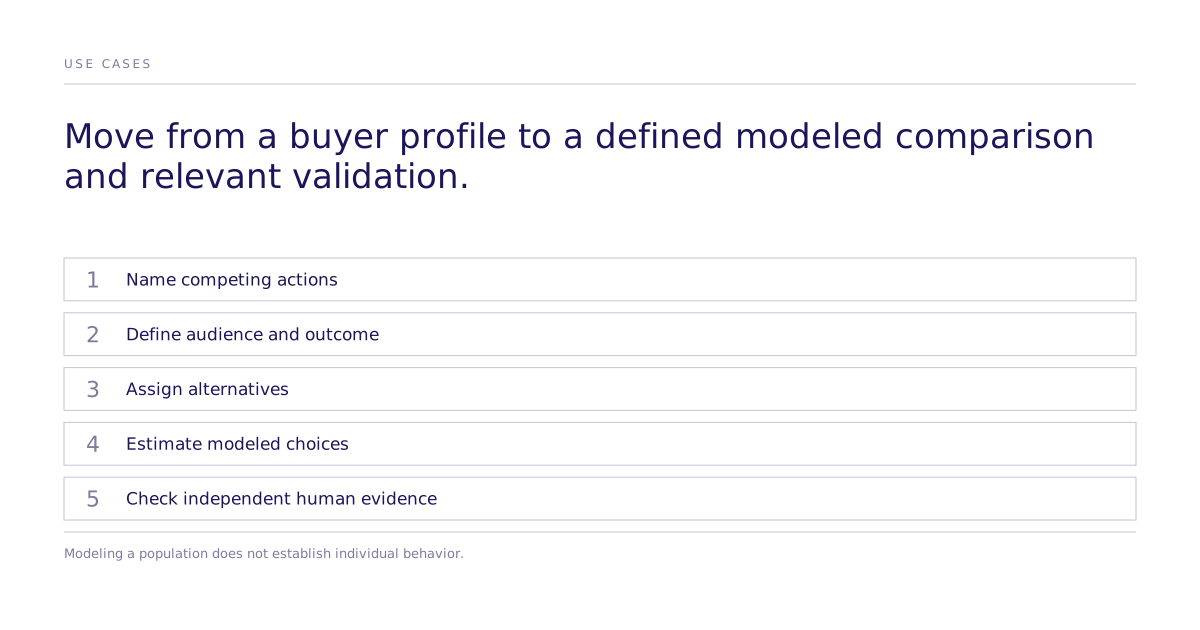
How do you turn a launch choice into treatments?
An effect question needs a defined comparison, assignment, and outcome. A conversation can be part of that task, but a single unassigned answer does not establish the effect.
Name the actions: a positioning test might compare two value propositions, a roadmap test two feature descriptions. Define the audience, exposure, and task endpoint, such as a generated choice between the options. Actual purchases or usage require separate behavioral measurement.
Subconscious can structure randomized discrete-choice-style comparisons within a modeled population. Prespecify the task endpoint, estimator, and supported uncertainty. Interpret the result within the design and check calibration and independent validation for the intended buyer decision.
How do you match the audience to the decision?
Confirm coverage and calibration for the modeled buyer population. A representation does not imply recruited participation or validate an individual’s response.
Define the relevant buyer roles and confirm their coverage and calibration. If a buying committee contains different roles, inspect appropriate comparisons for those roles instead of treating one profile as every participant’s view.
This method is useful when the team can state the alternative actions:
- Compare value propositions before selecting a positioning line.
- Compare pitch framings or objection responses before a sales push.
- Compare candidate headlines or claims against a defined buyer population.
- Compare feature descriptions before committing roadmap capacity.
- Compare configured pricing scenarios without implying automatic price optimization.
Carry the same causal question into human validation
A modeled population does not establish an individual’s behavior or guarantee launch performance. Interviews, CRM records, and win/loss calls can supply relevant context and existing evidence. Inspect their design and provenance before inferring that a proposed action caused an outcome.
Scope matched human validation when the decision’s remaining uncertainty and downside justify additional evidence. Confirm who recruits and fields participants, their exposure, and the measured outcome. Preserve the comparison question while adapting the study design; review method evidence within its reported scope.
What should you define before committing the budget?
Write down the action, alternative, audience, and outcome before asking for an answer. Open-ended buyer discovery may help define those elements. For a causal comparison, specify assignment, estimation, and relevant validation before treating an apparent preference as decision evidence.
See how a study is structured, then use the live walkthrough to frame the first comparison.