Social Listening Tools Can't Tell You How Your Audience Will React
A social listening dashboard can tell a brand or comms leader what people have already said about a topic. It cannot tell them how those people will react to a message, concept, or crisis response that hasn't published yet. The question this raises: when is monitoring data enough, and when does a team need a forward-looking experiment before committing budget or reputation to a message?
What do social listening tools actually measure?
Social listening tools crawl public conversation on social networks, forums, blogs, and news sites, then aggregate what has already been published into volume, sentiment, and trend data (Sprinklr, "Social Listening: A Complete Guide for 2026"). A related but distinct discipline, social media monitoring, tracks direct brand mentions and engagement in near real time rather than analyzing broader conversation trends (Pulsar Platform, "What Is Social Listening? Definition, Examples & Tools (2026)").
Both jobs are retrospective by design. They can surface a spike in negative sentiment, a competitor's new claim, or a trending complaint. Neither can show how an audience would respond to a message it hasn't seen, because nothing in a crawled archive reflects a reaction to content that doesn't exist yet.
The decision this creates for brand and comms leaders
Once a listening tool surfaces a signal, the team still has to decide what to say next, and getting it wrong carries real cost. A message, campaign, or crisis response that backfires with the target audience is usually discovered only after it publishes, once spend and reputational exposure are already committed.
The question isn't whether to keep monitoring. It's whether monitoring data alone justifies publishing a response, or whether the response needs testing against the audience first.
Why can't detection tools answer that question?
A monitoring or listening platform has no mechanism to show a message to an audience and record how that audience actually responds; it's built to observe conversation that already occurred, not to run an intervention. Testing a draft statement, concept, or crisis response requires putting that content in front of a representative slice of the audience and comparing candidate versions, a different kind of tool doing a different kind of job: an experiment, not a crawl.
Historically, that meant commissioning a traditional research study that could take weeks. For a fast-moving crisis or a tight timeline, that lag is often why teams end up publishing on intuition instead of evidence.
Testing a message before publication
Subconscious runs a controlled, randomized experiment on the audience segment a message is meant to reach, comparing candidate messages or response options head-to-head, before anything publishes. That produces a causal read on which option performs better with that audience before it ships.
Subconscious can run controlled studies against a person-level audience graph covering 800 million real people. That graph is distinct from a recruited real-human panel: it's the basis for reaching a representative segment, not a pool of people who've already agreed to be surveyed. Where the decision calls for it, Subconscious can also validate studies with real human participants, moving from a fast pre-publication read to real-human validation without changing the underlying causal question. See how the method works.
Where this fits alongside monitoring tools
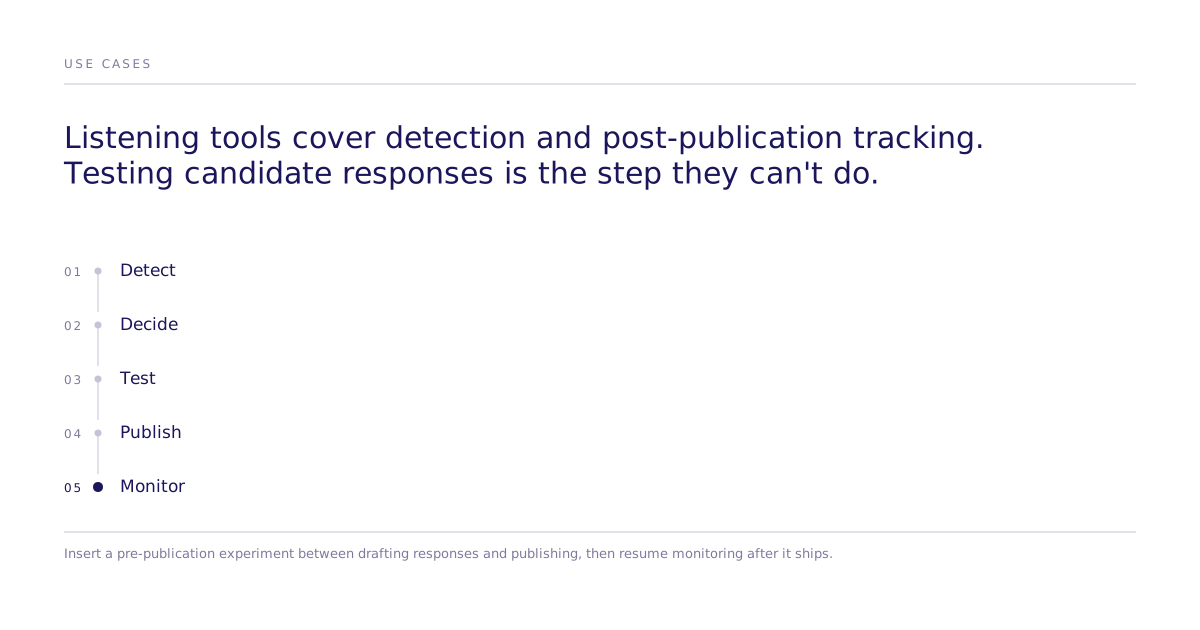
A pre-publication experiment complements social listening rather than replacing it. A practical sequence:
| Step | Job | What answers it |
|---|---|---|
| Detect | Notice a shift in sentiment, a competitor move, or an emerging complaint | Existing social listening or monitoring tools |
| Decide | Draft two or three candidate responses or messages | The comms or brand team |
| Test | Compare candidate responses against the affected audience segment before publishing | A randomized pre-publication experiment |
| Publish | Ship the response that performed best in testing | The comms or brand team |
| Monitor | Track how the published response actually lands | Existing social listening or monitoring tools |
Monitoring still owns detection and post-publication tracking. Testing owns the gap in between: deciding what to say once something needs a response.
What doesn't this replace?
A published limit gives a buyer something to check before trusting the method. Subconscious does not detect real-time public conversation, brand mentions, or emerging trends. A pre-publication experiment estimates how an audience is likely to react under controlled conditions; it doesn't guarantee the outcome once a message is live, subject to real-world context, timing, and reactions the study didn't model. Teams that need representative market sizing, precise elasticity curves for final pricing decisions, or longitudinal purchasing data over months still need the research methods built for those jobs.
Next step
If a team already has a monitoring tool signaling that a response is needed, the open question is usually which response to publish. See how a pre-publication message test is structured, or look at applied examples before scheduling a walkthrough.