Stakeholders Don't Need More Data. They Need a Decision.
A stakeholder wants the answer tomorrow. A report draft appears before the analyst has finished reading the data. A manager asks whether the team can automate the first pass. The answer is not another dashboard: use a causal experiment to produce a directional read, review the assumptions, then validate consequential findings with real people before the launch, price change, or campaign ships.
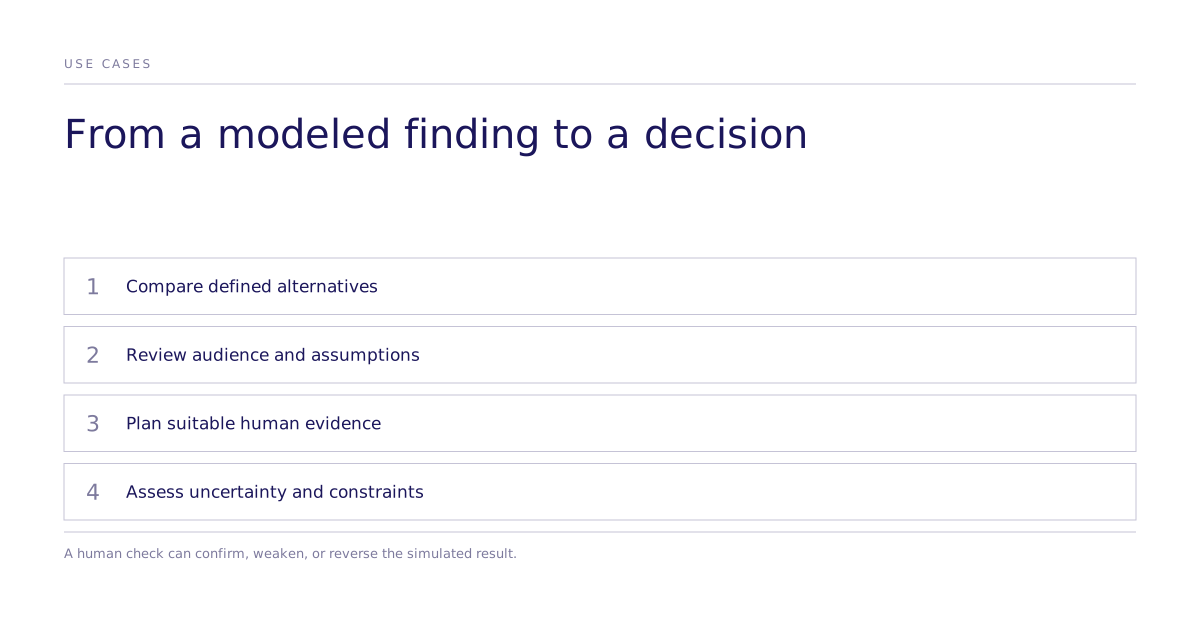
More output does not resolve the decision
For a market-research team, the risk is not that every task disappears. It is narrower: being asked for more dashboards while decisions stay stuck. As drafting and summarization get easier to automate, the analyst has to move closer to the decision, not further from it.
The current BLS outlook projects growth in market research analyst and marketing specialist employment over 2025–2035. That projection concerns employment; the case for more evidence review is a separate judgment about research work.
A number without its limits reads as marketing. A stakeholder acts on a plausible finding as if it were proven, then greenlights a product, pricing, or campaign decision based on an unvalidated read of customer behavior.
What actually changes in the analyst's job?
Expertise used to live partly in access: knowing how to field a study, clean responses, and package a finding. Automated drafting and synthesis narrow that advantage. A first-pass survey, transcript summary, or reaction to a concept is easier to produce.
The bar for proving expertise has moved: with a fluent answer available to anyone, value sits with whoever can judge which answer deserves trust, and trace which stage of the workflow it came from.
How do you separate a directional read from a validated claim?
Exploration can propose hypotheses and alternatives. A defined simulated comparison can then estimate a directional difference in generated responses. Before an expensive or public claim reaches a deck, check it against the relevant human endpoint.
Subconscious runs controlled randomized experiments in a simulation of the market. Carry the decision question into a human comparison with aligned alternatives and outcomes, documenting changes in recruitment, instrument, and delivery.
Define the study population, alternatives, endpoint, and calibration evidence before reading the result. Uncertainty reported by a simulation concerns its specified model and design; it does not automatically cover error in transferring the result to real buyers.
| Stage | What it can support | What remains unresolved |
|---|---|---|
| Simulated experiment | A directional comparison between defined actions, messages, or concepts | Whether the result holds with recruited real-human participants |
| Real-human validation | A check of the same causal question with real people | Whether the result guarantees market performance or financial return |
Naming what still needs review is what lets a buyer check the work. Audience definition, source quality, possible bias, and the level of evidence the decision requires still need human review.
Interpretation is the analyst's product
The mistake is confusing data access with understanding. It usually comes from pressure: a tool gives a fluent answer, and the deck needs a conclusion. An automated first pass can produce a useful hypothesis. It cannot decide on its own whether that hypothesis is valid for the decision in front of the team.
Make the boundary part of the deliverable. State what the simulated work tested, what it did not test, and what still needs validation before the business acts.
What the workflow deliberately leaves to the team
For this decision, the analyst owns the question, audience definition, evidence review, and recommendation. Agree the deliverable and the validation still needed with the team before a directional result reaches a stakeholder.
The team can keep the causal question consistent across a simulated experiment and real-human validation, while keeping a directional signal distinct from evidence suitable for a consequential decision.
Put one live decision through the workflow
Do not rewrite the whole research process at once. Start with one visible workflow:
- Pick a real project tied to a live decision.
- Write the business decision in one sentence.
- Define the audience and how much confidence the decision requires.
- Use a simulated experiment for the early, directional stage.
- Have a person check the output by hand, flagging what holds up, what is shaky, and what should not drive action.
- Present the answer with a clear caveat and, where the decision is expensive or public, a recommended real-human validation step.
Repeat that once a week for a month: directional evidence for exploration, explicit human review, and validation where the business is about to act on the answer.
For the buyer-decision side of that process, how Subconscious runs a causal experiment and the worked examples in the case studies show how the sequence applies to a product, pricing, or campaign decision. Reviewing active research is a useful next step once a team has a specific decision to test.