Synthetic User Research Platforms: Which Method Fits Your Decision?
Synthetic user research is now a practical category with real tools and real buyers. The harder question isn't which vendor to pick. It's which type of synthetic method answers the decision a research, product, or marketing leader faces, before budget or engineering time is committed.
What synthetic user research covers
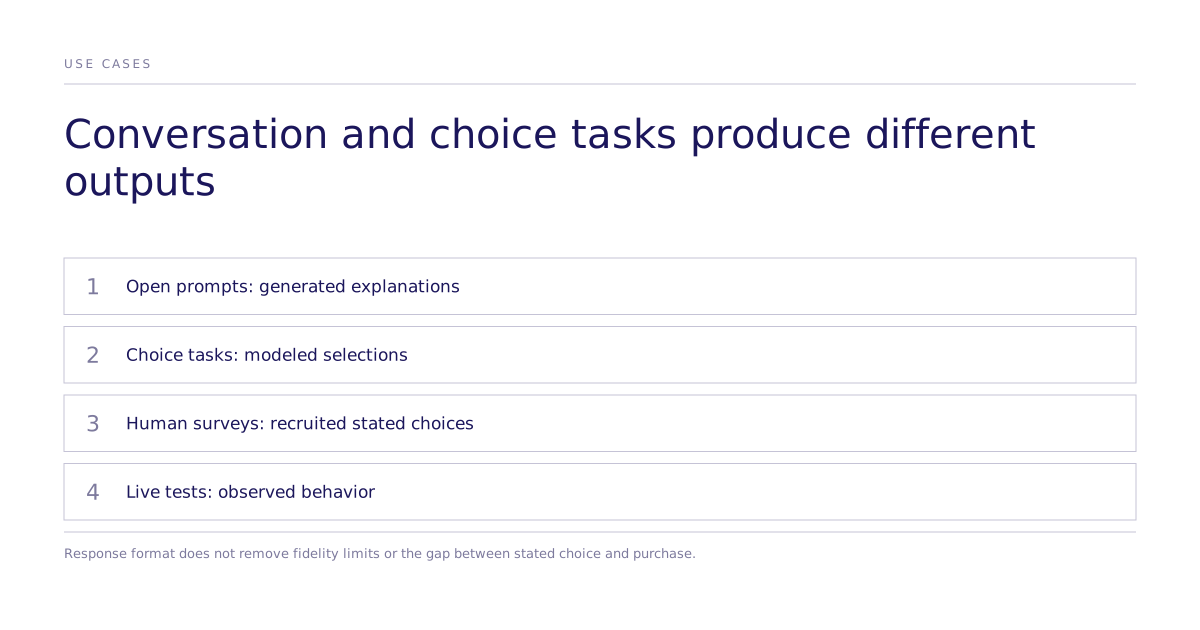
The category includes open-ended simulated conversations and structured comparisons of alternatives. Response format changes what can be analyzed, but a generated selection is still a modeled choice rather than observed human behavior.
Both are useful. They are not interchangeable, and picking the wrong one is the real risk.
The buyer's real choice
A team evaluating this category usually chooses between two shapes of tool:
| Method type | What it produces | Fits best when |
|---|---|---|
| Open-ended AI persona or panel chat | Directional impressions from simulated conversation with a calibrated persona | The question is exploratory: early concept reactions, tone-checking a message, surfacing objections before a decision is framed |
| Focus-group-style AI moderation | A simulated group discussion, structured like a familiar qualitative session | The team wants to explore discussion prompts or possible reactions before deciding whether a human moderated session is needed |
| One-off report generation from temporary personas | A generated report comparing a described concept against freshly created personas | A single occasional question needs an answer fast, with no ongoing persona library or team workspace |
| Controlled choice comparison | Differences in modeled selections between specified alternatives, with uncertainty where supported | Narrow a product, price, or message comparison before checking relevant human outcomes |
An open-ended session proposes reactions and objections. A structured choice comparison estimates which alternatives configured respondents select under specified conditions. Generated choices remain modeled responses; recruited stated choices and observed purchases are separate evidence.
Where do directional synthetic tools fit?
Open-ended persona and panel tools are the right choice earlier in a process, before the team has a short list of alternatives to compare. They also fit teams whose primary need is a lightweight, ongoing sense of a customer type across product, marketing, and sales, without a designed experiment for every question.
Focus-group-style tools and one-off report generators serve a narrower version of the same job: an occasional, self-contained read, useful when the research cadence is infrequent and the stakes are low.
Generated conversation is not observed human behavior. Persuasive language or a plausible response can still misrepresent the intended population. The ACM Interactions critique of synthetic personas raises this validity concern; check the tool’s actual validation and safeguards rather than assuming it can detect every error.
Where does a controlled experiment fit?
Subconscious compares defined alternatives on a simulated population and can support a matched human check. Inspect the design, choice endpoint, model uncertainty, and fidelity evidence. Whitty and colleagues’ think-aloud study compared acceptability of DCE and best–worst scaling among 24 participants; it does not validate synthetic choices or commercial outcomes.
"The majority (18,75%) of participants indicated a preference for DCE, as they felt this enabled comparison of alternative full profiles."
Whitty and colleagues, PLoS ONE (source)
Define the modeled population for the actual decision and check which roles and segments calibration evidence supports. The evidence record reports aggregate parameter-rank replication results and their limits; modeling a segment does not imply access to recruited members.
What doesn't a controlled experiment replace?
A simulated choice comparison estimates differences in generated responses under the configured design. It does not observe interface use, discover every unprompted objection, or establish in-market performance. Select usability, qualitative, or field research for those endpoints.
A simulated result is a provisional input. When the decision depends on transfer to people, plan real-human validation of the same question. Low stakes may justify using a hypothesis with limited checking, but do not establish fidelity.
Making the call
Four questions determine which method fits:
- Do you have a short list of alternatives, or are you still forming one? A short list points toward a controlled experiment. An open question still being explored points toward a persona or panel.
- What's the cost of guessing wrong? A pricing, launch, or positioning decision justifies a measured comparison. A low-stakes, easily reversible call doesn't need one.
- What's your research cadence? Frequent, exploratory conversations fit a persona tool. A decision that needs to be defensible, not just plausible, fits a designed experiment.
- Does the decision need to survive scrutiny? Record the source, design, endpoint, conditional uncertainty, and relevant human check. An interval around a modeled comparison alone does not establish a human effect.
A research program can use generated conversation to explore alternatives, then a controlled comparison to measure modeled choices among them. Check the human endpoint the decision requires. Book time to scope a specific question.