Test Crisis Apologies and Press Releases Before They Go Public
A crisis-communications lead has to choose which framing to publish first: an apology that leads with accountability, one that leads with the remediation plan, or one that leads with reassurance. Once the statement is public, the choice cannot be withdrawn or retested. The wrong framing can turn a manageable incident into a lasting loss of trust with the audience that matters most.
Why do crisis statements usually ship untested?
Most corporations have a crisis-communications plan, but the plan covers process, not content. It says who to call and when to issue a statement, not whether the statement itself will land the way the team intends.
Testing a draft apology or press release means showing sensitive material to outside people before it is public, which creates confidentiality risk. It also runs into a timing problem: a live crisis compresses the review window, and there is rarely room to schedule a traditional study before a statement has to go out. The result is that most companies find out whether their crisis communications worked the same way they find out whether an ad worked: by watching the public reaction after the fact.
What does a bad framing cost?
The 2023 Bud Light boycott cost Anheuser-Busch InBev more than $1 billion in lost sales (CNN Business, 2024). United Airlines faced a comparable reckoning after a passenger was dragged off an overbooked flight in 2017, a response that became a defining case study in how a mishandled statement compounds an operational failure (Fortune, 2017). Neither company's underlying incident alone explains the damage. Both show how much a communications response can add to, or subtract from, the cost of a crisis.
Framing this as a causal test, not a review
The underlying decision is not "does this statement read well." It is "which framing changes how the affected audience responds." That is a causal question: hold the facts of the incident constant, vary the framing, and estimate which variant moves the audience's stated reaction most in the intended direction.
Subconscious is built to test actions like this as a randomized experiment rather than a single reviewer's judgment call. A crisis-comms team can compare framings such as accountability-first, action-first, and reassurance-first against a defined audience segment and get a causal estimate of which framing performs better, with uncertainty attached to the result.
| Approach | What it measures | Confidentiality exposure | Best fit |
|---|---|---|---|
| Publish and observe | Real-world reaction, after the fact | None before publication | Never; the statement is already irreversible |
| Traditional focus group or interview panel | Stated reaction from recruited participants | Requires disclosing sensitive material to outside people | Longer review windows where legal or regulatory rigor requires it |
| Randomized experiment on a simulated audience | Causal comparison between framing variants, with uncertainty | Can be run on an anonymized version of the scenario | A first pass to narrow framing options before any human sees the real statement |
Testing an apology: a worked example
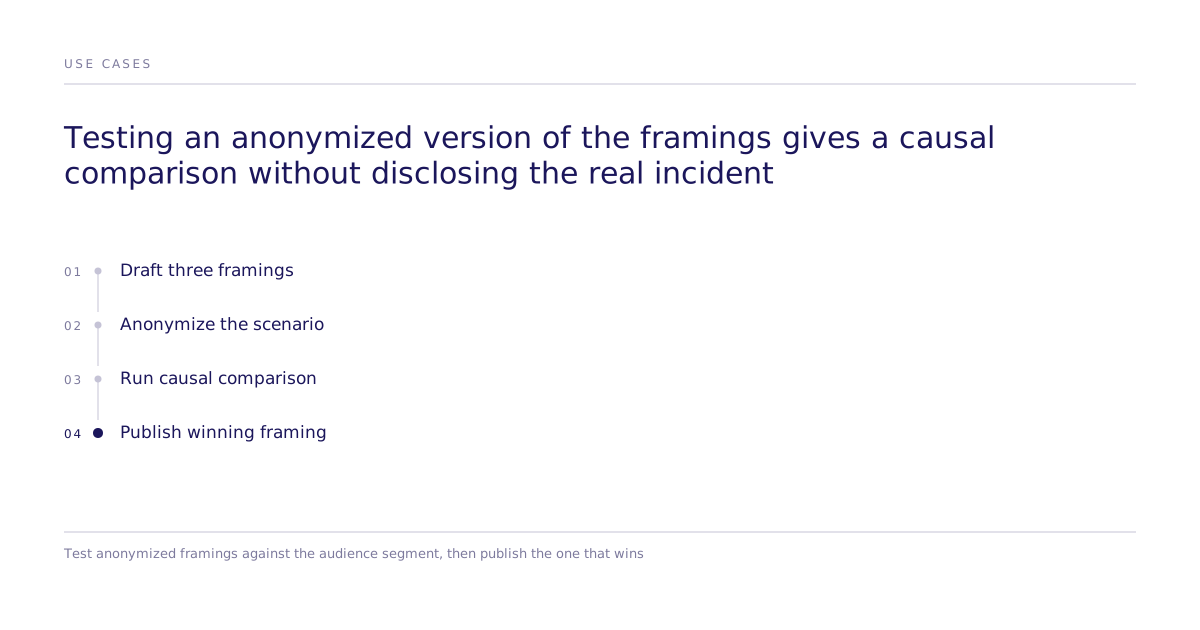
Consider a company that has to notify affected customers after a data breach and has drafted three candidate apologies: one that leads with accountability and a clear account of what happened, one built around the corrective steps the company is taking, and one that leads with reassurance about safeguards going forward.
Running the three drafts as a controlled comparison against a defined audience segment answers a specific question: does this audience respond more strongly to accountability, to action, or to reassurance? The output is a causal comparison between the candidate framings, not a single reviewer's preference.
Press releases face a multi-audience problem
A crisis press release has to satisfy several audiences that do not want the same thing: the press wants news, investors want the financial picture, customers want reassurance, and regulators want compliance clarity. A release optimized for one audience can read poorly to another.
The same experimental logic applies: define each audience segment explicitly and test whether a given framing moves that segment's stated response in the intended direction. A capability worth publishing includes the case where it does not apply. Segmenting by named professional role, such as journalist, investor, or regulator, is a study design choice a team should confirm is supported for its case, not a standing feature of every comparison.
The confidentiality objection
A common objection to pre-testing crisis material is that testing requires disclosing the incident before it is public. The answer is to test the anonymized framework rather than the specific disclosure: hold the company and incident details generic, and vary only the structural choice under test, such as whether an apology leads with action or with explanation, or whether a release states a specific remediation commitment. That structural question can be tested before any real crisis occurs, so a team enters an actual incident already knowing which framing pattern performs better for its audience.
Moving from simulation to human confirmation
Subconscious can run these controlled comparisons against a person-level audience graph covering 800 million real people. A number without its scope invites the wrong assumption. That audience graph is the population a study can define and query. It is not a recruitable panel of people signed up to participate. When a decision is consequential enough to warrant it, Subconscious can also test or validate a study with real human participants, moving from a simulated comparison to real-human confirmation without changing the underlying causal question being asked.
When simulated testing is the wrong tool
Naming where a method stops is what lets a team pick the right one. A causal comparison on a simulated audience is a first pass, not a replacement for every kind of crisis research. It fits best when a team needs to narrow several framing options quickly and the material is sensitive enough that showing it to outside recruits creates its own risk. It fits poorly when the stakes are existential enough that every element needs full validation, when a regulator or legal team requires a specific research method, or when the evidence needs to be defensible in later litigation. In those cases, traditional research with recruited human participants remains the right tool.
Limitations
A tool's limits belong on the page next to its claims. This is a framing-comparison tool, not a live, always-on crisis-monitoring workflow, and it does not guarantee a specific delivery time. It does not replace legal review, regulatory requirements, or human judgment about what a company can honestly commit to in a statement. Treat any output as one input to a decision that a communications and legal team still owns.
Next step
Teams that want to see how a causal comparison is structured for a specific audience and decision can review the research methodology or how Subconscious runs a study, or book a working session to scope a comparison against their own crisis-response playbook.