Testing In-App Upgrade Prompts Before They Reach a Live A/B Test
A product or growth lead who owns in-app monetization copy has one real decision to make before a new upgrade-prompt variant ships: run it through a controlled pre-production experiment first, or send it straight into a live production A/B test. A live test exposes customers to every weak variant, with possible costs in churn, foregone revenue, and support demand.
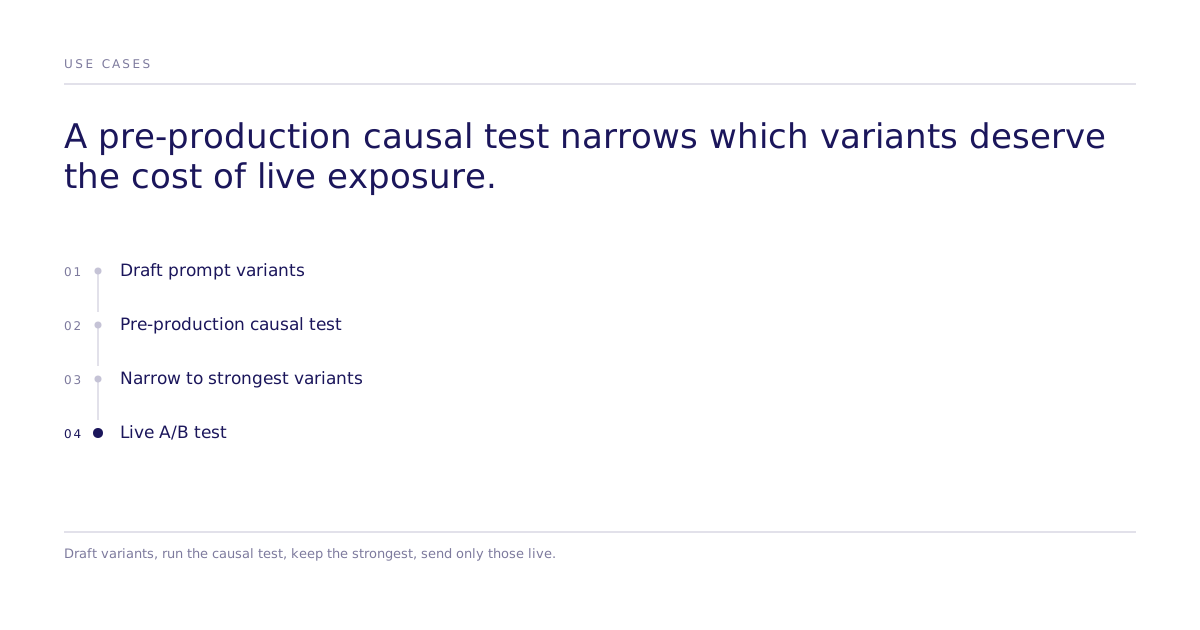
The useful answer is not to replace the production test. It is to decide which wording, price framing, and trigger conditions deserve production exposure.
Decide what earns production exposure
An upgrade prompt is part offer, part product interruption. The team is choosing what to say, when to say it, and which commercial action to ask a buyer to take. A weak choice also risks repeated dismissal of the prompt.
Pricing experiments can affect customer trust, perceived fairness, and brand positioning, while subscription tests may also change retention and expansion behavior beyond the first conversion. Kameleoon's guide to pricing A/B tests describes those commercial and lifecycle effects.
Pre-production and production experiments answer related but different questions:
| Decision stage | Question | Evidence | Boundary |
|---|---|---|---|
| Controlled pre-production experiment | Which wording, price framing, and timing produce the strongest causal response for the defined population? | Causal effects, confidence intervals, and segment differences | Narrows the variants that merit live exposure |
| Live production A/B test | What do customers do in the working product and purchase flow? | Observed conversion, purchase, retention, and support outcomes | Carries the commercial and customer cost of each exposed variant |
Turn the prompt into a causal question
Start with the action the team wants to understand. For example: does naming the blocked feature increase upgrade intent relative to naming the paid tier? Does showing the price in the prompt change willingness to pay? Does the same offer produce a different response after a hard limit than after a successful task?
Then hold the causal question steady while varying the parts of the prompt that the team can act on:
- Wording. Compare the benefit, the blocked action, and the offer without changing the price at the same time.
- Price framing. Compare how the commercial choice is presented while keeping the underlying offer fixed.
- Timing. Test the trigger context as part of the treatment, not as background detail.
- Buyer segment. Define who is making the decision. An individual buyer and a team administrator may respond differently to the same offer.
- Decision output. Require confidence intervals and segment differences rather than a single ranked winner.
Subconscious supports claims tests, pricing-sensitivity experiments, and monadic concept tests for this kind of comparison. The research approach is designed to estimate causal effects against a defined respondent population before a team commits a variant to a live test.
Use planning examples without turning them into promises
Inherited prompt exercises can still be useful when they are treated as planning inputs, not performance claims. A historical example used a twenty-word prompt to focus the review on one compact decision surface. Another planning exercise separated five buyer states and contrasted a one-month trial with a yearly commitment.
Those quantities do not establish a benchmark, forecast conversion, or define the right offer for another product. Their value is practical: they force the team to specify the prompt, buyer, and commitment being tested.
Keep the live test in the evidence plan
A modeled willingness-to-pay signal is not observed purchase behavior, and this use case does not carry a named customer result or a specific accuracy figure.
For a high-stakes pricing decision, carry the same causal question into recruited real-human validation before treating the pre-production result as final. The experiment process should define both the early screen and the production evidence needed to make the shipping decision.
Test the draft already under review
Bring the wording, price framing, trigger, and intended buyer for the next upgrade prompt. Book a walkthrough to map those choices into a controlled comparison and define what the later live test still needs to prove.