Testing a Narrative Before the Board Sees It
The deck is finished. It goes to three colleagues first, each invested in the presenter's success, so each one gentle. Then the narrative meets the executive team or the board, and the first hard question exposes exactly what the friendly reviewers were too polite to name.
Test the narrative against a defined set of buyer or stakeholder perspectives before the room that actually matters, instead of relying only on colleagues who want the presenter to succeed.
Why does internal review miss the break?
Internal review can miss important questions when the brief or reviewer task is unclear.
Relationship pressure. A reviewer may hesitate to challenge the presenter. Assign explicit criteria so disagreement is part of the review.
The reviewer pool is a biased sample. People who already work with the presenter, or already buy into the idea, are not the audience in the room.
Unclear reviewer task. Ask for criticism of evidence and assumptions rather than reassurance about the presentation.
Friendly-review bias is a risk to manage, rather than a universal fact about colleagues. Assign an independent reviewer a specific task: identify unsupported claims, unclear assumptions, and the question the board is most likely to ask. Record disagreements instead of seeking reassurance.
What does a structured test do differently?
A randomized experiment run against defined buyer or stakeholder segments is not a replacement for the real meeting. It is the rehearsal a presenter cannot get from people who already want them to succeed.
Subconscious can compare narrative variants on a configured modeled audience and report differences in generated responses. Check audience relevance and human reader evidence before applying the result to a board meeting.
AI reviewers also need scrutiny. Research on generative AI decision support reports variation across the tested models: some challenged flawed assumptions while others tended to comply. The study evaluates model responses, rather than showing how all leaders or AI tools behave.
| Internal review | Structured buyer-segment test | |
|---|---|---|
| Sample | Colleagues invested in the presenter | Defined buyer or stakeholder segments |
| Bias to check | Relationship and evaluation pressures | Model agreement bias, framing sensitivity, and audience mismatch |
| Output | Comments on clarity, substance, and delivery | Differences in modeled response plus explanations to investigate; the explanations do not identify the mechanism |
| Hard questions | Depend on the assigned reviewer task | Specify them in the protocol and check the generated answers |
A workflow to run before the review
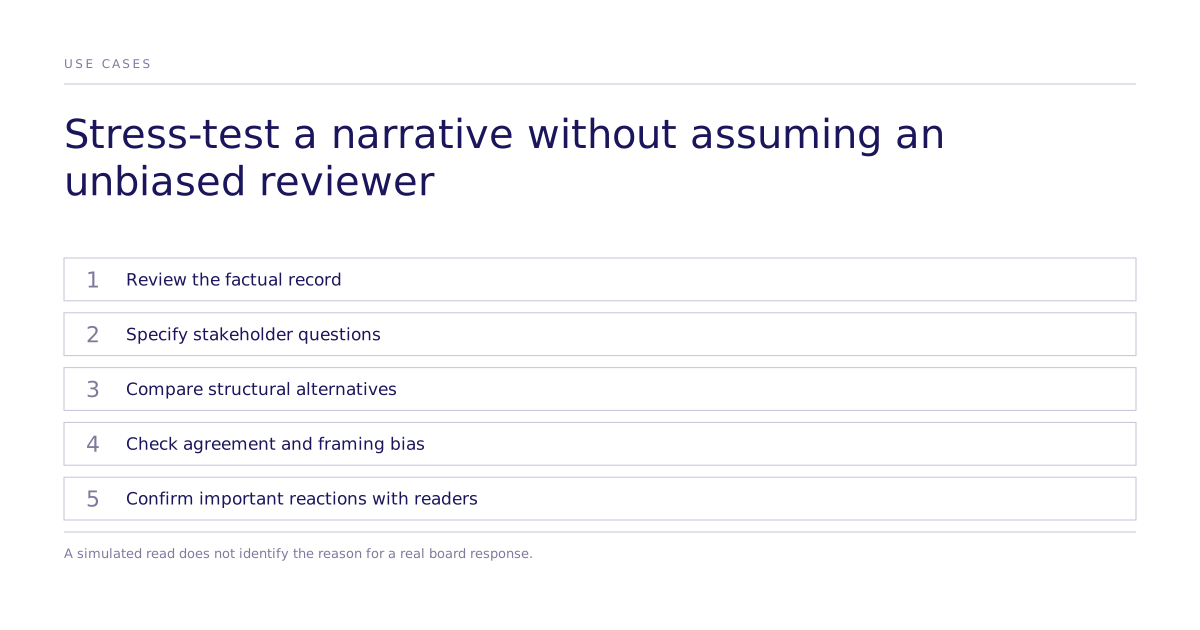
Read the narrative once, flat. Ask one question: what does this say the company does, who is it for, and what is being asked for. Several claims will not land the way the presenter assumed.
Identify the single biggest objection per segment. Different buyer or stakeholder segments will flag different concerns: market size, team, defensibility, go-to-market, competitive position. That is a prioritized list of risks to address before the real meeting.
Test whether the story holds together. Does an early claim contradict a later one? Does the stated ask match the stage implied by the traction shown?
Rehearse the hardest questions. Use the simulated Q&A to propose questions and prepare answers. Verify the factual basis of each answer before the meeting.
Compare the “why now” framing. A draft may leave timing unclear. Comparing versions can show which modeled readers find clearer; confirm important comprehension with actual readers.
What this kind of test tends to surface
Four hypotheses to check in the draft:
- The problem statement is not as universal as the presenter assumed. Segments disagree about whether it is real, big, or urgent, and that disagreement is the market risk, surfaced early instead of in the room.
- The traction or proof point is calibrated wrong in one direction or the other: overclaiming for the stage, or underselling material evidence the deck buries.
- The team or capability slide does not pattern-match to what the audience is looking for.
- The ask is misaligned with the story the rest of the narrative tells.
Limitations and failure conditions
Naming where a test stops is what lets a buyer check the method against the claim. A structured test surfaces disagreement and structural weakness. It does not predict how one board or one buyer will react in the room, and it does not replace the live meeting.
The misses get published next to the hits, so anyone can weigh both. A narrative can score well against every tested segment and still fail because of timing, internal politics, or a mismatch the test was never built to see. The test catches fixable weaknesses in the argument. It cannot manufacture conviction the material does not earn.
The first narrative comparison is simulated. Define what readers must understand and which response is measured, then plan a human check when the decision warrants it. Keep the same decision question while adapting recruitment and delivery as needed. See how Subconscious runs studies. Population coverage and fidelity need evidence for this audience; a generic benchmark does not establish them.
Where to see this in practice
Review the aggregate replication evidence and limits and applied case studies. Neither supplies a board-narrative result for this draft. Scope a reader comparison around the meeting deadline and the questions the board must understand.