Testing Paywall Copy Before You Spend Live A/B Test Traffic
A team with several paywall variants can use a simulated comparison to propose a live-test shortlist. Keep a baseline and credible alternatives where screening error could matter; agree the objective and guardrails before selecting traffic exposure.
Why the paywall decision is expensive to get wrong
At a paywall, a user may upgrade, dismiss the offer, or stop the task. Copy can affect understanding of that choice; price, product value, and the surrounding flow also matter.
CTA wording and offer framing can be tested in a paywall experiment (Qonversion’s guide). Adapty’s guide discusses sample requirements, duration, and overlapping experiments. Choose the variant count and stopping rule around available traffic and the useful effect, rather than assuming a universal cap.
A controlled experiment run against defined audience segments before the live test does not replace the live test. It filters the variant list down to the ones worth spending live traffic on.
Which reader segments decide whether paywall copy works?
Paywall copy has to work for more than one reader at once, and each reader arrives at the paywall in a different state:
| Segment | State when they hit the paywall | What the copy needs to do |
|---|---|---|
| Delighted power user | Uses the product regularly, hit the limit because the product is delivering value, ready to pay | Get out of the way, confirm the value already proven, make upgrading the obvious next step |
| Annoyed power user | Uses the product regularly, hit the limit mid-task, feels interrupted rather than served | Acknowledge the friction, offer a clear fix, avoid making heavy use feel like a penalty |
| Evaluating user | Has explored the product for a short time, understands roughly what it does, has not decided it is worth paying for | Do real persuasive work, since this reader has not crossed the belief threshold the power user already crossed |
| Accidental visitor | Triggered a paid feature without meaning to, is looking at an unexpected modal | Explain what was touched and why it costs money, or provide a clear path back to the free tier |
When one variant serves several segments, assess the relevant readings together. Use targeted variants where feasible. "Write clearer copy" is not an actionable instruction on its own, because clarity for one segment can read as a mismatch to another.
Should paywall segments come from a generic template?
The segment definitions above are a starting shape, not a fixed persona set. A defined segment should come from the team's own paid and free user data, not an assumed archetype: job function, company size, use-case depth, and frequency of use are the kinds of traits that separate a paying user from a free user, and those traits differ by product. A B2B workflow tool and a consumer creator tool will not share the same power-user profile, and copy tuned to one will not automatically work for the other.
The free-tier segments, the evaluating user and the accidental visitor, are harder to characterize because there is less behavioral data on them. A rough profile built from available usage data is still more useful than an untuned, generic one.
Running the pre-test before the live test
- Write variants that stake out different strategic positions, not small wording tweaks of the same idea. A value-reminder framing, a scarcity framing, a social-proof framing, a direct-utility framing, and a minimal framing that gets out of the reader's way are different bets.
- Run every variant against every segment. Ask each defined segment what it would do next on seeing the copy and what it would need to read before upgrading. This surfaces which variants fail, and the failures are often not the ones a team expects.
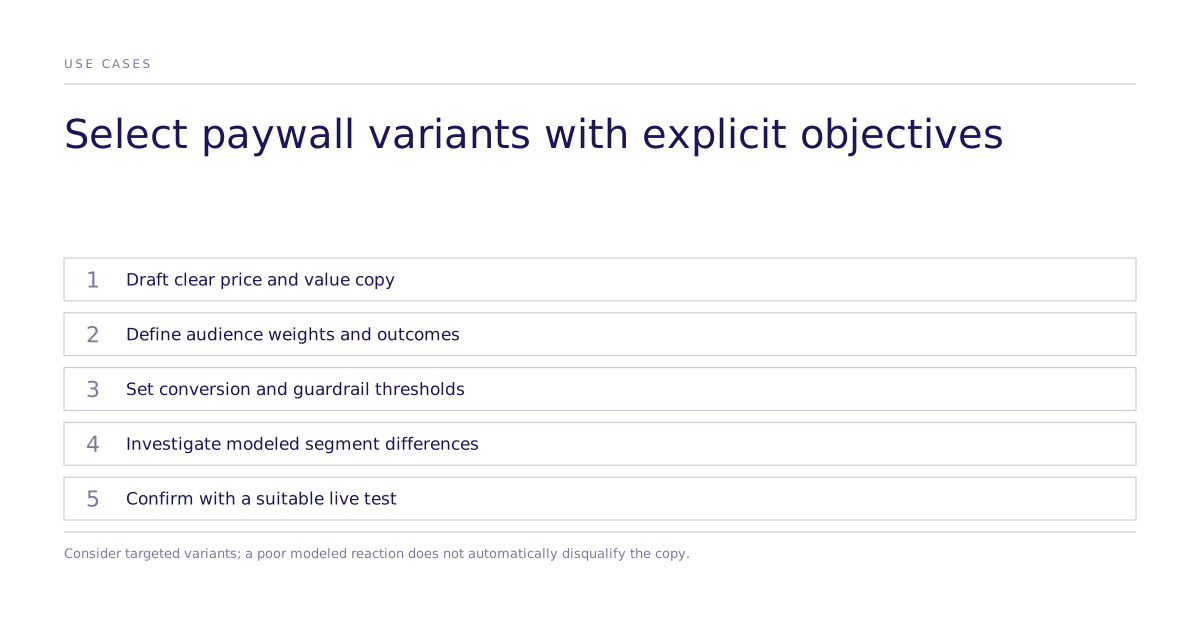
- Prespecify the selection rule. Weight segments to the intended audience, set conversion and guardrail thresholds, and consider segment-specific copy where feasible. A single poor modeled reaction should trigger investigation, not automatic rejection.
- Stress-test the candidates. Ask what is confusing or unearned, then investigate those lines. Generated explanations do not establish which line caused lost conversion.
- Take the shortlist, baseline, and credible challengers into the live test. The synthetic screen can propose candidates, but may miss a useful variant. Measure actual upgrades and the planned retention guardrails.
Hypotheses to investigate in the pretest
Recurring patterns worth checking for directly:
- Compare copy centered on paid features with copy acknowledging the task interrupted. Check both comprehension and the relevant live conversion endpoint.
- Test whether showing price and value together helps readers understand the offer. Preserve clear price and billing terms in every variant; do not assume that de-emphasizing price improves conversion.
- Check whether the “not now” path is clear, accessible, and respectful. Model comprehension first, then measure any conversion and retention effect rather than assuming that an unfriendly exit causes churn.
- Compare recognizable customer proof with specific, verifiable usage details; keep each claim sourced and appropriate for the audience.
These are candidate comparisons, not findings from a published paywall study. Simulated reactions can help refine them, while live conversion and retention are the commercial endpoints.
What does a paywall pre-test not replace?
A pre-test experiment does not predict the live A/B test's exact result, and it is not a substitute for direct customer discovery or for observed churn and retention data once a variant ships. The pretest can inform the candidate list. Manage overlapping experiments separately, and measure conversion and retention in the live test.
Subconscious can compare paywall variants using generated upgrade choices as a modeled endpoint. A matched human check can test the same question, and a live experiment can measure actual upgrades and retention. No published Subconscious paywall-specific benchmark is supplied here; use the research program to inspect the general method and scope evidence for this application separately.
If a paywall, pricing page, or trial-expiry flow is already on the roadmap, the fastest way to see this in practice is a live walkthrough against real copy variants.