Testing a Podcast Host-Read Script Before It Airs Once
Compare a host-read ad script's tone, proof point, and call to action against a defined listener segment before the host records it. Published limits let a buyer check the number instead of just trusting it. The result estimates how each version changes stated trust and intent to act. It does not predict what the host will actually say on air.
The decision: which script goes to the host
A brand or agency media buyer books a podcast sponsorship slot, often a mid-five-figure to six-figure spend, and owns the ad script brief before it reaches the host. Podcast ad spend is projected to surpass $3 billion in 2025 (Adweek, IAB podcast upfront coverage).
Unlike paid social or display, a host-read sponsorship airs once, in the host's own voice, inside an episode the buyer never previews. A script that reads awkwardly, borrows generic website language, or ends on an unspeakable call to action burns the full spend and can cost host goodwill on the next renewal.
Why doesn't internal review answer the question?
A brief reviewed inside the marketing team checks whether the copy is clear and on-brand. It does not check whether the words survive being read aloud to a listener who trusts the host and not the brand.
| Method | What it answers | Limitation for this decision |
|---|---|---|
| Internal or agency review | Is the script accurate, on-brand, and legally clear? | Reviewers are not the show's audience and are not reading the script aloud. |
| Waiting for the live air date | Did the host deliver the read, and how did the audience respond? | The spend is already gone; there is no version two to compare it against. |
| Controlled pre-air experiment | Which tone, proof point, or call to action changes stated trust and intent for the show's listener segment? | The result is an estimate from a simulated experiment, not a recording of the actual broadcast. |
How do you compare script variants before they reach the host?
Subconscious can run a pre-launch experiment comparing draft variants of the script against a defined target-audience segment, before the buyer commits budget to the slot. Hold the offer and audience constant while changing one script element at a time.
| Script element | Intervention to compare | Decision evidence |
|---|---|---|
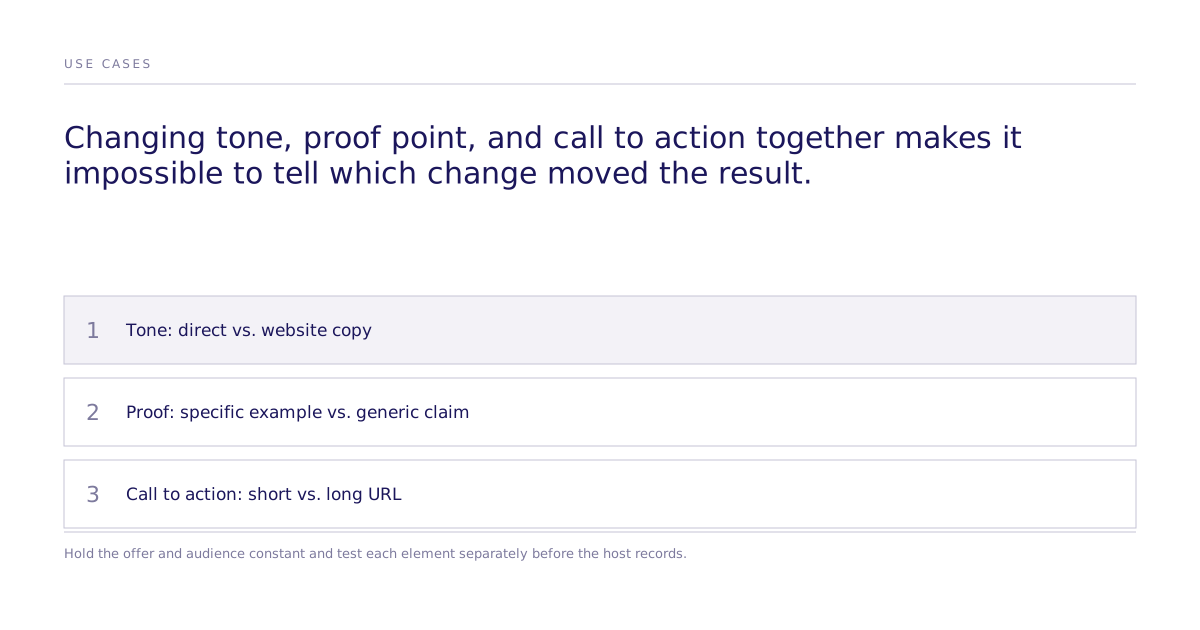
| Tone | Direct, conversational language versus copy pulled from the brand's website | Which version reads as native to the show rather than imported from a different context? |
| Proof point | A specific outcome or named example versus a generic claim like "trusted by thousands" | Which version increases stated trust without relying on an unverifiable superlative? |
| Call to action | A short, sayable offer versus a long URL, code, or multi-step redemption | Which version increases stated intent to act among listeners who cannot type while driving or exercising? |
Changing tone, proof point, and call to action together makes it impossible to tell which change moved the result.
Where does the experiment stop and the host's read begin?
Naming what a method cannot do is what lets a buyer check it before relying on it. A pre-air experiment tests how a defined audience segment reacts to a script's text. It does not simulate a specific named host's vocal delivery, ad-libbing, or the trust that host has built with their own listeners. A host may still rewrite, cut, or riff on the tested script, and the buyer should expect that divergence.
A claim earns trust when its source and its limits are both on the record. Third-party research on podcast host-read effectiveness, including recall and return-on-spend studies, is directional and produced outside Subconscious. It is useful context for a media plan, not a substitute for testing the specific script against the audience segment.
Moving from a simulated read to real-human validation
Subconscious can run controlled studies against a person-level audience graph covering 800 million real people. A number without its limits attached is marketing. That describes audience reach, not a recruitable panel of participants, and it is separate from the number of people in any one study.
For a slot large enough to warrant it, Subconscious can also test or validate studies with real human participants, without changing the underlying causal question. Neither route substitutes for the host's own judgment or guarantees the audience's response once the episode is live. Reviewing how a study like this gets built is a reasonable step before choosing between the two.
Start before the next slot is booked
Most teams that buy podcast sponsorships book somewhere between three and ten slots a quarter, enough for one pre-air comparison per slot to compound into fewer wasted reads. Freeze the candidate script language before it goes to the host, define the show's listener segment, and test tone, proof point, and call to action one at a time.
Reviewing a comparable pre-launch study before the next slot is booked shows what the output looks like. Set up a study once the candidate scripts are ready.