Testing a Welcome Sequence Before It Reaches Your List
Email gives a team a direct relationship with permissioned subscribers, while inbox providers still control spam filtering and placement. Google’s sender guidance describes deliverability requirements. A welcome sequence can affect whether newly acquired subscribers stay engaged, so measure both delivery and response.
The decision a lifecycle or CRM marketing lead faces before any sequence ships is whether to test message order, tone, CTA escalation, subject lines, and send timing against the subscriber base first, or find out after the send whether the sequence worked.
What does it cost to guess wrong on a welcome sequence?
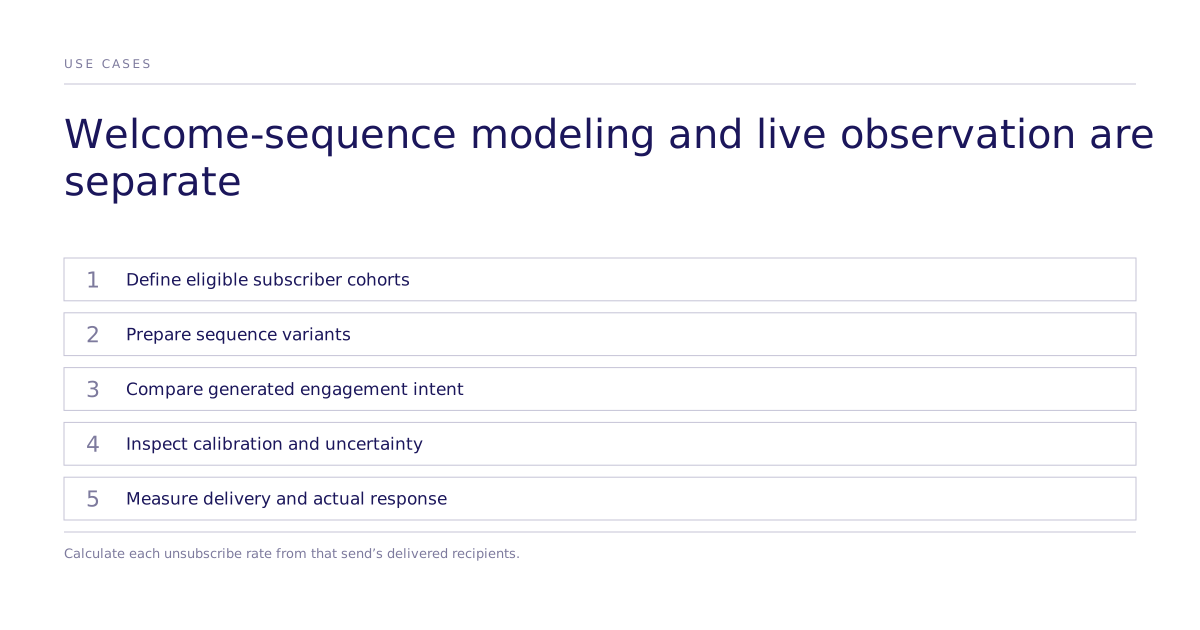
In a hypothetical cohort of 1,000 delivered welcome emails, a 12% unsubscribe rate means 120 unsubscribes; 2% means 20. The difference is 100 subscribers from that cohort, not ten percent of the entire list every week. Calculate each send from delivered recipients, and assess later emails on the remaining eligible cohort.
Re-engagement flows fail the same way, just louder: send the wrong message to a subscriber already drifting toward churn and the sequence accelerates the decision to leave. Nurture flows fail more quietly, people simply stop opening, but the lost pipeline is the same.
A live test exposes actual recipients, and its duration depends on eligible volume, effect size, and the stopping rule. A simulated pretest can help refine candidates but cannot replace the later observation of subscriber behavior.
How do you test a sequence before the list sees it?
Before the sequence ships, compare generated reactions to message order, tone, or CTA escalation in a configured subscriber model. State whether the endpoint is modeled engagement, click intent, or unsubscribe intent. Those outputs do not observe actual clicks or unsubscribes; report model uncertainty and confirm the commercial endpoint in a suitable live test.
Define the simulated subscriber audience from permitted, relevant list data and check that the modeled segments resemble actual subscribers. This is a model of who might receive the sequence, separate from recipients in the live email test.
Where each sequence type tends to break
Different sequence types fail in predictable ways, and knowing the failure mode in advance is what makes an experiment worth designing.
| Sequence type | Common failure mode | What to compare |
|---|---|---|
| Welcome sequence | The opt-in promises one thing, a later email delivers another | Whether the throughline holds from the first email through the last |
| Nurture flow | Relevance decays: the first email lands, later ones feel generic | Where in the sequence engagement would plausibly drop off |
| Re-engagement campaign | Tone misses, reading too needy or too oblivious to the gap in contact | Which tone reads as appropriate given the churn signal |
| Onboarding sequence | A tutorial email arrives before the recipient has done anything to act on it | Whether pacing matches actual product usage timing |
Subject lines and send timing are worth testing the same way: which subject line sets the right expectation for the email body it opens, and which day and time the segment would plausibly want to hear from the brand, rather than defaulting to whatever slot is open on the calendar.
What does this not replace?
The pretest proposes variants for a live comparison; it does not establish that discarded versions would underperform. Retain a baseline and plausible challengers when screening error matters. Specify the sequence context actually supplied to the model, then measure delivery, clicks, unsubscribes, and other planned live endpoints.
When transfer to subscribers matters, compare with real participants or run a suitable live experiment. Keep the decision question consistent, while accounting for delivery, provider filtering, and the outcome actually measured.
Where to start
The clearest place to begin is the sequence most likely already losing subscribers: the welcome flow. Define a population that matches the real subscriber base, run the first email in the sequence against it, and look at where engagement would plausibly break down before the second email goes out. From there, case studies and how Subconscious runs an experiment cover what a full sequence test looks like end to end, and a live walkthrough covers the workflow directly. For more on the underlying method, see Subconscious's research.