Trade Show Booth Messaging: Test the Headline Before the Signage Prints
The decision: which headline goes on the backdrop before it prints
A field marketing lead has to lock a booth headline, a session title, or a swag line before a fixed production deadline, days rather than weeks. Once the signage ships, the message cannot be revised until the next event. There is rarely time for a traditional focus group between the creative draft and the print run, so the decision usually gets made by committee opinion instead of evidence.
Trade show messaging is not untestable. The standard research timeline just does not fit the print calendar.
Why does booth messaging fail without anyone noticing?
Booth creative rarely fails visibly. It fails as a lower number: fewer people stopped, fewer badges scanned, fewer qualified conversations. Nobody traces that back to the headline, because there is no diagnostic step between "we printed this" and "traffic was soft." Common, quiet failure modes:
- Insider language. The headline leans on category jargon before the target buyer has learned why it should matter to them.
- Vague benefit claims. Generic phrasing about smarter workflows shows up on multiple booths at the same show. Nobody stops to read the third version of the same sentence.
- Mixed-audience confusion. One line tries to reach buyers, users, champions, and procurement simultaneously, and lands clearly with none of them.
- Weak category framing. At a show with hundreds of exhibitors, a visitor has a few seconds to place a booth in a category they already recognize. Assuming that context exists is a bet, not a fact.
- No specific hook. The booth explains what the company does but gives no reason to stop walking.
Each of these is a testable claim about how a specific buyer reacts to specific wording. None of them get tested in practice.
What does a fast pre-print comparison test look like?
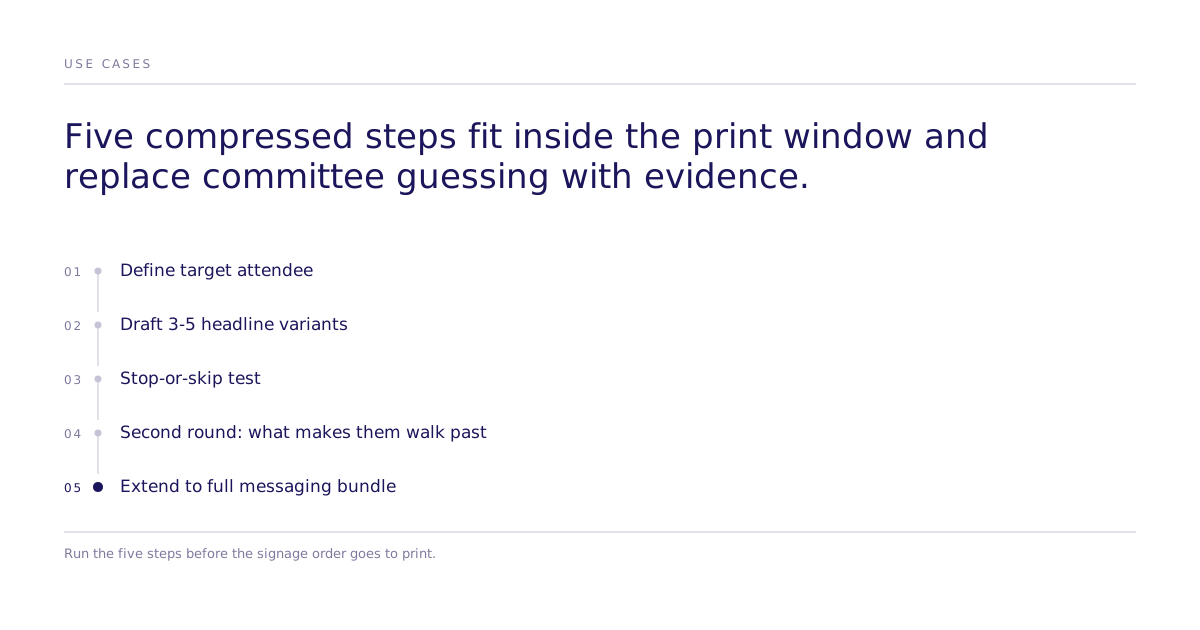
The fix compresses testing into a controlled comparison that fits inside the production window:
- Define the target attendee precisely. Not the general ideal customer profile, the version of that buyer who is actually walking a trade show floor: title, seniority, company size, industry, and event-attendance behavior. Build that definition once and reuse it for every show that season.
- Draft three to five distinct headline variants. A safe version, a more pointed version, a category-reframe version, and something the team is nervous about. Testing one variant with no comparison is a guess with extra steps.
- Ask a direct stop-or-skip question. Put the variants in front of the defined target buyer and ask which one would make them stop at a booth, given limited time between sessions.
- Run a second round on the leading variant. Ask what would make someone walk past it instead, and what it implies about the product behind it. The second round often surfaces what to cut, not just what to keep.
- Extend the same test to the rest of the messaging bundle. The backdrop headline is one asset among several: the sub-head, the demo prompt, the swag line, the sales team's opening question, the pre-show invite subject line, the session title, and the post-show follow-up. Each is a separate, testable claim.
This is a controlled discrete-choice comparison of message variants against a defined target buyer, the same causal-effect method Subconscious runs for other early-stage messaging decisions, applied to a deadline-constrained use case. It is not a packaged trade-show pre-test product, a live floor-attention simulator, or a same-day workflow guarantee. Read more on the research page.
What tends to change after one comparison round?
Across messaging tests, headlines that survive a comparison round move in the same few directions: shorter, more specific, and more clearly differentiated from what a target buyer expects to see elsewhere in the category. A vague claim nobody on the team questioned often turns out to be the exact phrase a buyer skims past without registering.
Pricing the decision
A mid-sized B2B trade show carries an all-in bill, booth build, travel, staff, sponsorship, plus outbound before and after, that typically lands between $75,000 and $250,000, and can go higher depending on scope (exOptions, Trade Show Budgeting Guide). Exhibitor cost pressure has been rising industry-wide, which is why an untested message riding on that spend is a bigger bet than it looks (Trade Show Executive, CEIR Releases Exhibitor Spending Report). The messaging bundle that determines whether that budget converts into pipeline costs comparatively little to test before it ships. Skipping the test is a habit, not a decision.
| Without a pre-print comparison | With a pre-print comparison |
|---|---|
| One headline, chosen by committee opinion | Three to five variants tested against a defined target buyer |
| Failure shows up only as soft booth traffic, with no clear cause | A stop or skip signal and a stated reason, before the print deadline |
| Only the backdrop gets scrutiny | The sub-head, swag line, session title, and outbound subject line are each tested separately |
Where this fits and where it doesn't
Subconscious runs controlled experiments that compare how a defined target buyer responds to different message variants, and reports the causal effect with a confidence interval. That is a directional decision input, not a guarantee of floor traffic or lead volume. It is not a live simulation of a show floor, and it does not replace watching an actual booth perform. When the stakes on a specific claim are high enough, or the result contradicts what an internal comparison test suggested, the same causal question can move from a controlled experiment to a recruited-human validation study without changing what is being asked. See how we work.
Next step
If a show is inside the next production window, define one target-attendee profile, draft three to five variants of the headline plus one other asset (an outbound subject line, a session title, or the sales team's opening question), and run the comparison before the print deadline instead of after the show. Document the result and measure booth engagement or lead conversion afterward against it. See a worked example in case studies, or book time to scope a comparison test against an upcoming show date.