What Is AI-Driven Market Research? A Buyer's Definition
AI-driven market research uses AI to generate responses to research stimuli, to analyze those responses, or both. It replaces parts of a workflow that traditionally needed real participants, manual analysis, and a long field calendar. The question a VP of Insights has to answer is not "what is this category" but "which of my research questions can move through it, and which need a human in the loop before I make a public claim."
The decision this term is standing in for
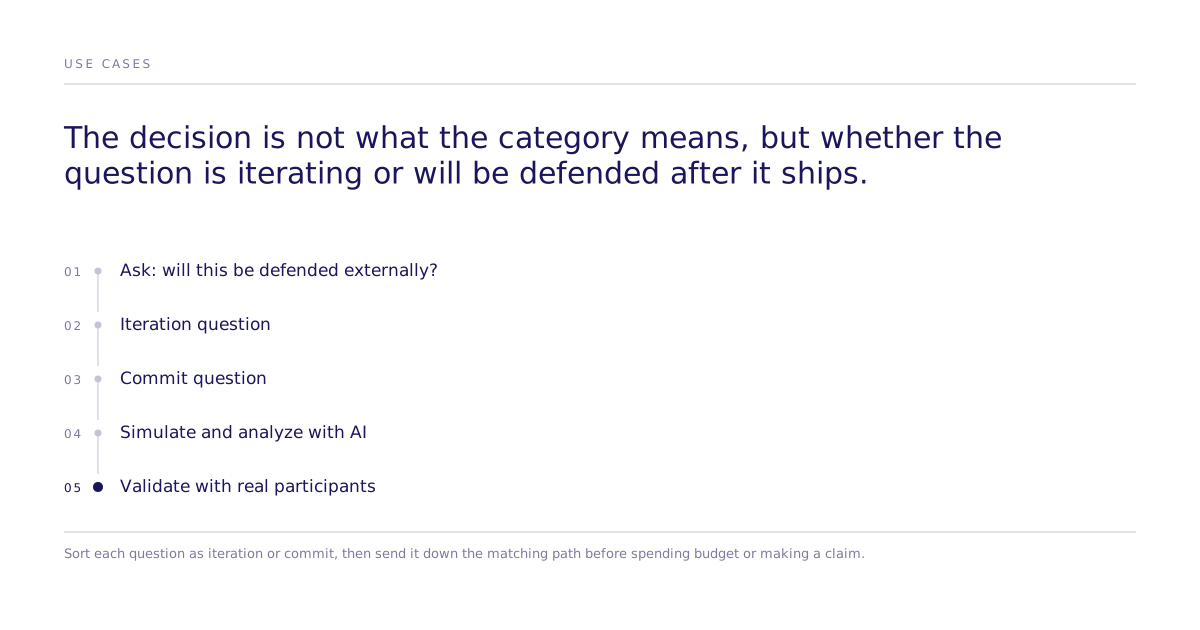
Every research team runs two kinds of question. Iteration questions ask which of several concepts, messages, or segments deserves more work. Commit questions ask what a team will put on packaging, in a regulatory filing, or in front of a board as a defensible population estimate. AI-driven methods are strong on the first kind and unproven on the second. Naming the category correctly routes a question to the right method before budget or credibility is on the line.
What are the two capabilities inside AI-driven market research?
The term covers two capabilities that vendors often bundle together:
Generation. AI personas produce responses to a research stimulus, standing in for the recruitment-and-fielding stage of a traditional study.
Analysis. Language-model tooling themes, summarizes, and compares responses, whether those responses came from AI personas or real participants, without the manual coding pass a human analyst would otherwise do by hand.
A tool that only does analysis is AI-assisted. A tool that also generates responses is AI-driven in the fuller sense.
Why did teams adopt AI-driven market research?
Two forces made this practical rather than theoretical. Large language models became reliable enough that conditioned personas produce research-grade output instead of generic chat text. Peer-reviewed validation work gave the method academic footing: Argyle et al. (2023) showed that language-model-driven sampling could approximate real survey response distributions on directional questions (Political Analysis). That paper, not a vendor's self-reported accuracy figure, is the citable anchor for the "does this work at all" question.
The third force is calendar pressure. Product and marketing cycles compressed, and a research process that runs on a multi-week fielding calendar cannot answer questions on a sprint cadence.
Where does the boundary sit between simulation and validation?
The slow iteration loop is the part these methods take over: narrowing a wide set of concepts to a few, running several message variants to find the strongest, and comparing segments to see where a positioning holds up. Work that used to need a dedicated field period can now happen inside a working session.
The final validation step stays untouched for a decision that has to survive scrutiny after it ships:
- Claims featured on packaging or carried in advertising copy
- Submissions reviewed for regulatory or compliance purposes
- Population estimates cited as a specific percentage of a named group, where the number has to be defensible
- Sensory or emotional response to a physical product
Where a causal platform changes the shape of this
Most AI-driven research platforms stop at Layer 3: they simulate or predict what a described audience would say, then summarize the result. That answers "what would people say" but not "what would change their behavior if we altered one variable." Subconscious runs controlled, randomized experiments on simulated populations, so the output is a causal effect with a confidence interval rather than a generated opinion. When a decision is close enough to require it, the winning options can move to a real-human validation study without redesigning the study or changing the underlying causal question. That step is a check on the simulated answer, not a replacement for it, and it does not turn a causal experiment into a usability session or a clinical trial.
What good practice looks like on a modern workflow
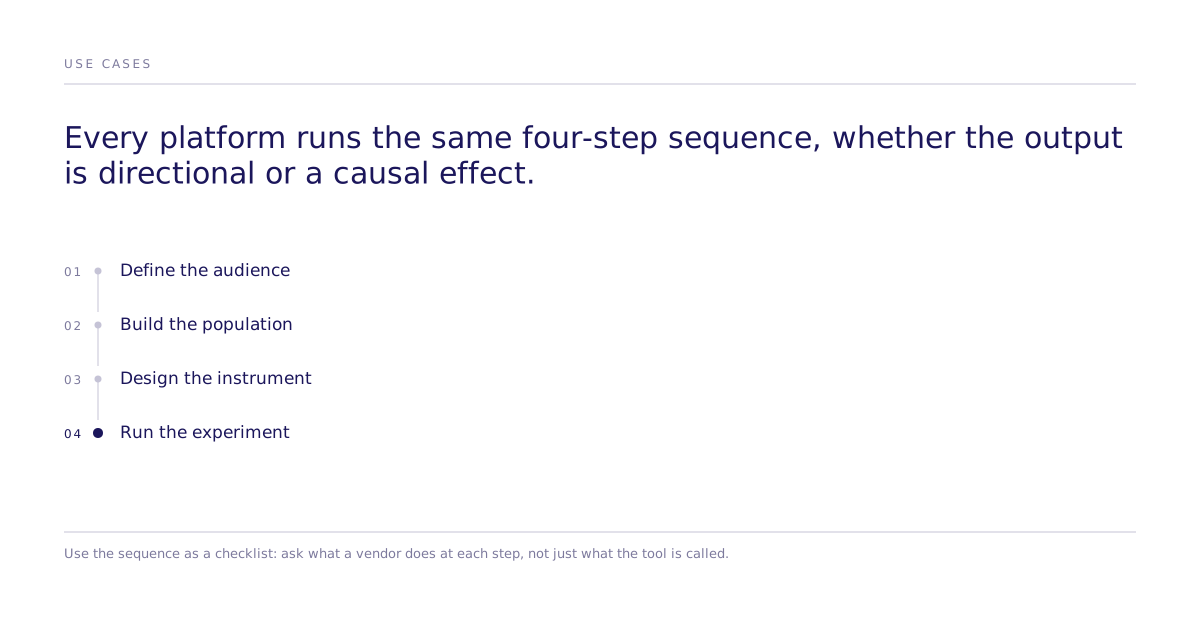
The shape is consistent across platforms in this category, whether the output is directional or causal:
Define the audience. Specific demographic and psychographic parameters produce a more useful answer than a broad description.
Build the population. Enough respondents, stratified across the parameters that matter, to support the comparison being made.
Design the instrument. A concept brief, message test, or comparison, structured the same way it would be fielded traditionally.
Run the experiment. Submit the stimulus and the variations being tested; responses and comparative results come back together.
Read the results, then decide what still needs a field study. Segment comparisons and directional reads answer most iteration questions on their own. A result the team plans to state publicly is the trigger for real-human validation, not an automatic next step for every study.
Related terms
- Silicon sampling, the academic name for the validation work behind AI-generated survey responses.
- The say-do gap, the gap between what people report and what they actually choose, which any of these methods has to account for.
- Randomized experiments on simulated populations, the mechanism a causal platform uses instead of a single generated opinion.
Where to go next
To see how a causal platform frames a comparable study, read how Subconscious tests actions rather than describing sentiment. To decide whether a specific decision needs real-human validation before it ships, see how a study moves from simulation to validation. Teams evaluating recent studies can review case studies or book a walkthrough.