What Is Customer Simulation? 4 Use Cases and When Each Needs Human Validation
Customer simulation generates responses from a model of intended buyers without recruiting participants for each generated session. A persona or panel can react to a concept, script, or pricing scenario. Check those responses against relevant human evidence before assuming they describe the segment.
The open question is which jobs simulation can do alone, and which still need a real-human check.
What Customer Simulation Actually Is
A customer simulation is a model of a customer segment built from behavioral data, psychographic detail, and domain knowledge, then queried the way you'd query a person.
Three things separate a real simulation from a chatbot wearing a persona prompt:
- Segment specificity. The model is calibrated to a defined customer type, not "an average person."
- Consistency. Inspect whether responses change across wording, context, and model versions. Identical answers can still be systematically wrong; consistency is separate from human fidelity.
- Validation against real outcomes. A trustworthy platform shows simulated answers reproducing a real human study, not just sounding fluent. Reliability varies by question type (Assessing the Reliability of Persona-Conditioned LLMs as Synthetic Survey Respondents, arXiv).
4 Use Cases Buyers Bring to Customer Simulation, and Which Ones Need a Validation Check
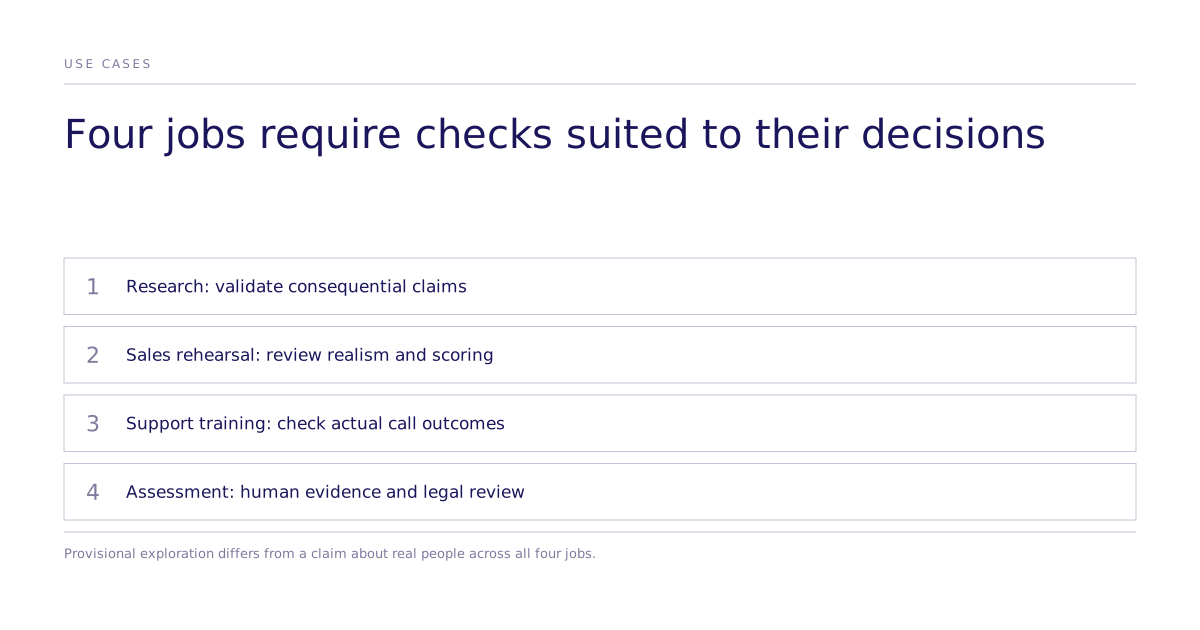
Buyers searching for customer simulation usually mean one of four jobs, each carrying different risk if the team acts on a wrong read.
1. Market Research and Customer Insight
Use cases include concept testing, message testing, pricing hypotheses, segmentation checks, and early buyer-journey exploration. Confirm a new market or tracking wave against current human evidence rather than assuming a model captures change.
The output is directional, useful for narrowing a wide set of options to the ones worth a closer, statistically grounded look.
2. Sales Coaching and Roleplay
Reps practice against simulated buyer types: skeptical procurement, technical evaluators, security-focused stakeholders, price-sensitive owners. The simulation raises realistic objections and produces a rubric a manager can review.
This is rehearsal, not prediction: lower-risk, because a bad rep answer surfaces a gap before a live call does.
3. Customer Service and Support Training
Contact centers use simulated customers to train agents on de-escalation, empathy, and script adherence. Difficulty tunes from a calm billing question to an unresolved issue three contacts deep.
Like sales roleplay, this is training: agent behavior improving over time, verifiable against call outcomes.
4. Hiring, Assessment, and Behavior Modeling
Some vendors put candidates through a simulated discovery call or escalation and score the resulting behavior. A related use runs in academic and policy research, modeling how a population might respond to a price change or messaging shift using generated responses whose representativeness still needs validation.
A hiring decision made from a simulated interaction affects a real person, and hiring-related AI assessment carries added regulatory scrutiny. Treat a simulated score as one input, not the deciding one.
What Separates a Trustworthy Platform From a Plausible One
Fluent output alone isn't a signal. Five things to check first:
- Calibration. Built from your audience's data, or a general-purpose model with a persona prompt on top?
- Validation. Does the platform publish how it measures accuracy, and against what ground truth?
- Panel structure. Can personas disagree in a group setting, or is every interaction one-on-one?
- Auditability. Can you trace why a persona answered the way it did?
- Workflow fit. Does the output move into the tools your team already uses, or stay locked in one interface?
How a Customer Simulation Is Built
A simulation has three working layers. The data layer combines public segment data, private customer data such as CRM records and interview transcripts, and structured psychographic detail.
The modeling layer configures generation from the supplied data, prompts, and rules. A stated explanation is a hypothesis to investigate, rather than a faithful trace of why a person would choose.
The interaction layer is what a user sees: chat, a panel room, a survey, a voice call, or a roleplay scorecard. A fluent interface does not establish model quality. Validity also depends on the study design, source coverage, calibration, and intended endpoint.
Customer Simulation Compared to Traditional Research
| Scenario | Customer simulation | Traditional research |
|---|---|---|
| Early-stage concept screening | Provisional comparison under a model | Human exploration may reveal missing needs and alternatives |
| Message and copy screening | Can propose variants and questions | Needed when the claim concerns actual human response |
| Pricing reaction | Modeled choice contrast; check calibration and hypothetical bias | Human choice or actual purchase evidence for the pricing claim |
| Brand perception tracking | Generated scenarios require task-specific calibration | Measure actual attitudes with comparable instruments across waves |
| Forecasting new purchase behavior | Check performance on held-out purchases for the intended audience and horizon | Compare forecasts with observed purchases and a suitable baseline |
| Tracking a cohort across multiple waves | Generated follow-up responses are modeled projections | Track the defined cohort and check attrition, instruments, and actual longitudinal outcomes |
| Regulatory or legal evidence | Check whether the actual protocol permits the output | Obtain the evidence and review the applicable rule requires |
| Sensory product testing (taste, scent, fit) | Generated descriptions require relevant sensory calibration | Measure the actual human perception or physical endpoint the claim concerns |
| Exploratory research at scale | Provisional hypotheses; inspect omissions and source grounding | Human discovery can reveal missing needs and alternatives |
| Sales objection preparation | Rehearsal; inspect realism and scoring | Check relevant buyer and actual call outcomes |
| Service de-escalation training | Practice scenarios; review errors and difficulty | Assess transfer on human interactions and call outcomes |
| Hard-to-recruit audiences | Access difficulty does not establish fidelity | Check coverage and relevant human evidence |
Choose the sequence around the question. A simulated screen may refine alternatives, but the human study’s sample depends on useful effects, precision, and segment needs rather than an assumed smaller shortlist.
Where Simulation Still Needs a Human Check
Generated responses are model outputs, separate from observed human behavior. Population claims, major commitments, and regulated decisions require suitable human evidence, inference, and applicable review; no study guarantees statistical certainty.
Generated respondent answers are not observations of taste, scent, physical fit, or in-person reaction. Claims about those endpoints need relevant human measurements. In hiring and assessment specifically, a simulated score should never be the sole input to a decision about a real candidate.
Proving the Result Before You Act On It
The useful question is whether a result would reproduce what an actual human study finds, not whether it sounds plausible.
Subconscious compares alternatives in controlled simulations and evaluates fidelity through replication of human choice studies. Inspect its public working paper for the particular parameter-rank endpoint, study filters, and limitations. Those results are distinct from Jia and colleagues’ LISS-panel survey evaluation, and neither supplies a market-performance guarantee.
Scope a human comparison around the intended audience, alternatives, and endpoint. Confirm recruitment, measurement, and delivery responsibilities, and document changes needed to preserve the intended contrast. See how Subconscious runs a study.
Confirm the modeled population and its calibration for the specific job. Audience definitions are separate from recruitable participants; ask which human evidence can test the same endpoint before using the result consequentially.
Frequently Asked Questions
How does customer simulation differ from a chatbot?
A chatbot is a language model steered by a system prompt. Customer simulation is a model of one segment's behavior, calibrated against real data.
How accurate are customer simulations?
Accuracy depends on question type and how rigorously the platform validates against real human outcomes. Treat any simulated answer as directional until checked against a validated benchmark or a real-human study.
Can customer simulation replace traditional market research?
Simulation can help with reversible exploration when its output is labeled provisional and checked for the relevant errors. Directional use alone does not establish fidelity. Population claims, major spend, and regulated decisions need suitable human data and review.
Is customer simulation regulated?
Rules depend on jurisdiction, input data, and the role of the output in a decision. Simulated respondents do not remove obligations when identifiable personal data is used or an automated assessment affects real people. Confirm privacy, employment, and sector requirements before using the output; the 2023 US agency joint statement describes existing enforcement responsibilities for automated systems.
Who is customer simulation for?
Marketing and insights teams, product managers, sales-enablement and service-training leads, and anyone who wants a directional read before a full study.
Where to Start
Pick one decision your team is debating, run it through a simulated panel that matches the relevant audience, and compare the output against what you already have. For hiring or any regulated decision, plan for a real-human validation step before the result changes what you do. See worked examples in case studies or book a walkthrough via a demo.