What Is Persona Simulation, and When Should You Trust Its Answer?
Persona simulation configures a model as a queryable stand-in for a customer, user, or stakeholder. A team can ask questions or compare message responses before a launch. An interactive answer is intended to model a person or segment; correspondence to that audience needs separate evidence.
The harder question for a buyer isn't whether a persona tool exists. It's whether a given answer from one is validated behavioral signal or a fluent, confident-sounding output that happens to confirm what the team already believed. Shipping a message, price, or launch decision on the strength of the wrong answer means discovering the mismatch only after the spend is committed.
What separates a simulation from a persona document
Interactivity makes a profile queryable. Repeated consistency is one reliability check, while correspondence to held-out human data is a separate fidelity check; identical answers can still be systematically wrong.
Three things distinguish a persona simulation from a static profile:
- Interactivity. A team can ask questions and follow up rather than reading only a fixed profile document.
- Data grounding. Inspect the permitted source data and how retrieval or conditioning uses it. A persona label alone does not establish that its answers trace to observed behavior.
- Validation. Look for held-out human comparisons, tested endpoints, and published limits. A platform’s interactive format does not establish fidelity.
How does a persona simulation get built?
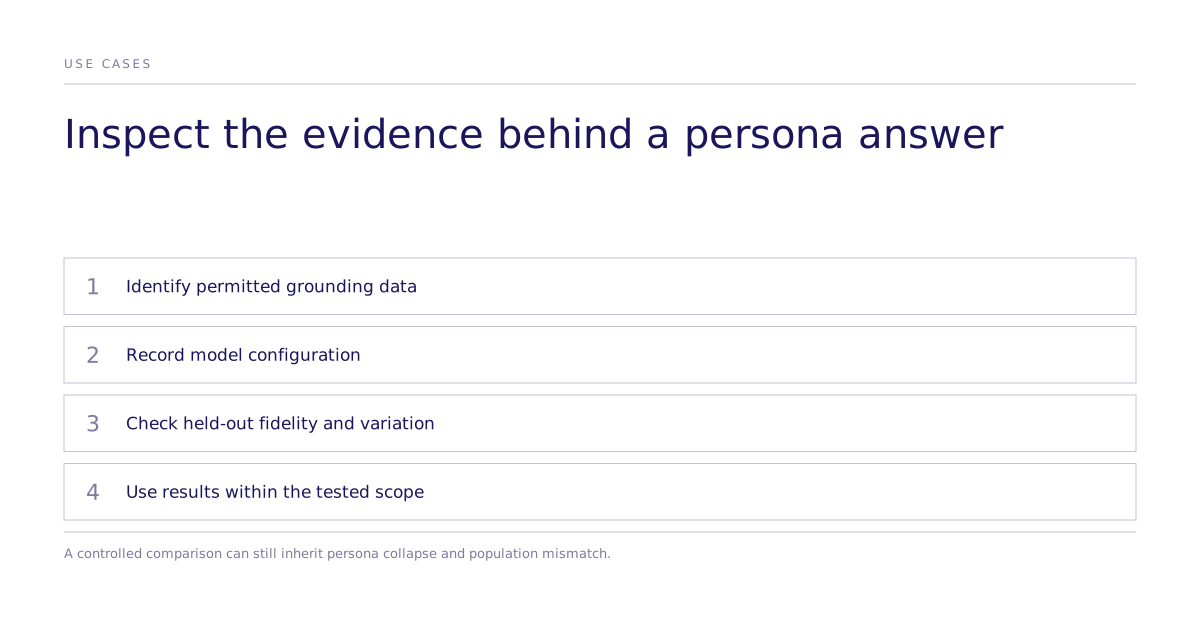
Inspect four stages of a persona workflow: the permitted input data; the model configuration, retrieval, or conditioning; held-out fidelity and population-variation checks; and the task where the outputs are used. Vendors may implement these stages differently, so ask what the actual workflow does.
Persona-conditioned models can lose population variation even when individual answers appear consistent. Xiao and colleagues examine collapse across personality, moral-reasoning, and self-introduction tasks and report a fidelity–diversity trade-off in their evaluated models. Related work on persona validity also examines stable but limited variation. These findings motivate checking variation for the intended task; they do not validate a Subconscious audience or establish that a controlled comparison avoids collapse.
What is a persona simulation useful for?
Teams use interactive personas to test messaging by putting two versions of a claim or a tagline in front of a persona and asking which lands and why, to pressure-test a product concept before committing engineering time, to pre-test campaign creative or a pricing change before it reaches the market, to run a panel of simulated customers that delivers a focus group's qualitative feel without recruiting, scheduling, or moderating a live one, to rehearse a sales or investor pitch against a simulated buyer before the real meeting, to walk a persona through a customer journey and flag friction at each step, and to explore a churned-customer persona for why they left without running exit interviews.
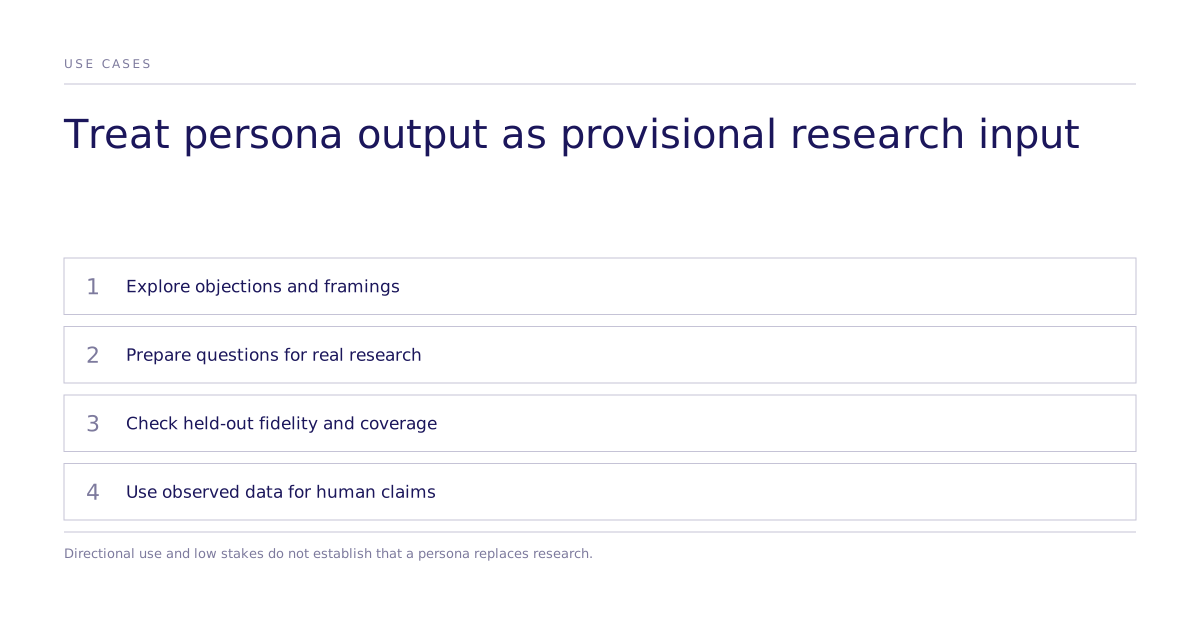
Persona output can help explore framings and prepare questions for human research. Whether it substitutes for any task depends on held-out fidelity, coverage, and the endpoint; a rough directional label alone is not validation. Use suitable observed human evidence for claims about real behavior or population estimates.
Four questions before trusting a persona's answer
A buyer evaluating any persona simulation tool should push on four things:
- Validation. Does the platform publish accuracy figures, state what they were measured against, and explain how the check was run? A vague claim of realism is a red flag; a stated benchmark with its source and denominator is a signal worth weighing.
- Source data. Identify whether grounding uses public records, permitted customer data, interviews, or surveys. Evaluate held-out fidelity and coverage; more data or detail does not guarantee improvement or population variation.
- Consistency. Repeat a prespecified task across runs and compare variation with the endpoint and expected human test–retest behavior. Variation can arise in a grounded stochastic model; inspect source grounding separately rather than treating any contradiction as proof that no grounding exists.
- Specificity. Ask a prespecified question relevant to the segment and examine the answer against suitable human evidence. A generic answer can signal poor task fit or limited variation; it does not alone identify whether the cause is grounding, prompting, or the model.
Where does the framework break down?
Watch for generic outputs, repeated prompting until the model agrees with the plan, and treating fluent answers as proof. Inspect model configuration and grounding before attributing a generic response to either one. Prespecify comparisons to reduce selective interpretation, and check important findings against relevant human evidence.
How this maps to a causal experiment
A single fluent response and a controlled comparison answer different questions. Subconscious can assign alternatives in a configured simulated population and estimate differences in generated responses. That design still needs checks of population variation, model uncertainty, and fidelity. Persona collapse can affect a simulated population; random assignment does not remove it. Agree an aligned human check when the decision depends on transfer to real people.
Check the configured population and calibration evidence for this decision. Modeling more profiles does not establish representativeness or access to recruited people. Inspect the aggregate replication evidence and limits, and request evidence relevant to the actual audience and endpoint when transfer matters.
Before a persona verdict changes a decision
Treat a persona simulation's answer as a hypothesis, not a verdict. Run the four-question check above on any platform under consideration. Then require that a directional finding gets checked against a controlled comparison before it changes a message, a price, or a launch call, using real-human validation when the decision is expensive enough to justify it. Teams that want to see what that comparison-plus-validation workflow looks like in practice can review how Subconscious works or read more about the company.