What Is a Silicon Sample?
A silicon sample consists of model-generated responses conditioned on attributes intended to represent a target population. Those outputs are separate from recruited human participants. Inspect conditioning, calibration, and held-out fidelity before treating generated responses as a stand-in for human research; measure the full study effort before comparing cost or duration.
Where does this method come from?
Argyle and colleagues conditioned a language model on demographic backstories and evaluated its responses on selected US political-survey tasks. Their 2023 paper examined silicon sampling as a research method. Its findings concern those tasks and conditions, rather than every market-research audience or endpoint.
How a silicon sample gets configured and checked
A useful construction checklist covers five steps:
- Define the target population: the demographic and psychographic parameters that matter, such as geography, age, income, occupation, attitudes, and prior brand exposure.
- Determine sample composition: build proportions along those parameters so the sample mirrors the real population's makeup, rather than generating a flat batch of respondents.
- Calibrate against relevant human data: use permitted panel data, survey waves, or other suitable records where available. Assess held-out fidelity separately; conditioning on more records does not by itself validate the sample.
- Generate the sample: produce the conditioned, addressable units.
- Query the sample: submit the research instrument, aggregate, analyze.
What it answers well, and what it doesn't
| A silicon sample is strong for | A silicon sample is not built for |
|---|---|
| Directional modeled opinions and preferences | Human-population estimates without calibration and an auditable inference method |
| Hypotheses about hard-to-reach audiences, subject to relevant grounding | Novel settings with no validation evidence for the intended endpoint |
| Candidate cross-market comparisons with measurement checks | Embodied sensory experience; multimodal stimulus analysis is a separate capability |
| Repeated exploratory comparisons under a fixed setup | Statistical accuracy claims that omit error and calibration limits |
A directional comparison describes what the configured model selects under the tested conditions. It does not establish the same preference, effect size, or uncertainty in the human population. Check relevant calibration and observed human evidence before using the output for a launch, price, or message decision.
What does a typical deployment look like?
As a hypothetical workflow, compare several concept variants in a configured model, inspect sensitivity, then choose options for a human check while retaining a baseline and credible challengers. Choose persona composition and human sample size for the audience, endpoint, and precision needed rather than an inherited fixed count.
Closing the gap: from directional signal to a decision you can defend
Subconscious can compare generated selections between defined alternatives on a modeled population. Randomized assignment supports a contrast under the specified setup; the result does not identify a real buyer’s psychological reason or the effect in a human market. Report model uncertainty and check fidelity separately.
For consequential decisions, specify a matched human study of the same question and relevant endpoint. Subconscious can support this validation; check recruitment and delivery needs rather than equating a modeled population with a panel of people ready to respond.
Does the terminology for this method vary?
Commercial platforms describe this underlying method with several different labels. Some name the group, others name the individual unit inside it. The framing changes depending on whether the source is academic literature, a platform's marketing page, or a sales deck. The mechanism underneath stays constant: condition a model on a target population, generate outputs, aggregate.
What this means for a pending research decision
Before treating a silicon-sample readout as a green light for a launch, price, or message decision:
- Confirm it was calibrated against real prior data from the target audience, not a flat, uncalibrated batch.
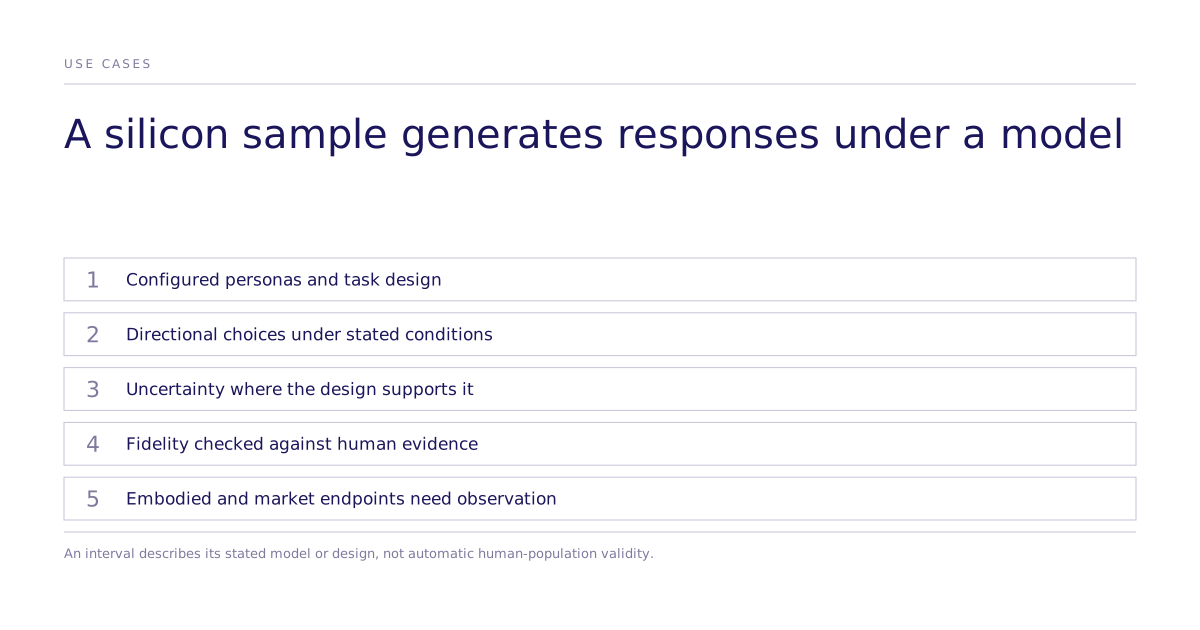
- Inspect the endpoint, model assumptions, interval where supported, and held-out fidelity. An interval from generated responses is not automatically an interval for the human population.
- Where the decision is expensive to get wrong, route it through a causal experiment, and add real-human validation before committing budget.
Related reading: the research workflow, aggregate replication evidence and limits, and the Subconscious team.