What Is Simulated Market Research? A Buyer's Guide to When to Use It
Simulated market research runs a defined audience through research stimuli, such as a survey, a concept test, an ad, or a messaging variant, using models conditioned to respond as members of that audience would. You describe the audience, the platform generates the responses, and the output looks structurally like real-respondent data: quant scores, segment cuts, and open-ended responses with the texture of an interview transcript.
The category also goes by synthetic market research and AI-driven market research.
The decision this framing is meant to help you make
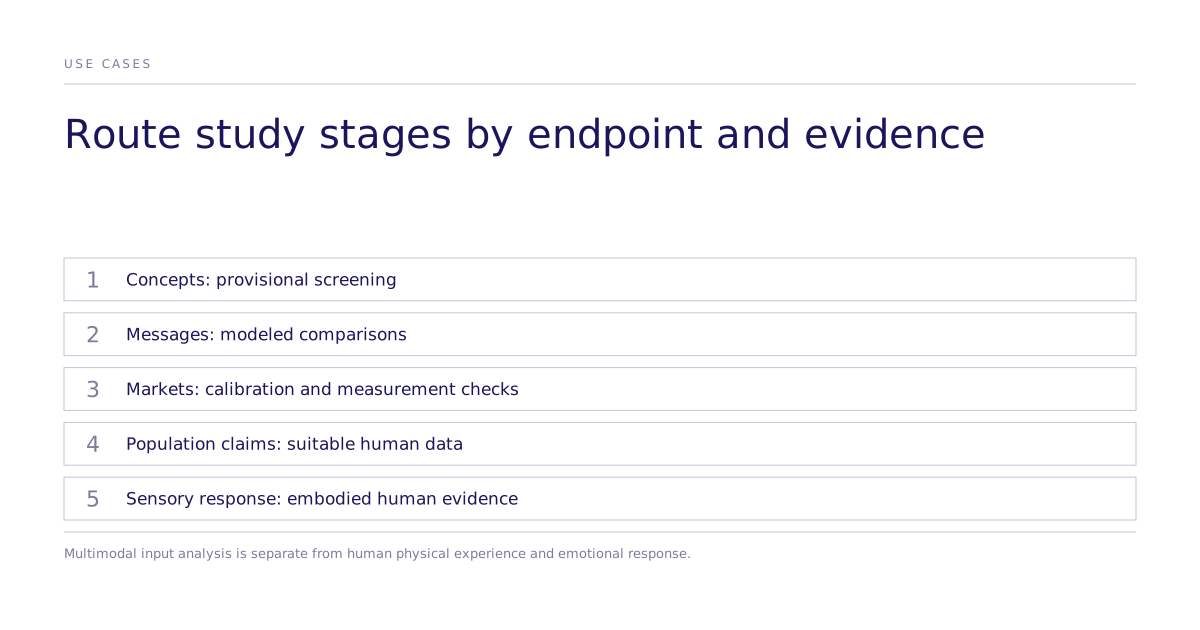
A research leader must decide which questions can use provisional generated input and which require suitable human evidence. A poorly framed study can waste fielding effort; a simulated preference can also mislead a consequential decision. Choose the sequence from existing evidence and the cost of error.
How the workflow runs
- Define the audience. Set the boundaries that will condition the responses: age range, geography, income, occupation, attitudes, prior brand exposure, and any other demographic or psychographic trait that matters for the study.
- Configure the simulated panel. Choose persona composition, task count, and repeated runs from coverage and sensitivity requirements. A larger number of generated responses does not by itself improve human fidelity.
- Design the research instrument. Survey, concept brief, ad pretest, or open-ended discovery script. Build whatever you'd normally use to field the study with real participants.
- Run the session. Push the stimulus out to the panel and let each simulated respondent reply; the output pairs numeric scores with qualitative color.
- Synthesize, then decide what still needs a human. Read the themes, compare segments, and identify which concept or message earns a real-respondent check before it ships.
Where simulation earns its keep
- Concept screening. Narrow a long list of concepts to a short list worth fielding for real.
- Message and ad iteration. Compare many wording or creative variants before committing budget to one.
- Cross-market comparison. Run the same study against multiple national or regional audiences side by side.
- Hard-to-reach audiences. Simulation can propose hypotheses about senior B2B buyers or regulated professionals. Check coverage and fidelity for those groups first; recruitment difficulty does not validate the model.
- Continuous discovery. Recurring pulses on brand perception or message resonance that keep a team looking at data between formal studies.
Where simulation stops
A number without its limits is marketing. These three limits hold regardless of which platform runs the simulation:
- A generated sample alone does not establish a human-population estimate. Report the modeled endpoint and its uncertainty separately from fidelity and sampling evidence needed for a claim about real people.
- Novel settings need evidence. Training-data coverage and grounding affect performance. A plausible extrapolation to a new product may be wrong; compare with suitable human evidence rather than assuming either reliable transfer or zero signal.
- It does not reproduce embodied sensory experience. A multimodal model may analyze an image, audio, or video stimulus if the workflow supports those inputs. That is different from tasting, wearing, using, or emotionally experiencing a product as a person.
Taday Morocho and colleagues found heterogeneous effects of persona conditioning on US World Values Survey alignment, including larger errors for some questions and underrepresented groups. That evaluates selected survey tasks; it does not establish sensory experience or reliable transfer to a new product.
Routing a study
| Study stage | Best-fit method | Why |
|---|---|---|
| Concept screening | Simulation | Directional comparison across many candidates before committing fielding budget |
| Message and ad iteration | Simulation | Wording and creative variants are low-effort to re-test |
| Cross-market comparison | Simulation | Runs the same question across audiences without sequential fielding |
| Regulatory or hero public claims | Real-human validation | Requires a defensible population estimate, not a directional read |
| Novel category | Relevant human evidence | Check the new context and outcome rather than assuming reliable model extrapolation |
| Sensory or physical product response | Human product research | Requires embodied use or perception, separate from model analysis of media |
Where Subconscious changes the shape of this hybrid
Subconscious compares specified alternatives and modeled outcomes in controlled studies. Define the simulated audience and check its calibration for the question; a modeled population does not imply recruited buyers or observed human reactions.
Carry the same decision question into a human study when relevant evidence is needed. Retain a baseline and credible challengers if simulated screening could discard a useful alternative. Agree recruitment and instrument adaptations for the actual audience. The aggregate evidence record and applied case examples provide context; neither automatically validates this study’s result.
A glossary of adjacent terms
- Synthetic market research. Same methodology, framed around the generated-respondent angle rather than the simulation angle.
- AI-driven market research. A broader term that can cover generated respondents, analysis of existing human data, or research-design assistance. Identify which task the vendor actually performs.
- Silicon sampling. The academic line of work behind using model-generated responses as a stand-in for survey samples.
- Multi-step simulated research. A newer extension where simulated respondents act and react across a sequence of scenarios rather than answering single prompts.
Next step
If the decision in front of you is choosing among concrete alternatives, price points, messages, or launch options, that is a controlled-experiment question. Read how Subconscious runs a study or see who's behind the method before deciding which stage of your next study to simulate and which stage to validate with real people.